
NEW
Font size
 Worksheets
Unit 3 Test Review
Total questions: 25
Worksheet time: 15mins


The highest CDRs and CBRs are found in countries in which stage of the DTM?
Stage 1
Stage 2
Stage 3
Stage 4


For every 1,000 people in Mozambique this year, nearly 150 of them will die. The rate of 150 deaths per 1,000 people is known as the:
crude death rate.
crude birth rate.
total fertility rate.
infant mortality rate.

More developed countries (MDCs) moved from Stage 1 to Stage 2 of the DTM 200 years ago in part because of:
the Black Plague
the Industrial Revolution.
people moving to cities.
women choosing to enter the labor force.

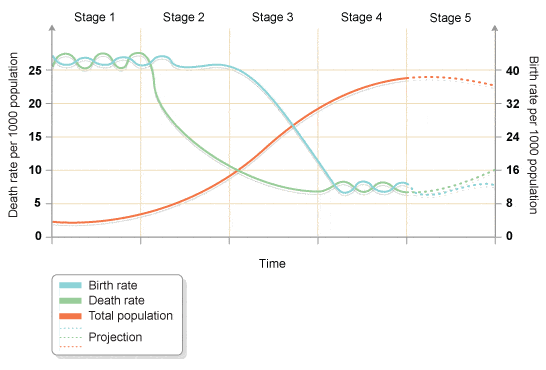

Death rates fall rapidly due to increased hygiene and medical advances during stage
1
2
3
4

Which correctly describes the term demographic transition?
The transition from low birth rates and death rates to high birth rates and death rates as a country develops.
The transition from high birth rates and death rates to low birth rates and death rates as a country develops.
The transition from high birth rates to low death rates as a country develops.
The transition from low birth rates to high death rates as a country develops.
What primary factor led to exponential population growth in the human population?
The bubonic plague
The Industrial Revolution
A lack of resources
An abundance of highways
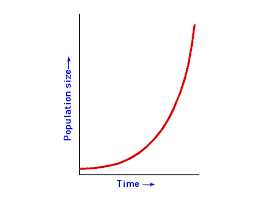
What type of growth is shown in the diagram?
exponential growth/Resources are abundant
logistic growth /Resources are abundant
predator-prey cycle
boom-bust curve
What primary factor leads to logistic growth (S shaped curve) in a population?
Abundance of medicine
Lots of free education
Limited resources
Abundant resources
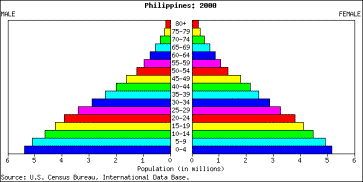


According to this population pyramid the population is _______________
growing
declining
staying the same
increasing fast
Why might birthrates in developing nations tend to be higher than those in developed nations?
Birth control is more available in
developing nations.
Large families are needed for economic survival (kids are viewed as economic assets)
More child-care assistance is available in
developing nations.
Military concerns dictate the need for
larger populations.
Which of the following is most likely a characteristic of a developing country?
Low unemployment rate
High GDP per capita
High birth rate
High literacy rate

Countries with high levels of literacy and higher education are in which level of economic development?
Developed
Newly Industrialized
Undeveloped
Transitional

Countries with high infant mortality rates and low life expectancy are in which level of economic development?
Developed
Newly Industrialized
Undeveloped
If the birth rate and death rate are equal, ....
The population will grow rapidly
The population will decline
The population will grow slowly
Zero population growth will occur
Which of the following contributes to infectious diseases emerging in a geographic region?
Increasing mobility of the world's population
Overcrowding in cities
International distribution of food
All of the above
Life expectancy and infant mortality rate best help to determine ___________.
The average gross domestic product of a country
The quality of life in a geographic region
The amount of infrastructure in a region
The average income of a population
Birth rate, immigration, death rate, and emigration must be considered to calculate a country's ____________.
Gross domestic product
Change in population
Average annual income
Rate of infectious disease
India, China, and the United States are the _______________________.
Poorest countries in the world
Wealthiest countries in the world
Three countries with the highest populations
Three countries with the smallest populations

