

wayground logo

Free Printable Worksheets

NEW

Font size

S
M
L
XL
Worksheets

Y11 electrolysis revision

Total questions: 23

Worksheet time: 13mins
Name
Class
Date
1.
What is electrolysis?
a)
breaking down of a compound using a current
b)
making a compound using a current
2.
What kind of Electrical Current does Electroysis require?
a)
Direct
b)
Indirect
c)
Anternative
d)
A alternating
3.
Which statement correctly describes the 2 electrodes?
a)
The anode is negative and the cathode is positive
b)
The anode and cathode are both positive
c)
The anode is positive and the cathode is negative
d)
The anode and cathode are both negative.
4.
What is the name given to the solution that is being electrolysed?
a)
Salt solution
b)
Electric solution
c)
Mineral solution
d)
Electrolyte
5.
Explain why the electrolyte has to be a liquid.
a)
So the ions can move
b)
So the electrons can move
c)
So that it doesn't get too hot
d)
So the fish are ok
6.
It is essetial that the electrolyte is a liquid so that...
a)
Charged ions can migrate towards the electrodes. 
b)
Charged ions can migrate towards the electrodes.
c)
The solution can move around.
d)
The current can flow through it.
7.
What happens at the positive electrode?
a)
Positive non-metal ions are attracted
b)
Positive metal ions are attracted
c)
Negative non-metal ions are attracted
d)
Negative metal ions are attracted
8.
Positive ions (cations) will move towards the cathode (-) where they will discharge by....
a)
Breaking apart
b)
Losing electrons
c)
Clumping together.
d)
Gaining electrons
9.
When NaCl solution is electrolysed what has forms at the anode?
a)
Hydrogen
b)
Oxygen
c)
Chlorine
d)
Sodium
10.
What does the Cathode (-) do to ions?
a)
Give electrons to the Positive ions to turn them back into atoms
b)
Take electrons from the positive ions?
c)
Turn ions back into atoms by removing electrons
d)
Turn atoms into ions by adding electrons
11.
What is the equation to show what happens to Cl ions at the anode.
a)
Cl- --> Cl + e-   
b)
2Cl- --> Cl2 + 2e-   
c)
Cl2 + 2e-   2Cl- 
d)
Cl2 + 2e-  -->  2Cl- 
12.

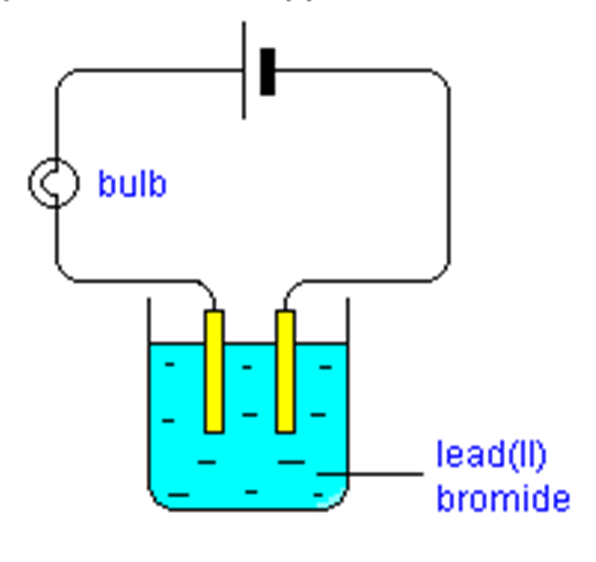
The diagram shows the electrolysis of lead(II) bromide using inert electrodes. Why does the bulb only light up when the lead(II) bromide is melted?

a)

Bromine atoms in lead(II) bromide are converted to ions when it is melted

b)

Electrons flow through the lead(II) bromide when it is melted

c)

The ions in lead(II) bromide are mobile charge carriers in the molten state.

d)

There are no ions in solid lead(II) bromide

13.

In electrolytic cell that uses aqueous copper(II) sulfate as electrolyte and copper plates as electrodes, what is the product at the anode?

a)

Oxygen gas and water

b)

Copper metal

c)

Copper(II) ions

d)

Hydrogen gas

14.
What is the product formed at the anode during the electrolysis of concentrated copper(II) chloride?
a)
copper
b)
chlorine
c)
hydrogen
d)
oxygen
15.

What is the half-equation for the discharge of hydroxide ions?

a)

2O2- --> O2 + 4e-

b)

OH- --> OH + e

c)

4OH- --> 2H2O + O2 + 4e-

d)

2H2O + O2 + 4e- --> 4OH-

16.

What factors do not affect the products of electrolysis in the electrolysis of aqueous magnesium chloride using graphite electrodes?

a)

position of ions in the electrochemical series

b)

concentration of ions in the solution

c)

type of electrodes

17.

Electroplating is an industrial process where objects are coated by a thin layer of a nonreactive metal by electrolysis. What should be used as the cathode in this process?

a)

Graphite electrode

b)

The electroplating metal

c)

The object to be electroplated

d)

Magnesium ribbon

18.

In the electrolysis of brine what products do we get at the anode?

a)

Oxygen gas

b)

hydrogen gas

c)

chlorine gas

d)

sodium metal

19.

In the electrolysis of brine what product do we get at the cathode?

a)

hydrogen gas

b)

oxygen gas

c)

sodium metal

d)

chlorine gas

20.

Which are the useful products of electrolysis of brine?

a)

sodium hydroxide, chlorine and hydrogen

b)

sodium metal, oxygen and chlorine

c)

sodium metal, chlorine and sodium hydroxide

d)

sodium hydroxide, oxygen and hydrogen

21.
Which cell is not spontaneous?
a)
voltaic
b)
electrolytic
22.
Atoms of which element can most easily be oxidized?
a)
Copper
b)
Zinc
c)
Iron
d)
Calcium
23.
In the electrolysis of water, hydrogen gas is produced at the 
a)
anode 
b)
cathode
