wayground logo

Free Printable Worksheets

Font size

S
M
L
XL
Worksheets

Unit 3 - Forces Review Quiz (Newton's Laws)

Total questions: 55

Worksheet time: 47mins

Name
Class
Date
1.
"For every action, there is an equal and opposite reaction."
a)
Newton's 1st Law
b)
Newton's 2nd Law
c)
Newton's 3rd Law
d)
Newton's 4th Law
2.
Force = Mass x Acceleration
a)
Newton's 1st Law
b)
Newton's 2nd Law
c)
Newton's 3rd Law
d)
Newton's 4th Law
3.
The tendency of an object to resist changes in its motion is...
a)
inertia
b)
force
c)
acceleration
d)
velocity
4.
The force that opposes motion between two surfaces in contact with each other.
a)
inertia
b)
friction
c)
momentum
d)
gravity
5.
The combination of all the forces acting on an object is the...
a)
net force
b)
action force
c)
reaction force
d)
balance force
6.

When an unbalanced force acts on an object, the force ______________________.

a)

changes the motion of the object

b)

is cancelled by another force

c)

does not change the motion of an object

d)

is equal to the weight of the object

7.
An automobile you are riding in suddenly stops, but you continue to go forward.
a)
Newton's
1st
Law of Motion
b)
Newton's
2nd
Law of Motion
c)
Newton's
3rd
Law of Motion
8.
You push against a wall and the wall is pushing back on you.
a)
Newton's
1st
Law of Motion
b)
Newton's
2nd
Law of Motion
c)
Newton's
3rd
Law of Motion
9.

What is the acceleration of a 50 kg object pushed with a force of 500 newtons?

a)

100 m/s2

b)

25,000 m/s2

c)

10 m/s2

d)

25 m/s2

10.
A sled sliding on a flat, icy surface with a constant velocity is best described by
a)
Newton’s first law of motion for objects at rest.
b)
Newton’s first law of motion for objects in motion.
c)
Newton’s second law of motion.
d)
Newton’s third law of motion.
11.
According to Newton’s first law of motion, a moving object that is not acted on by an unbalanced force will
a)
remain in motion.
b)
eventually come to a stop.
c)
change its momentum.
d)
accelerate.
12.
A person steps out of the boat and onto the dock.  As the person moves forward onto the dock, the boat moves backward.  Which statement best describes the backward motion of the boat as the person steps forward?
a)
For every action there is an equal and opposite reaction.
b)
Every mass exerts a force on every other mass.
c)
An object at rest tends to stay at rest.
d)
Friction opposes the motion of an object.
13.
A person in car  slides to the right when going through a very sharp left turn on the highway. 
a)
1st Law
b)
2nd Law
c)
3rd Law
14.
What is the definition of "weight"?
a)
the force in which gravity pulls on an object
b)
the time it takes to get on a ride 
c)
the amount of matter in an object
d)
the size of an object
15.
Which of these best describes why your weight (on Earth) would change on another planet?
a)
weight doesn’t change, no matter where you are
b)
different planets have different gravitational pulls
c)
In general, the smaller the planet, the greater weight
d)
dehydration effects on different planets change weight
16.
An empty truck and a fully loaded truck are next to each other at a traffic light. When the light turns green, the lighter truck increases speed more quickly. Which of these best explains this situations
a)
Newton's first law
b)
Newton's second law
c)
Newton's third law
d)
Conservation of momentum
17.
If you double the mass of an object with the same force apply on it, the acceleration will
a)
double
b)
cut in half
c)
the same
d)
zero
18.
Which one needs a greater net force to move, a kilogram of feathers or a kilogram of iron? 
a)
feathers 
b)
iron
c)
same
d)
depends on their friction
19.
After a cannonball is fired into frictionless space, the amount of force needed to keep it going equals
a)
twice the force with which it was fired
b)
the same amount of force with which it was fired
c)
1/2 the force with which it was fired
d)
zero, since no force is required to keep it moving. 
20.
The acceleration produced by a net force on an object is
a)
inversely proportional to the mass of the object.
b)
directly proportional to the magnitude of the net force.
c)
in the same direction as the net force.
d)
 all of the above
21.
Which one of Newton’s Laws of Motion best explains why the dishes do not move when the table cloth is removed?
a)
Newton's 1st Law
b)
Newton's 2nd Law 
c)
Newton's 3rd Law 
d)
Newton's Law of Biology
22.
What is the difference between mass and weight?
a)
mass is how much matter is in an object, and weight is the gravitational pull on that object
b)
mass and weight are the same
c)
weight affects how much mass is in an object
d)
weight is determined by how many atoms make up an object
23.

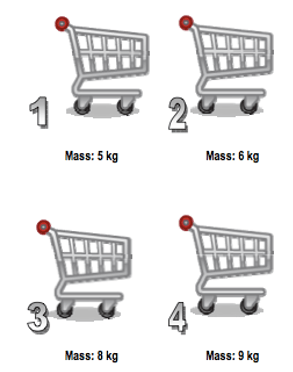
A force of 90N is applied to each cart below, which one will have a larger acceleration?

a)

Cart 1

b)

Cart 2

c)

Cart 3

d)

Cart 4

24.

When an object is moving, friction acts in the _______ direction as the motion.

a)

perpendicular

b)

same

c)

opposite

d)

precise

25.

Friction is a contact force that acts _______ to the surfaces in contact.

a)

parallel

b)

perpendicular

c)

equal

d)

at an acute angle

26.

The magnitude of the friction force depends on ...(Mark all that apply)

a)

The Normal Force

b)

The Force of Gravity

c)

The Coefficient of friction

d)

The Net Force

27.

The type of friction that prevents an object from moving is called _______ friction.

a)

rolling

b)

fluid

c)

kinetic

d)

static

28.

How would the absence of friction affect the motion of a marble on a long, straight path?

a)

The marble's speed would decrease.

b)

The marble's speed would remain constant.

c)

The marble's speed would increase.

d)

The marble would stop immediately.

29.

The type of friction that acts on moving objects, trying to slow them down is called _______ friction.

a)

Static

b)

Rolling

c)

Dynamic

d)

Kinetic

30.

The equation for the force of friction is _______.

a)

Ff = µFg

b)

Ff = µFN

c)

Ff = µFT

d)

Ff = µFs

31.

What affect would decreasing the normal force between two objects have on the force of friction?

a)

The force of friction would increase.

b)

The force of friction would decrease.

c)

The force of friction would remain the same.

d)

The force of friction would disappear completely.
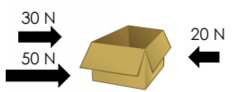
32.
How will this object move? 
a)
It won't move. 
b)
It will move to the right. 
c)
It will move to the left. 
d)
It will move up. 
33.
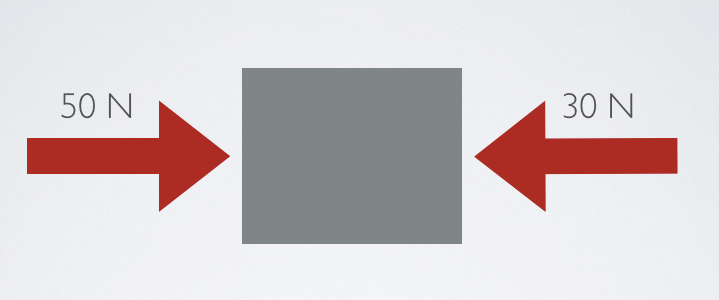
How will this object move? 
a)
It won't move. 
b)
It will move to the right. 
c)
It will move to the left. 
d)
It will move in both directions. 
34.
What is the net force?
a)
30 N left
b)
25 N right
c)
5 N left
d)
55 N right
35.
What is the net force?
a)
40 N left
b)
0 N Balalnced
c)
400 N right
d)
40 N right
36.
Calculate the Net Force. 
a)
60N, Left 
b)
40N, Right 
c)
0N
d)
60N, Right
37.
Pushing a child on a swing is easier than pushing an adult on the same swing, because the adult has more inertia.
a)
Newton's 1st Law
b)
Newton's 2nd Law
c)
Newton's 3rd Law
38.

Weight is measured in units called_______________.

a)

Newtons

b)

kilograms

39.

Acceleration due to gravity is:

a)

.98

b)

98

c)

9.8

d)

980

40.

A 20-kg crate is being pushed across a floor with a force of sliding friction of 20 N. If the pushing force is also 20 N, what is the acceleration of the crate?

a)

0 m/s2

b)

2 m/s2

c)

0.5 m/s2

d)

40 m/s2

41.

A winch is supplying a force of 100 N on a large 50-kg crate to move it along a trailer bed with a friction force of 50 N. What is the acceleration of the crate?

a)

0 m/s2

b)

10 m/s2

c)

1 m/s2

d)

2 m/s2

42.

A person who has a mass of 60 kg on Earth will have a mass of ________ on the moon.

a)

less than 60 kg

b)

60 kg

c)

more than 60 kg

d)

less or more mass on the moon it just depends on whether she has fallen into a crater or is standing on top of a hill.

43.

A sled dog supplies a pulling force of 100 N to a 40 kg sled and the sled accelerates at 2 m/s2. What is the force of sliding friction between the sled and the snow?

a)

-5 N

b)

-10 N

c)

-20 N

d)

-40 N

44.
When a heavy football player and a light one run into each other, who exerts more force?
a)
The heavy one
b)
The light one
c)
They are equal
d)
there is no such thing as force
45.

If you double the force on an object the acceleration will

a)

double

b)

cut in half

c)

the same

d)

quadruple

46.

If you double the force and double the mass on an object the acceleration will be

a)

double

b)

cut in half

c)

the same

d)

quadruple

47.

If you double the force and cut the mass on an object in half the acceleration will be

a)

double

b)

cut in half

c)

the same

d)

quadruple

48.

Which one has a greater Inertia, a kilogram of feathers or a kilogram of iron?

a)

feathers

b)

iron

c)

same

d)

depends on their friction

49.

When a heavy football player and a light one run into each other, who experience the greater acceleration?

a)

The heavy one

b)

The light one

c)

They are equal

d)

there is no such thing as force

50.

Based on the diagram, what is the acceleration of the block. You have 5 minutes

a)

3.156 m/s2

b)

31.56 m/s2

c)

5.196 m/s2

d)

2.04 m/s2

51.

The mass of the box is 100 kg. If the Coefficient of Friction is 0.2, determine the acceleration of the box. You have 5 minutes,

a)

3.2 m/s2

b)

4.9 m/s2

c)

0.0 m/s2

d)

1.69 m/s2

52.

The mass of the box is 100kg. Determine the coefficient of static friction needed for the block to remain stationary on the incline. You have 5 minutes.

a)

0.466

b)

9.8

c)

2.14

d)

0

53.

If m1 is 7 kg and m2 is 3 kg, determine the acceleration of the system and the tension in the string. There will be two answers (1 acceleration and 1 Tension) and you have 5 minutes.

a)

6.86 m/s2

b)

3.92 m/s2

c)

41.46 N

d)

48.2 N

54.

If m1 is 7 kg and m2 is 3 kg, determine the acceleration of the system and the tension in the string. There will be two answers (1 acceleration and 1 Tension), the is no friction and you have 5 minutes.

a)

2.94 m/s2

b)

3.92 m/s2

c)

20.6 N

d)

17.64 N

55.

If m1 is 7 kg and m2 is 3 kg, determine the acceleration of the system. You have 5 minutes. There is no friction for this problem and the angle of the incline is 30 degrees.

a)

0.49 m/s2

b)

4.9 m/s2

c)

0.98 m/s2

d)

9.8 m/s2