Worksheets
DNA Replication, Protein Synthesis (1.5)
Total questions: 15
Worksheet time: 11mins
What characteristic of double-stranded DNA determines the ability of one strand to make an exact copy of the other strand?
complementary pairing of bases
location of the base pairs in the center of helix
ability of bases to be connected in any order
hydrogen bonding between strands
What aspect of the DNA molecule encodes hereditary information concerning an organism’s traits?
the molecular mass
the folded three-dimensional shape
the distribution of electrical charges
the sequence of base pairs

The diagram shows a cellular process in which a double-stranded molecule of nucleic acid gives rise to a single-stranded molecule of nucleic acid.
Which best describes the process shown?
DNA is transcribed into RNA.
RNA is transcribed into DNA.
DNA is translated into RNA.
RNA is translated into DNA.
How many amino acids can be represented by a single 3-base DNA sequence?
5
3
1
2
How are cells able to produce the proteins required by certain conditions?
by synthesizing new genes
by altering existing genes
by expressing existing genes
by mutating new genes
A new trait that allows a more efficient release of energy from food appears in a fly population. The trait proves beneficial to survival and quickly spreads through the population. Which is the most likely origin of the new trait?
the combination of recessive genes in each generation
the mutation of a gene that results in an altered protein
the replication of a gene that produces an increase in RNA
the adaptation of a new genes to existing genes in the digestive system
What are the subunits of DNA and RNA?
fatty acids
amino acids
nucleotides
sugars

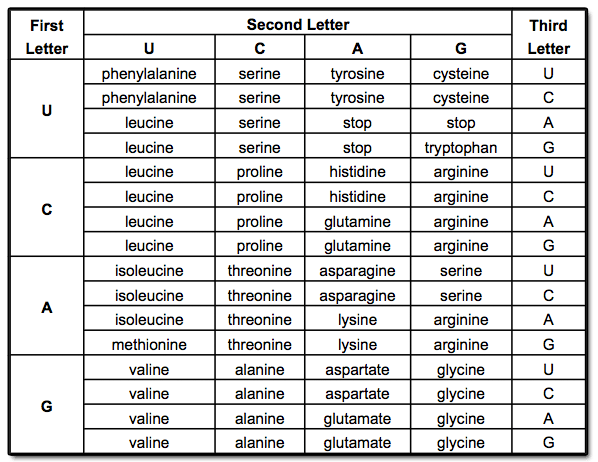
A DNA strand has a nucleotide sequence of TTA TGC TCC TAA for a gene segment. What is the amino acid sequence of the complementary mRNA strand of this DNA strand ?
Gly Val Val Phe
Leu Cys Ser Stop
Asn Thr Arg Ile
Phe Ser Ser Stop
What statement best describes the role of DNA in protein synthesis?
DNA caries the amino acids to the ribosomes.
DNA forms the structural parts of the ribosomes.
DNA joins the chains of amino acids to form a protein.
DNA contains the information for building individual proteins.
What is the correct order to make a protein?
Protein, DNA, RNA
RNA, DNA, Protein
DNA, RNA, Protein
Protein, RNA, DNA
How is DNA related to amino acids?
DNA is transcribed into messenger RNA which is then translated into an amino acid sequence to make a protein
DNA is translated into messenger RNA which is then transcribed into an amino acid sequence to make a protein
DNA is transcribed into a protein which is then translated into an messenger RNA sequence to make an amino acid
DNA is translated into a protein which is then transcribed into an messenger RNA sequence to make an amino acid
ATG TGA CAG
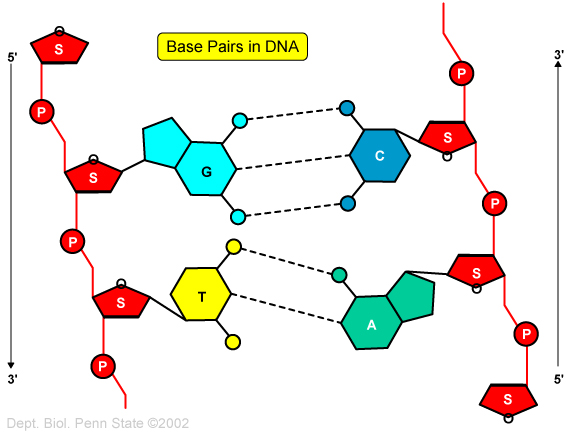
DNA replication is a semiconservative process. Why?
When DNA replicates, each new DNA molecule contains half of the original molecule.
When cells reproduce, the new cell needs a copy of the DNA.
The two DNA strands do not go in the same direction.
DNA polymerase can only add nucleotides to the 3’ end of the DNA strand.