Wayground logo

Free Printable Worksheets

Font size

S
M
L
XL
Worksheets

Unit 3 Review: Population Dynamics

Total questions: 50

Worksheet time: 4hrs 10mins

Name
Class
Date
1.

A food web is more realistic than a food chain for showing the feeding relationships in ecosystems because

a)

it compares the number of consumers to the number of micro-organisms in an ecosystem

b)

food chains use only a small sampling of organisms.

c)

a food web explains why there are more producers than consumers.

d)

producers are usually eaten by many different consumers and most consumers are eaten by more than one predator

2.

Only a small amount of the energy stored in food is available to the next organism in a food chain because

a)

there are more producers than consumers in a food chain

b)

there are fewer top consumers than producers in a food chain

c)

primary and secondary consumers compete for food

d)

most of the energy is used for life processes

3.

Which of the following describes a food web?

a)

layers of organization in a biosphere

b)

a series of overlapping food chains

c)

a symbiotic relationship

d)

a population

4.

The bottom layer of an ecological pyramid is comprised of __________.

a)

predators

b)

herbivores

c)

omnivores

d)

producers

5.

Producers make food using _______ to trap the Sun's energy in a process called photosynthesis.

a)

chlorophyll

b)

food chains

c)

cellular respiration

d)

microscopic organisms

6.

A food chain shows _________.

a)

what foods are most nutritious for an organism

b)

how energy passes from the sun to organisms

c)

how matter on Earth is recycled

d)

how energy from food passes from one organism to another

7.

The main source of energy on earth is the

a)

ocean

b)

wind

c)

water

d)

sun

8.

One night, you trap 40 mice, mark them, and let them go. Two nights later, you again trap 40 mice, and 10 of them are marked. Using the Lincoln-Peterson Index formula, what is the total estimated number of mice in the meadow?

a)

10

b)

40

c)

160

d)

240

9.

What is a suitable way to sample plants in a field?

a)

Counting Random Plants

b)

Using Quadrats

c)

Using Pooters

d)

Using Pitfall traps

10.

Two of the primary consumers in the food web are the

a)

coyote, rattlesnake, and hawk

b)

grass and cactus.

c)

rabbit and grasshopper.

d)

rabbit, grasshopper, and scorpion.

11.
Which of these organisms is a producer?
a)
strawberries
b)
insect
c)
mouse
d)
owl
12.
What is a source of energy for the mouse?
a)
strawberries
b)
insects
c)
other mice
d)
owls
13.

What is a square called that we use to sample populations?

a)

grid

b)

quadrat

c)

cube

d)

quarter

14.

Ten 1m2 quadrats were placed in a 40m2 field. On average 2 snails were found in every quadrat. Estimate the population size of the whole field.

a)

2

b)

10

c)

40

d)

80

e)

20

15.

These four 1m2 squared quadrats were place in a 8m2 garden. Estimate the total population of flowers in the whole garden.

a)

16

b)

17

c)

8

d)

40

e)

20

16.

Which organism can be measured with a quadrat?

a)

lion

b)

flies

c)

rat

d)

dandelion plants

e)

fish

17.
Unbiased sampling is:
a)
when you choose the group you think will represent the sample
b)
when any member of the population is equally likely to be chosen for the sample
18.
Largest number of individuals of a population that the environment can support...  
a)
carrying capacity
b)
population crash
c)
lag phase
d)
mutualism
19.
What do you call a period of rapid growth?
a)
exponential growth
b)
logistic growth
c)
emigration
d)
predator-prey cycle
20.
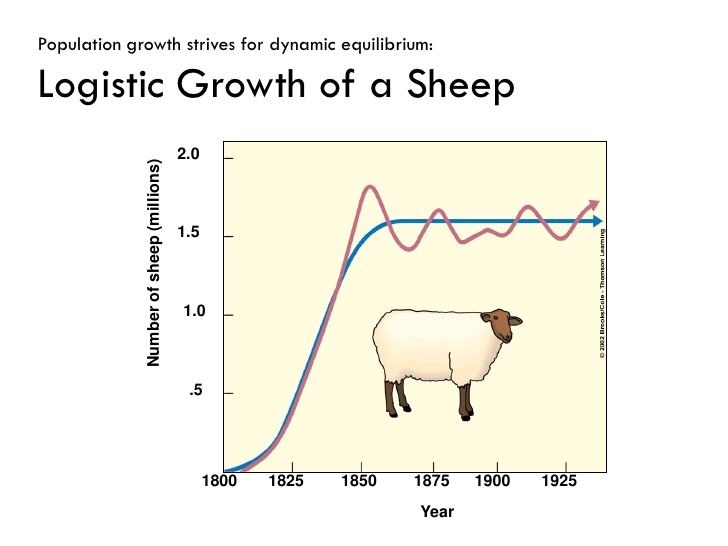
What is the carrying capacity for this sheep population?
a)
1.8 million
b)
1.25 million
c)
1.6 million
d)
1.o million
21.
What is the carrying capacity of this population?
a)
100
b)
200
c)
300
d)
400
22.

If a disease destroys barley plants in a field, what would happen to the barley-eating bird population in the the field?

a)

The bird population would stay the same

b)

The bird population would infinitely increase

c)

The bird population would decrease

23.

Will competition increase or decrease the carrying capacity for the animals that are competing?

a)

Decrease

b)

Increase

24.
When a population grows past the ecosystem's carrying capacity, what happens to the population?
a)
Continues to grow
b)
The population starts to die off to return to carrying capcity
c)
The population will go extinct due to lack of resources
d)
The population grows then finds a new carrying capacity
25.

An environmental factor such as predation, disease, and competition that depends on the number of members in a population per unit

a)

dispersion

b)

growth factor

c)

limiting factor

26.
If the number of births is greater than the number of deaths in a population, what will happen to the growth of the population?
a)
It will increase.
b)
It will decrease.
c)
It will stay the same.
d)
It will fluctuate.
27.

What might happen if the earth exceeds its carrying capacity?

a)

There might not be room for people to move around.

b)

There might not be enough food and water for everyone.

c)

The continents might sink into the oceans.

d)

Most of the people on the planet would starve.

28.
An area where an organism finds food, shelter and water in a specific arrangement
a)
niche
b)
biosphere
c)
biome
d)
habitat
29.
The study of how living things interact with one another and with their environment.
a)
Biology
b)
Lithology
c)
Ecology
d)
Farmacology
30.
Examples of a producer
a)
frog
b)
algae
c)
worm
d)
mouse
31.
Which one is NOT an example of a decomposer?
a)
mushroom
b)
leaves
c)
mold
d)
worm
32.
What is a producer?
a)
an organism that gets energy from eating other organisms
b)
an organisms that uses sunlight to make its own food
c)
an organism that gets energy from eating dead organisms, non-living material or waste
d)
an organism that uses chemical energy to make its own food
33.
What is a herbivore?
a)
an animal that gets energy from eating other animals
b)
an organism that gets energy from eating only plants
c)
an animal that gets energy by eating both plants and other animals
d)
an animal that eats only herbs
34.
What is a carnivore?
a)
an animal that gets energy by eating other animals
b)
An animal that gets energy by eating only plants
c)
an animal that gets energy by eating both plants and animals
d)
an animal that makes its own energy through photosynthesis
35.
The shrew provides energy for the _______?
a)
cricket
b)
grasshopper
c)
frog
d)
snake
36.
Where do all life forms get their energy?
a)
Earth's Core
b)
Water
c)
Plants
d)
The Sun
37.
What is this called?
a)
Food Web
b)
Food Chain
c)
Abiotic Factors
38.
What is this called?
a)
Food Web
b)
Food Chain
c)
Abiotic Factors
39.
The snake is a predator to what prey in this food chain?
a)
frog
b)
grass
c)
grasshopper
d)
hawk
40.
The frog is a predator to what prey in this food chain?
a)
frog
b)
grass
c)
grasshopper
d)
hawk
41.
What are organisms that use other organisms for food in order to gain energy?
a)
decomposers
b)
producers
c)
herbivores
d)
consumers
42.
What type of organism makes its own food?
a)
consumer
b)
carnivore
c)
producer
d)
animal
43.
A red wolf is a __________ and a ________.
a)
producer and hunter
b)
consumer and carnivore
c)
decomposer and carnivore
d)
decomposer and omnivore
44.
Which are examples of consumers?
a)
grass and cows
b)
turtles and seaweed
c)
owls and bears
d)
sun and mushrooms
45.
A living organism that puts materials from dead  plants and animals back to the soil is called a ____________?
a)
carnivore
b)
decomposer
c)
herbivore
d)
omnivore
46.
What do the arrows represent in this diagram?
a)
who is being eaten
b)
the flow of energy
c)
the decomposition of organisms
d)
what things can change into
47.

Cactus

a)

Producer

b)

Consumer

c)

Decomposer

48.

Frog

a)

Producer

b)

Conusmer

c)

Decomposer

49.

Fungi

a)

Producer

b)

Consumer

c)

Decomposer

50.

Pine Tree

a)

Producer

b)

Consumer

c)

Decomposer