
 Worksheets
Chemical Equations
Total questions: 40
Worksheet time: 34mins
How many oxygen atoms are present in the following chemical formula?
4Ca(OH)2
4
6
8
1
How many atoms of pretend element E are there in this silly chemical formula?
2E2Fg3Hi4
4
2
1
3
Determine what number goes in the blank to balance the chemical equation below.
2KI + ____Cl2 → 2KCl + I2
1
2
3
4
What numerical coefficient should go in the blank space below to balance the chemical equation?
2Al +____ HCl → 2AlCl3 + 3H2
2
4
3
6
In chemical reactions, what does the principle of conservation of mass/matter mean?
Matter is not created or destroyed.
The total mass of the reactants is greater than the total mass of the products.
The total mass of the reactants is less than the total mass of the products.
Matter is not changed.
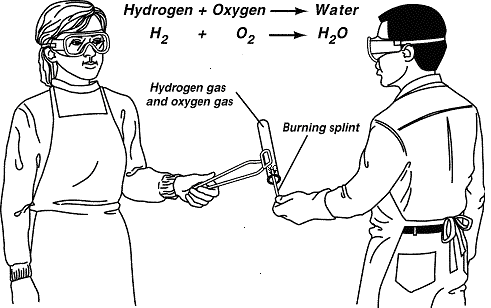
How many hydrogen atoms are there in 4H2O?
6
8
2
4
Which of the following choices shows the correctly balanced chemical equation below?
Fe + O2 -> Fe2O3
4Fe + 3O2 -> 2Fe2O3
2 Fe + 3O2 -> Fe2O6
4 Fe + O6 -> 2Fe2O3
None of the options are correctly balanced.
How many HCl molecules do you need to balance this equation?
Mg + __HCl ---> MgCl2 + H2
1
2
3
4
Balance the following equation:
_Al +_HCl --> _H2 +_AlCl3
2, 6, 3, 2
it is already balanced
4, 12, 3, 4
2, 1, 4, 5

Identify the Reactants in this equation.
A
B

What state of matter is this substance?
solid
liquid
gas
aqueous

Identify the number in blue.
Product
Reactant
Coefficient
Subscript

In what state is this substance?
solid precipitate
dissolved in water
released as a gas
liquid

How many atoms of nitrogen are in the compound shown above?
1
2
3
4

What are the blue numbers called?
oxidation numbers
subscripts
group numbers
product numbers

How many atoms of nitrogen are present in this molecule?
1
2
3
4

Which compound is formed as a precipitate in this reaction?
Pb(NO3)2
KI
PbI2
KNO3

What does the symbol inside the circle mean?
"yields, or produces"
"dissolved in water"
"forms a precipitate"
"released as a gas"

Is the compound in the pink box a Reactant or a Product?
Reactant
Product
What type of reaction is represented by the equation below?
4Si + S8 --> 2Si2S4
Synthesis
Decomposition
Single displacement
Double displacement
What type of reaction is represented by the equation below?
3Ca + 2AlCl3 --> 3CaCl2 + 2Al
Synthesis
Decomposition
Single diplacement
Double displacement
What type of reaction is represented by the equation below?
2Pb(NO3)2 --> 2PbO + 4NO2 + O2
Synthesis
Decomposition
Single displacement
Combustion
What type of reaction is represented by the equation below?
3Mg + N2 --> Mg3N2
Synthesis
Decomposition
Single displacement
Combustion
What type of reaction is represented by the equation below?
2NO2 --> N2 + 2O2
Synthesis
Decomposition
Single displacement
Combustion
What type of reaction is represented by the equation below?
P4 + 3O2 --> 2P2O3
Synthesis
Decomposition
Single displacement
Combustion
What type of reaction is represented by the equation below?
C4H12 + O2 --> CO2 + H2O
Synthesis
Combustion
Single Replacement
Double Replacement
What type of reaction is represented by the equation below?
NH3 + HCl ---> NH4Cl
Synthesis
Decomposition
Single Replacement
Double Replacement

Magnesium can be burned in air to produce solid magnesium oxide.
Choose the correctly balanced equation below that represents the word equation above.
2Mg(s) + O2(g)→ 2MgO(s)
Mg(s) + O(g) → MgO(s)
2Mg(s) + CO2(g) → 2MgO(s) + C(s)
2Mg(s) + O2(g) → Mg2O2(s)

Sodium reacts with chlorine to produce sodium chloride.
Choose the correctly balanced equation below that represents the word equation above.
NaCl(s) → Cl(g) + Na(s)
Na(s) + CO2(g) → NaCO2(s)
2Na(s) + Cl2(g) → 2NaCl(s)
Na(s) + Cl(g) → NaCl

When lead reacts with oxygen, a yellow lead(II) oxide powder is produced.
Choose the correctly balanced equation below that represents the word equation above.
2Pb(s) + O2(g) → 2PbO(s)
Pb(s) + O2(g) → PbO2(aq)
4Pb(s) + O2(g) → 2Pb2O(g)
Pb(s) + O(g) → PbO(s)

