wayground logo

Free Printable Worksheets

NEW

Font size

S
M
L
XL
Worksheets

Tectonics

Total questions: 61

Worksheet time: 1hrs 21mins

Name
Class
Date
1.
A ______ is a section of the lithosphere that slowly moves over the asthenosphere, carrying large slabs of continental and oceanic crust.
a)
wedge
b)
plate
c)
chunk
d)
fault
2.
A break in Earth's crust along which rocks move is called a ________.
a)
plate
b)
rift
c)
fault
d)
breach
3.
What is the name of the single landmass that began to break apart 200 million years ago?
a)
Panthalassa
b)
Laurasia
c)
Gondwanna
d)
Pangaea
4.
The movement of fluid, caused by differences in temperature, that transfers heat from one part of the fluid to another is _____________.
a)
Convection current
b)
Seismic waves
c)
Sea-floor spreading
d)
Conduction current
5.
The process by which molten material adds new oceanic crust to the ocean floor is called ___________.
a)
Divergent boundary
b)
Sea-floor spreading
c)
Convergent boundary
d)
Renovating 
6.
What is an undersea mountain chain where new ocean floor is produced?
a)
Rift valley
b)
Deep-ocean trench
c)
Mid-ocean ridge
d)
Transform bounda
7.
A __________ is a deep valley along the ocean floor beneath which oceanic crust slowly sinks toward the mantle.
a)
deep-ocean trench
b)
rift valley
c)
sea-floor spreading
d)
mid-ocean ridge
8.
What is the process by which oceanic crust sinks beneath a deep-ocean trench and back into the mantle at a convergent plate boundary?
a)
Subduction
b)
Induction
c)
Abduction 
d)
Reduction
9.
_____________ is a plate boundary where two plates move away from each other.
a)
Convergent boundary
b)
Transform boundary
c)
Divergent boundary
d)
Insurgent boundary
10.
_____________ is when two plates move toward each other.
a)
Convergent boundary
b)
Allegiant boundary
c)
Transform boundary
d)
Sliding boundary
11.
A _____________ is when two plates move past each other in opposite directions.
a)
emergent boundary
b)
divergent boundary
c)
transform boundary
d)
convergent boundary
12.
A _________ is a valley that forms where two plates move apart.
a)
Fissure
b)
Rift valley
c)
Sea-floor spreading
d)
Fault
13.
___________ is the theory that pieces of Earth's lithosphere are in constant motion, driven by convection currents in the mantle.
a)
Seismic waves
b)
Convection current
c)
Divergent boundary
d)
Plate tectonics
14.

What is the correct order (starting from the surface) of Earth’s layers?

a)

crust, outer core, inner core, mantle

b)

mantle, outer core, inner core, crust

c)

crust, mantle, outer core, inner core

d)

outer core, inner core, crust, mantle

15.

In sea-floor spreading, molten material rises from the mantle and erupts

a)

along the edges of all the continents.

b)

along mid-ocean ridges.

c)

in deep-ocean trenches.

d)

at the north and south poles.

16.

The process by which the ocean floor sinks beneath a deep-ocean trench and back into the mantle is known as _______

a)

convection.

b)

continental drift.

c)

subduction.

d)

conduction.

17.

Most geologists think that the movement of Earth’s plates is caused by _______

a)

convection.

b)

continental drift.

c)

subduction.

d)

conduction.

18.

The geological theory of _______ states that pieces of Earth’s lithosphere are in constant, slow motion.

a)

subduction

b)

plate tectonics

c)

deep-ocean trenches

d)

sea-floor spreading

19.

A place where two plates slip past each other, moving in opposite directions, is known as a _______

a)

transform boundary

b)

divergent boundary.

c)

convergent boundary.

d)

rift valley.

20.

Scientists think that convection currents flow in Earth’s

a)

continents.

b)

mantle.

c)

lithosphere.

d)

inner core.

21.

The place where two plates come together is known as a _______

a)

transform boundary.

b)

divergent boundary.

c)

convergent boundary.

d)

rift valley.

22.

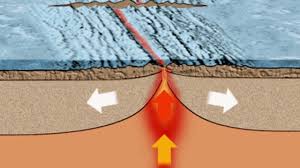
Below is a picture of sea-floor spreading. How are the ocean crusts moving?

a)

Converging

b)

Diverging

c)

Sliding

d)

No movement

23.

The San Andreas Fault in California is known as an active earthquake area. What type of

boundary is it?

a)

Converging

b)

Diverging

c)

Transform

d)

Sea Floor Spreading

24.
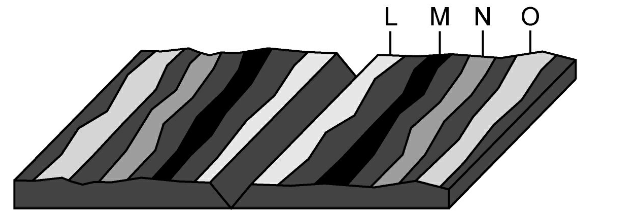
Where would the oldest rock be found?
a)
L
b)
M
c)
N
d)
O
25.
How is it possible for new crust to be formed without increasing the surface area of the Earth?
a)
Crust is destroyed at the same time it is created
b)
New crust is underwater where it sinks
c)
New crust breaks more easily than old crust
26.
This layer of Earth is the thickest part
a)
crust
b)
outer core
c)
mantle
d)
inner core
27.
What are the two types of crust
a)
continental and oceanic
b)
ocean and upper
c)
lower and upper
d)
pizza and subway
28.
The Himalayas in Asia are an example of what type of plate boundary?
a)
divergent
b)
continent-to-continent convergent
c)
ocean-to-continent convergent
d)
transform
29.
What type of boundary is the SAN ANDREAS FAULT on?
a)
Covergent
b)
Transformers
c)
Divergent
d)
Transform
30.
What are Tectonic Plates?
a)
A continent 
b)
The Trees in Vietnam 
c)
ThE PlaTES That MoVE uNdERGRound :)
d)
The Plates that move the Continents
31.
What is Pangaea?
a)
the name of a German scientist
b)
the name of the super-continent that existed millions of years ago
c)
another name for continental drift
d)
the name of an ancient fossil
32.
What are the two types of crust?
a)
continental and oceanic
b)
ocean and basin
c)
lower and upper
d)
thick and thin
33.
Mountains form from ...
a)
plates sliding past one another
b)
collision of plates
c)
plates moving away from each other
34.

The shaking that results from the movement of rock beneath Earth’s surface is called an __________________

a)

tsunami

b)

earthquake

c)

volcano

d)

fault

35.

When a volcano is not currently active but able to become active in the future is called ___________________

a)

extinct

b)

fault

c)

hot spot

d)

dormat

36.

A force that acts on rock to change its shape or volume is called a ______________

a)

tension

b)

stress

c)

fault

d)

dormat

37.

When a volcano is no longer active and unlikely to erupt again is called ____________________

a)

extinct

b)

fault

c)

tension

d)

dormat

38.

Stress that stretches rock so that it becomes thinner in the middle is called __________________

a)

tension

b)

stress

c)

dormat

d)

fault

39.

An area where magma from deep within the mantle melts through is called a ____________________

a)

fault

b)

dormat

c)

hot spot

d)

stress

40.

Stress that squeezes rock until it folds or breaks is called ______________

a)

fault

b)

compression

c)

shearing

d)

tension

41.

A molten mixture of rock forming substances, gases, and water, from the mantle is called _____________________

a)

magma

b)

lava

c)

hot spot

d)

dormat

42.

Stress that pushes masses of rock in opposite directions, in a sideways movement is called __________________

a)

compression

b)

fault

c)

tension

d)

shearing

43.

A weak spot in the crust where magma has come to the surface is called _____________________

a)

hot spot

b)

lava

c)

volcano

d)

fault

44.

A break in Earth’s crust along which rocks move is called ___________

a)

stress

b)

compression

c)

dormat

d)

fault

45.

The measurement of an earthquake’s strength based on seismic waves and movement along faults is called ________

a)

fault

b)

tension

c)

stress

d)

magnitude

46.

A giant wave usually caused by an earthquake beneath the ocean floor is called __________________

a)

earthquake

b)

volcano

c)

tsunami

d)

fault

47.

________________ caused by the movement of the Earth’s massive tectonic plates generates tremendous force in the crust causing an ___________________.

a)

tension : earthquake

b)

stress : earthquake

c)

tension : tsunami

d)

stress : tsunami

48.

There are 3 types of stress:

a)

normal, compression, & shearing

b)

reverse, strike-slip, & normal

c)

reverse, shearing, & compression

d)

shearing, compression, tension

49.

There are 3 types of faults:

a)

normal, reverse, & tension

b)

normal, reverse, & compression

c)

normal, reverse, & strike-slip

d)

normal, reverse, shearing

50.

____________________ are vibrations that travel through Earth carrying energy released by various processes.

a)

seismic waves

b)

tension waves

c)

stress waves

d)

compression waves

51.

Earth’s surface directly above the earthquake’s focus called ________________

a)

seismic waves

b)

fault

c)

epicenter

d)

seismic center

52.

The device that converts the energy in the different waves from an earthquake is called a _____________________.

a)

seismogram

b)

seismograph

c)

seismometer

d)

seismoteller

53.
The arrow is pointing to...
a)
an ash cloud
b)
lava
c)
magma
d)
a vent
54.
The arrow is pointing to...
a)
an ash cloud
b)
lava
c)
magma
d)
a vent
55.
The arrow is pointing to...
a)
an ash cloud
b)
lava
c)
magma
d)
a vent
56.
The arrow is pointing to...
a)
an ash cloud
b)
lava
c)
magma
d)
a vent
57.
_________________________ is hot, molten, or melted rock which reaches the surface of the Earth.
a)
magma
b)
lava
c)
volcano
d)
earthquake
58.
Lava that is still deep inside the earth is called ____________________________.
a)
lava
b)
magma
c)
volcano
d)
earthquake
59.
The state of _______________________ is a group of volcanic islands in the Pacific Ocean.
a)
Hawaii
b)
Japan
c)
California
d)
Volcano
60.

What are the 3 types of Volcanoes?

a)

arc, plate, and chunks

b)

vents, liquids, and cone

c)

shield, cinder-cone, composite

61.

A volcano that has not erupted for some time is called?

a)

dormant volcano

b)

active volcano

c)

extinct volcano

d)

sleeping volcano