wayground logo

Free Printable Worksheets

Font size

S
M
L
XL
Worksheets

World War One test

Total questions: 60

Worksheet time: 48mins
Name
Class
Date
1.
One reason the Bolsheviks gained peasant support during the Russian Revolution was because the Bolsheviks promised to
a)
redistribute land
b)
abolish communes
c)
bring modern technology to Russian farms
d)
maintain an agricultural price-support program
2.
“The Allied…governments…affirm, and Germany accepts, the responsibility…for causing all of the loss and damages…” The passage above was taken from what historical document?
a)
Union Charter
b)
Treaty of Portsmouth
c)
Atlantic Charter
d)
Treaty of Versailles
3.
Vladimir Lenin’s promise of "peace, land, and bread” during the Bolshevik Revolution of 1917 was made in an effort to:
a)
end France’s occupation of Russian territory
b)
restore Czar Nicolas back to the throne
c)
gain support of the people and to take control of the government
d)
resolve conflicts between the farmers and the ruling class
4.
How did the Treaty of Versailles affect Germany?
a)
It stabilized Germany’s economy
b)
It limited the German army
c)
It allowed Germany to reconcile with its enemies
d)
It caused Germany to become a superpower
5.
The man who succeeded Vladimir Lenin as the leader of Russia was:
a)
Karl Marx
b)
Joseph Stalin
c)
Leon Trotsky
d)
Rasputin
6.
After WWI, the League of Nations established a system of mandates to:
a)
Help Germany pay back reparations for Allied war costs and damages
b)
Prepare the people in former colonies for self-rule
c)
Abdicate the incompetent leaders of the Central Powers
d)
Provide military aid to countries that needed to settle disputes
7.
Military leaders were not prepared for the trench warfare of WWI, in which:
a)
Troops moved quickly through trenches to capture territory
b)
Artillery destroyed enemy forces before soldiers captured new territory
c)
Opposing forces fought each other from elaborate systems of trenches without much gain of land
d)
Forces moved quickly with u-boats and artillery
8.
Which country was created after WWI?
a)
Yugoslavia
b)
East Germany
c)
Northern Ireland
d)
Transylvania
9.
During the first Christmas of the war, what event occurred?
a)
Germans developed poison gas and defeated the England with a surprise attack
b)
The countries leaders called for an one month armistice (peace treaty)
c)
French airplanes bombed Berlin with a barrage of candy canes
d)
Troops on the Western Front had an unofficial Christmas truce, sang songs together, played a soccer match, and buried their dead
10.
What did Italy want at the end of WWI?
a)
Land
b)
Money
c)
Letter of appreciation
d)
Papal (Catholic Church) leadership in Europe
11.
Observation of a Soldier in World War I Private Archie Surfleet, February 8th, 1918 — We have been in camp near the wood at Écurie for some days now and a more miserable existence it would be hard to imagine. There is nothing but unrest and uncertainty and everyone here is absolutely fed up to the teeth. — Malcolm Brown, Tommy Goes to War Which hypothesis can best be supported by this passage?
a)
Allied forces were on the verge of winning the war
b)
Technology had created a military stalemate
c)
Revolution in Russia hastened the end of the war
d)
Conditions contributed to low troop morale
12.
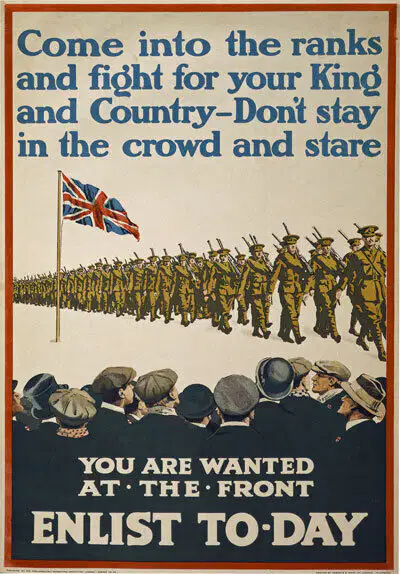
Which concept is represented in this World War I recruiting poster?
a)
justice
b)
diversity
c)
nationalism
d)
humanism
13.
Disintegration of the Austro-Hungarian Empire, creation of new nation-states in central Europe, and Germany’s loss of colonies were all consequences of
a)
the Napoleonic Wars
b)
the Franco-Prussian War
c)
World War I
d)
World War II
14.
One way in which King Louis XVI of France and Czar Nicholas II of Russia are similar is that both
a)
were executed by revolutionaries
b)
were known as great military leaders
c)
advocated religious reform
d)
supported the emancipation of serfs
15.
Which event is considered the immediate cause of World War I?
a)
signing of the Treaty of Versailles
b)
invasion of Poland by Germany
c)
assassination of Archduke Francis Ferdinand
d)
use of unrestricted submarine warfare by Germany
16.
Which action contributed to the success of Lenin’s communist revolution in Russia?
a)
Peasants were promised land reform and peace
b)
Businessmen were encouraged to form monopolies
c)
Landowners were offered tax relief
d)
Factory workers were required to start small businesses
17.
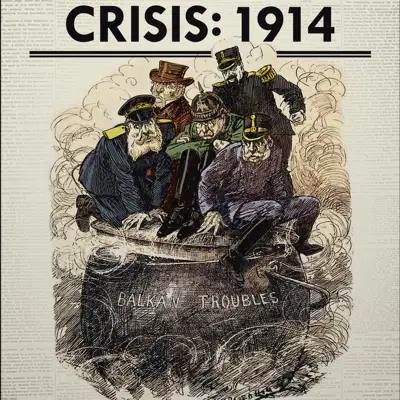
This 1912 cartoon depicts (The Boiling Point - Balkan Troubles)
a)
efforts to contain the Boxer Rebellion
b)
tensions in pre–World War I Europe
c)
reactions to the Bolshevik Revolution
d)
responses to the rise of the Weimar Republic
18.
… Whatever we may wish or hope, and whatever course of action we may decide, whatever be the views held as to the legality, or the humanity, or the military wisdom and expediency [advisability] of such operations, there is not the slightest doubt that in the next war both sides will send their aircraft out without scruple [hesitation] to bomb those objectives which they consider the most suitable.… — H. Trenchard, Marshal of the Royal Air Force, 1928 This passage implies that the author is
a)
grateful for the availability of new weapons
b)
aware that new weapons have broadened the theater of war
c)
certain that there will be no future wars
d)
anxious about the legality of future military operations
19.
What prompted the United States to enter World War I?
a)
attack on Pearl Harbor
b)
massive casualties at Verdun
c)
explosion of the Challenger space shuttle
d)
Zimmerman Telegram
20.
According to the quote below, which statement most accurately describes the impact of machine guns on the nature of war during World War I? “The officers were in front. I noticed one of them calmly carrying a walking stick. When we started firing we just had to load and re-load. They went down in the hundreds. You didn’t have to aim, we just fired into them.”
a)
It contributed to significant territorial gain
b)
It ended trench warfare
c)
It resulted in a speedier end to the war
d)
It contributed to a significant death toll
21.
During World War I, developments in military technology led to
a)
an early victory by the Allied powers
b)
the establishment of industrial capitalism
c)
the use of poisonous gas and submarine attacks
d)
an increase in ethnic tension in western Europe
22.
The technology developed during World War I resulted in
a)
smaller nations becoming part of larger empires after the war
b)
a smaller number of refugees during the war
c)
increased military casualties in battles fought during the war
d)
a slowdown in transportation improvements after the war
23.
"Bombardment, barrage, curtain-fire, mines, gas, tanks, machine-guns, hand-grenades — words, words, but they hold the horror of the world.” — Erich Maria Remarque, All Quiet on the Western Front This quotation best describes the effects of the
a)
technological developments used during World War I
b)
formation of alliances in World War II
c)
tension between the superpowers during the Cold War
d)
protests against reforms during the Indian independence movement
24.
Base your answer to the following question on the passage below and on your knowledge of social studies. ... A weary, exhausted, nerve-racked group of men it was indeed that, about noon November 1, assembled in a gully north of Sommerance [France] to rest and dig in for the night. The artillery was still firing furiously, but the enemy's barrage [bombardment] had ceased very suddenly about 10:00 a.m. and now only occasional shells from long-range rifles would explode in the vicinity. The weather was gloomy and the moist air chilled one to the bones. Yet it was with that meticulous [methodical] care that is characteristic of worn-out men, that we prepared our foxholes, carrying boards and iron sheeting from abandoned machine-gunners' dugouts in order to make our "houses" as comfortable as possible, even though only for one night.... Source: William L. Langer, Gas and Flame in World War I, Knopf/Borzoi Which means of warfare is described in this passage?
a)
guerilla
b)
nuclear
c)
biological
d)
trench
25.
What practice during the turn of the last century motivated powerful nations to influence and control other nations?
a)
imperialism
b)
marxism
c)
militarism
d)
nationalism
26.
What refers to extreme pride and loyalty to one’s country?
a)
fundamentalism
b)
imperialism
c)
militarism
d)
nationalism
27.
What led the United States to enter World War I?
a)
imperialism
b)
isolationism
c)
spread of communism abroad
d)
unrestricted submarine warfare
28.
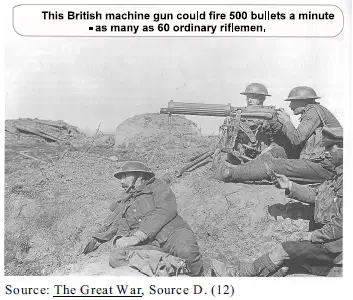
Using the source provided, which best explains why casualty rates increased as World War I progressed?
a)
condition of the trenches
b)
increased participation among warring nations
c)
more effective use of wartime technology
d)
spread of disease
29.
Which cause of World War I is best reflected in this image?
a)
Alliance System
b)
Arms Race
c)
Imperialism
d)
Nationalism
30.
Using the source provided, what was the primary objective of the French delegation at the Paris Peace Conference in 1919? “Germany must be crippled or we will never feel safe again.” - French Civilians
a)
create a tariff free zone
b)
ensure freedom of sea navigation
c)
maintain national security
d)
reclaim colonies lost in the war
31.
Which group aided Lenin in his seizure of power during the October/November Revolution of 1917?
a)
Bolsheviks
b)
Fascists
c)
Kulaks
d)
Mensheviks
32.
Russian Leader before Bolshevik Revolution
a)
Tsar Nicholas II
b)
Kaiser Wilhelm II
c)
King George V
d)
Vittorio Orlando
33.

The ______ Treaty ended all hostilities of World War I.

a)

Versailles

b)

Big Three

c)

14 Point

34.
Which of the following is NOT accurate concerning the signing of the final set of treaties that ended World War I?
a)
Russia was rewarded for its service by being given substantial Baltic territories
b)
Austria-Hungary was divided into Austria, Hungary, Czechoslovakia and Yugoslavia
c)
Germany was forced to accept blame for the war and pay huge war reparations
d)
A League of Nations was formed but in time provided ineffective
35.

Imperialism caused

a)

increased efforts to solve problems between countries

b)

decreased competition between countries

c)

increased competition between countries

d)

decreased tension between countries

36.
Franz Ferdinand was assassinated by the "Black Hand" a Nationalist terrorist group from
a)
Germany
b)
Russia
c)
Slovakia 
d)
Serbia
37.

An agreement between two or more countries to give other people help if needed is

a)

a treaty

b)

an alliance

c)

a partnership

d)

a friendship

38.

Which continent did most of the fighting of World War I take place?

a)

England

b)

France

c)

North America

d)

Europe

39.

Who sank the Lusitania?

a)

Japan

b)

U.S.

c)

Germany

d)

Russia

40.

What is a U-boat?

a)

A German Battle Ship

b)

An American Passenger Ship

c)

A German Submarine

d)

A French Aircraft

41.

What is the Zimmerman Telegram?

a)

A telegram where the U.S. encouraged Mexico to attack Germany

b)

A telegram where Germany encouraged Mexico to attack the U.S.

c)

A telegram between Germany and Russia encouraging a peace treaty

d)

A telegram between Britain and the US about an invasion on Germany

42.

World War 1 was known as the:

a)

The Final War

b)

The European War

c)

The Great War

d)

The Civil War

43.

Europe is divided into which two alliances?

a)

Triple Entente (Allied Powers) & Triple Alliance (Central Powers)

b)

Warsaw Pact & NATO

c)

Axis Powers & Allied Powers

d)

Roundheads & Cavilers

44.

Which of the following is the best example of how World War I was a total war?

a)

The alliance system drew nation after nation into the war.

b)

Modern weapons caused high casualty rates on the Western Front.

c)

Women took over many jobs in war industries.

d)

U-boats attacked Allied shipping in the Atlantic.

45.
What was President Wilson's proposed points called that he brought to Versailles?
a)
Fourteen Points
b)
Seven points
c)
Ten Points
d)
Two Points
46.

Match the following

a)

M

1.

Military

b)

A

2.

Alliances

c)

I

3.

Imperialism

d)

N

4.

Nationalism

47.

When a strong country takes over a weaker country

a)

Militarism

b)

Alliances

c)

Imperialism

d)

Nationalism

48.

How did the Treaty of Versailles attempt to prevent future conflicts?

a)

Allowing Germany to rebuild its military without restrictions

b)

Imposing heavy reparations on Germany, reducing its military capabilities, and creating the League of Nations

c)

Granting Germany more territory

d)

Forgiving all debts of Germany

49.

Which of the following was NOT a new technology used in World War I?

a)

Cavalry

b)

Tanks

c)

Planes

d)

Machine Guns

e)

Poison Gas

50.

Which cause of WWI can be best described as a policy of extending a country's power and influence through diplomacy or military force

a)

Militarism

b)

Alliances

c)

Imperialism

d)

Nationalism

e)

Ethnocentrism

51.

Which cause of WWI can be best described as a union or association formed for mutual benefit, especially among countries

a)

Militarism

b)

Alliances

c)

Imperialism

d)

Nationalism

e)

Ethnocentrism

52.

Which cause of WWI can be best described as the belief that a country/people should maintain a strong military and be prepared to use it aggressively to defend or promote national interests?

a)

Militarism

b)

Alliances

c)

Imperialism

d)

Nationalism

e)

Ethnocentrism

53.

A complete mobilization of all resources and people of a nation for the success of the war effort

a)

Food Rationing

b)

Total War

c)

Commandeering Transportation

54.

The Arch Duke of Austria Hungary was assassinated by a member of which Serbian terrorist/nationalist group that desired all Slavic people united into one country.

a)

Tamil Tigers

b)

Slavic Knights

c)

Black Hand

55.

Lenin gained support in Russia prior to the overthrow of the Provisional Government by promising which of the following things to the Russian people?

a)

Bread

b)

Liberty

c)

Land

d)

Peace

e)

Work

56.

The Treaty of Versailles allowed for an international body whose sole purpose was to maintain world peace and which would sort out international disputes as and when they occurred...this body was called?

a)

The United Nations

b)

The League of Nations

c)

The Concert of Europe

57.

The President of the United States during WWI.

a)

Theodore Roosevelt

b)

Woodrow Wilson

c)

Franklin Roosevelt

d)

Grover Cleveland

58.

This country had to accept the "War Guilt Clause" of the Treaty of Versailles, which said this country was 100% responsible for starting the war and also needed to pay reparations to the Allies for the cost of the war?

a)

Russia

b)

Austria Hungary

c)

Germany

d)

Serbia

59.
a)
Nationalism
b)
Imperialism
c)
Alliances
d)
Militarism
60.

In January of 1917, British cryptographers deciphered a telegram from German Foreign Minister Arthur Zimmermann to the German Minister to Mexico, von Eckhardt, offering United States territory to Mexico in return for joining the German cause. This message helped draw the United States into the war and thus changed the course of history. The telegram had such an impact on American opinion that, according to David Kahn, author of The Codebreakers, “No other single cryptanalysis has had such enormous consequences.” Excerpt from “The Zimmermann Telegram” by Mary Alexander and Marilyn Childress from Social Education, April 1981.


Based on the excerpt, what was the role of the Zimmermann telegram in World War I?

a)

It embarrassed the British, who secretly conspired with Germany to write it

b)

It created conflict between Mexico and the United States and delayed American arms production for the Allies.

c)

It angered many European nations who depended on the Mexican production of arms.

d)

It provoked the United States, a neutral nation, to become involved in the war.