wayground logo

Free Printable Worksheets

NEW

Font size

S
M
L
XL
Worksheets

Climate

Total questions: 31

Worksheet time: 17mins

Name
Class
Date
1.
The closer you live to an ocean the more likely your climate will be?
a)
maritime
b)
continental
c)
tropical
d)
polar
2.
A polar climate is?
a)
warm and cool
b)
consistently moderate
c)
consistently cool
d)
consistently warm
3.
What is the climate of the top of a mountain like as compared to the bottom of the mountain?
a)
warmer
b)
cooler
c)
drier
d)
wetter
4.
What is the difference between climate and weather?
a)
 Climate averages the weather conditions in a specific place over a long period of time, while weather describes the state of the atmosphere at a specific moment in time.
b)
 Weather averages the weather conditions in a specific place over a long period of time, while Climate describes the state of the atmosphere at a specific moment in time.
c)
Climate describes the weather conditions at night, while weather describes the conditions during the daytime.
d)
 There is not a difference between climate and weather.
5.
Which sentence best describes the relationship between elevation and air temperatures?
a)
 LOWER elevation = COLDER temperatures
b)
HIGHER elevation = COLDER temperatures
c)
HIGHER elevations = WARMER temperatures
d)
There is no relationship
6.
What is weather?
a)
What's happening in space at a time and place.
b)
What's happening in our atmosphere at a time and place.
c)
The average weather over many years
d)
The average temperature over many years.
7.
What is climate?
a)
What's happening in space at a time and place.
b)
What's happening in our atmosphere at a time and place
c)
The average weather over many years
d)
The average temperature over many years.
8.
Which of the following does NOT have an affect on a region's climate?
a)
Large bodies of water
b)
Latitude
c)
Mountains
d)
Longitude
9.
Which BEST describes why latitudes closest to the equator have warmer climates?
a)
they are at lower elevations
b)
they receive more solar energy
c)
they are nearer to ocean currents
d)
they get more winds that carry energy in the form of heat
10.
What is the condition of the Earth's atmosphere at a certain time and place?
a)
climate
b)
temperature
c)
weather
d)
air pressure
11.

How do ocean currents affect climate?

a)

they cause hurricanes

b)

they spread temperatures around the Earth a little bit more evenly

c)

they make the Equator closer to Earth

d)

they cause the seasons

12.

Cities that are closer to large bodies of water tend to have ...

a)

more extreme temperature changes

b)

less extreme temperature changes

c)

4 distinct seasons

d)

more sunshine

13.
The sun's rays are least direct
a)
near the poles
b)
near the equator
c)
at high altitude
d)
far from the ocean
14.

The closer you live to the ocean, the more likely your climate will be a...

a)

maritime climate

b)

tropical climate

c)

continental climate

d)

subtropical climate

15.

Streams of water called "*" move warm or cold water impacting the temperatures of nearby land

a)

sun spots

b)

ocean currents

c)

carbon dioxide

d)

air masses

16.

The land of the _______________ side of a mountain range is in a rain shadow.

a)

leeward

b)

windward

17.

Which zones are polar zones?

a)

Zones A and B

b)

Zones A and E

c)

Zones E and D

d)

Zones A, E, and C

18.

Which zone is the tropical zone?

a)

Zone B

b)

Zone C

c)

Zone D

d)

Zone E

19.
What is going on with the atmosphere at any particular time.
a)
Weather
b)
Climate
20.
We can expect rain on Tuesday.
a)
Weather
b)
Climate
21.
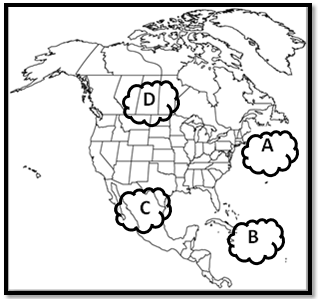
Which type of air would you find at air mass D?
a)
cold, dry
b)
warm, humid
c)
warm, dry
d)
cold, humid
22.
_______ affects weather because the further north or south you go from the Equator, the less solar energy (heat).
a)
altitude
b)
latitude
c)
sunlight
d)
atmosphere
23.
______ is the average pattern for weather over a long period of time.
a)
climate
b)
weather
c)
forecast
d)
sunlight
24.
The following photo represents.....
a)
Hurricane and Tropical storm paths 
b)
Warm and cool currents influencing climate
c)
Connections between the World's oceans 
25.

The sun's rays are most direct/intense

a)

near the poles

b)

near the equator

c)

at high altitude

d)

far from the ocean

26.
Being Near water makes the climate over nearby land ________
a)
more moderate- cooler summers warmer winters.
b)
more extreme- hotter summers and colder winters.
c)
more likely to rain all the time
d)
more cold- cooler summers and colder winters
27.

How does Elevation affect the climate of the land?

a)

The higher the elevation, the cooler the climate.

b)

The higher the elevation, the warmer the climate.

c)

The lower the elevation, the cooler the climate

d)

Elevation doesn't affect climate.

28.
How does Latitude affect climate for a given area? The closer you are to the
a)
equator, the warmer your climate is.
b)
equator, the cooler your climate is.
c)
north pole, the warmer your climate is
d)
summer months, the warmer your climate is
29.
Of the six factors, which has the biggest effect on climate?
a)
Latitude
b)
Ocean currents
c)
Near water
d)
Elevation
30.

Relief is the shape of the land: it shows the location of the hills, mountains, canyons etc.

a)

Relief affects where the winds blow and how weather moves

b)

Relief doesn't affect climate. The weather does whatever.

c)

Relief affects climate, but only over the oceans.

d)

Relief used to affect climate, but not since Global Warming

31.
Winds that blow in from the ocean
a)
have lots of moisture and make a lot of precipitation
b)
have lots of salt from the ocean that damages cars
c)
have lots of seagulls and they get lost over land
d)
have lots of flying fish and that's how we get fish & chips