
NEW
Font size
 Worksheets
Complete Review of the French and Indian War
Total questions: 37
Worksheet time: 22mins
What three European countries owned land in North America?
Africa, India, China
Great Britain, China, Africa
France, Great Britain, Spain
France, Great Britain, China
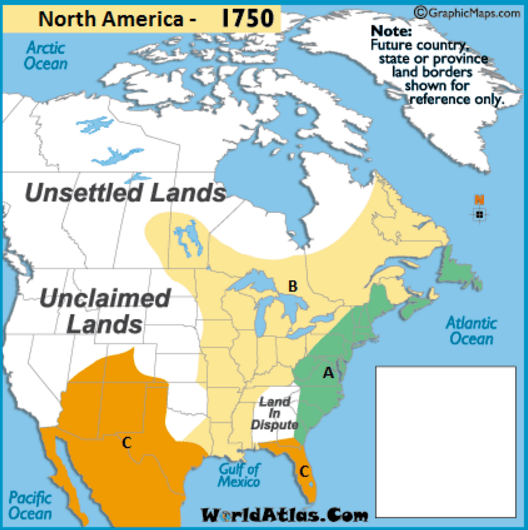
Which European power controlled territory A?
England
France
Spain
Who fought in the French and Indian War?
The French fought against the Indians.
The British and French fought against the Indians.
The French and Indians fought against the British and the colonists.
The colonists fought against the British.
What two countries fought against each other in the French and Indian War?
Great Britain and Africa
France & China
Spain and China
France & Great Britain
Why was the land in the Ohio River Valley so important to both the French and the British?
There were profitable fur trading opportunities
There were profitable corn trading opportunities
There were profitable lumber trading opportunities
There were profitable fish trading opportunities
The French and British fought over disputed land in the Ohio River Valley. This land was important because ___.
the French needed a place to settle
of its lucrative trade routes
the English had promised to share it with Spain
the Spanish were moving into the territory
One reasons why the French felt threatened by the British interest in the Ohio River Valley was because ___.
the British were a threat to their fur trade
the Natives preferred the British in the Ohio Valley
the French did not have an army
none of the above
What is one of the main reasons France wanted to keep England out of the Ohio River Valley?
to protect their gold
to protect their valuable fur trade routes
because they feared England's relationships with the Native Americans
so the Native Americans could be left alone
Why did the French feel threatened by the British being in the Ohio River Valley?
That they would take their fur trading routes
That they would take their lobster trading routes
That they would take their lumber trading routes
That they would take their fish trading routes
Some of the Native American helped the French in the war instead of the British colonists
because ___.
the French paid the Natives money to fight
the French did not want the Native’s land
the Natives did not like Washington
none of the above
An ally ___.
is the type of weapon used by a soldier during the war
is a group of soldiers who fight against each other in a war
joins with another to work towards defeating a common enemy
is the person with the most power during a conflict
It was an idea suggested by Benjamin Franklin to create a united government for the 13 colonies.
Ben's Plan
Albany Plan of Union
The Franklin Plan of Government
The Franklin Union
What is the Albany Plan of Union
1754; the first formal proposal to unite the American colonies, put forth by Benjamin Franklin
A group of citizens that come together and join the battle efforts.
controversial land that led to the French and Indian War;
Ben Franklin's Plan to Unite the French and British

The propaganda slogan used as part of the Albany Plan of Union was ____.
Get rich or die trying
Join or Die
Join or Stay
Join and get money
The Albany Plan of Union failed because ____.
Benjamin Franklin did not explain the plan well enough to the colonist’s representatives
not all of the colonies were represented at the meeting
representatives from Virginia did not like the plan
the colonies were not ready to give up their individual powers to form a union
How did William Pitt change the, "Tide of War"?
He married a Native American woman and earned their trust.
He helped the French by sending them money and persuading the Natives to side with the French.
He sent supplies to the Native Americans to help them fight against both the French and the British.
He sent money to the British colonies, his best generals, and also paid the colonists to fight.
One of the effects of the French and Indian War was the Treaty of Paris which ___.
marked the end of France’s power in North America
ended British power in the Americas
started a war between the Spanish and the Natives
None of the above
After the Treaty of Paris was signed in 1763, North America was divided between__.
France and Britain
France and Spain
Britain and Spain
France and the Netherland

After the Treaty of Paris was signed in 1763, What two European nations controlled North America
Spain and France
Native Americans and British
Great Britain and Spain
Spain and Russia
How did the French and Indian War affect the French?
France lost power and all territories in mainland North America
ended Spanish power in the Americas
France gained lands East of the Mississippi River
started a war between the French and Spanish
The Colonist resented the Proclamation of 1763 because______.
the British refused to pay them
the British allowed the French to stay in the Ohio River Valley
it did not allow them to live in the Ohio River Valley & speculators lost their land
none of the above
Why might the colonist have been mad that they were being forbidden from moving?
The law prevented them from visiting relatives
The law prevented them from claiming land they felt they fought for
The law prevented them from building roads through the mountains
The law allowed Natives to attack them.
The Proclamation of 1763 called for
a halt to westward expansion
a war
Native Americans to move west
settlers to move westward

