wayground logo

Free Printable Worksheets

Font size

S
M
L
XL
Worksheets

Probability - Theoretical and Experimental

Total questions: 100

Worksheet time: 6hrs 36mins

Name
Class
Date
1.
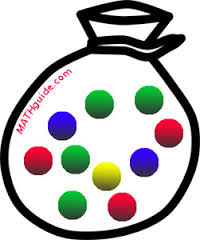
You pick a marble from this bag.
What is the probability you will choose either a black or a white marble?
*remember to simplify* 
a)
3/5
b)
4/10
c)
3/10
d)
6/10
2.
Experimental Probability is:
a)
What will happen
b)
What actually happened
c)
What should happen
d)
What I think will happen
3.
How do you write 0.02 as a percent?
a)
20%
b)
200%
c)
2%
d)
.02%
4.
P(not A) = 
a)
6/8
b)
3/4
c)
2/8
d)
1/4
5.
How many outfits are possible with 5 pairs of jeans, 8 t-shirts, and 2 pairs of shoes?
a)
15
b)
40
c)
80
d)
10
6.
What is the Theoretical Probability of not landing on red?
a)
25%
b)
50%
c)
65%
d)
66.7%
7.
Experimental Probability is:
a)
What Will happen 
b)
What actually happens
c)
What should happen
d)
What I think Happens
8.
Find the experimental probability:
Roll dice:  1, 3, 3, 4, 4
P(1) = 
a)
3/5
b)
1/6
c)
2/5
d)
1/5
9.
An experiment consists of rolling a fair number cube. Find the theoretical probability of rolling a 3.
a)
1/6
b)
3/6
c)
1
d)
1/2
10.
An experiment consists of rolling a fair number cube. Find the theoretical probability of rolling an 8.
a)
0
b)
8/6
c)
4/3
d)
1/2
11.
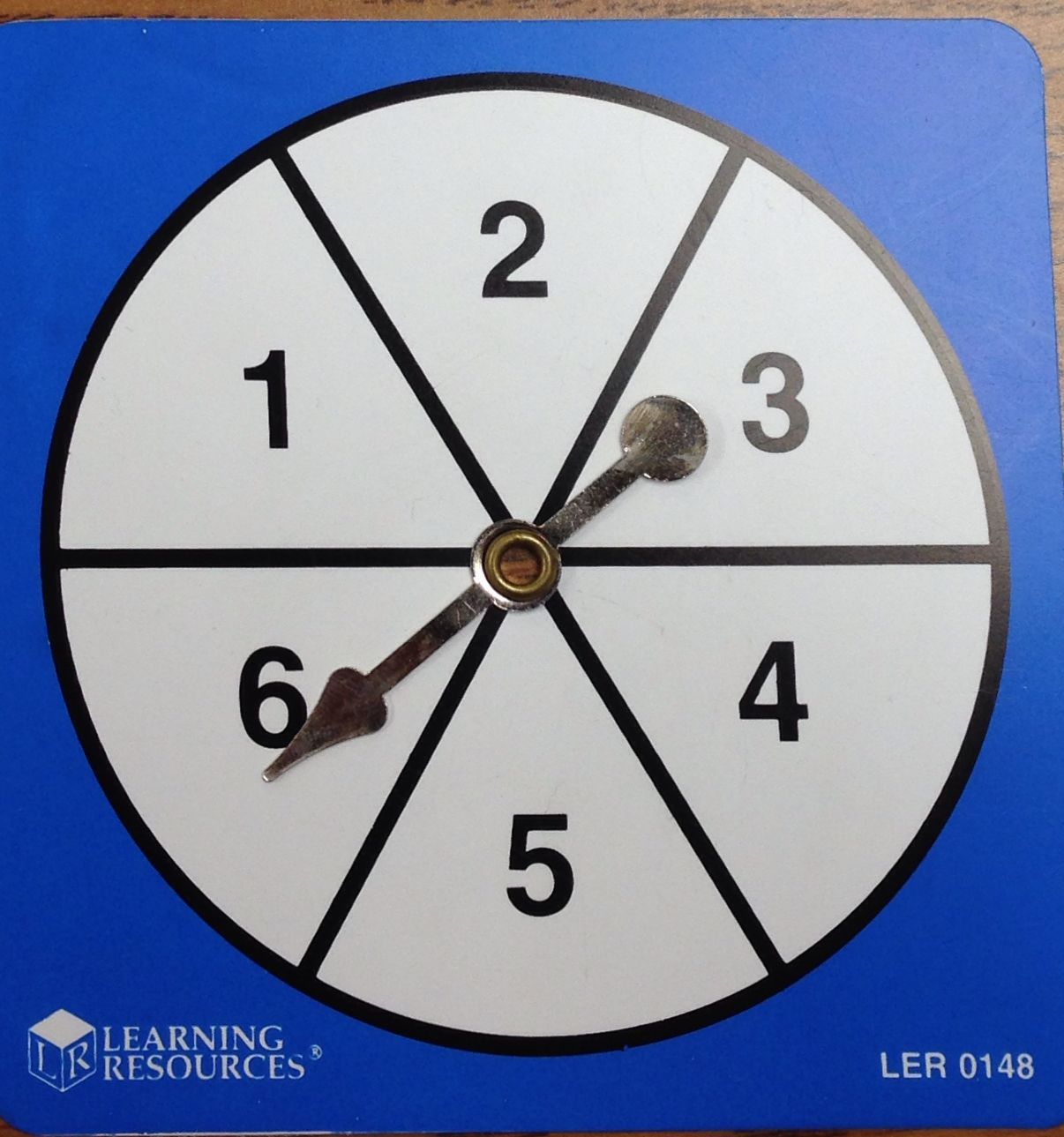
Find the theoretical probability of landing on green or red if you spin the spinner.
a)
0
b)
3/8
c)
5/8
d)
1/4
12.

Use the spinner to determine the theoretical probability of the event.

a)

P (purple) = 1/3

b)

P (purple) =1/4

c)

P (purple) =1/5

d)

P (purple) =1/6

13.
P(not A) = 
*Remember to simplify.*
a)
6/8
b)
3/4
c)
2/8
d)
1/4
14.

Bella spun a spinner with three sections. Using her results, find the likelihood that Bella lands on a red or yellow on her next spin.

a)

4/5

b)

2/5

c)

3/5

15.
If you flipped a coin 20 times and got tails 5 times, what is P(tails)?
a)
5/20
b)
1/2
c)
1/5
d)
Not Possible
16.

Bella spun a spinner with three equal sections. Using her results, find the likelihood that Bella will not land on blue on her next turn.

a)

2/5

b)

1/5

c)

4/5

17.

You have three sticks. Each stick has one red side and one blue side. You throw the sticks 10 times and record the results.


Use the table to find the experimental probability of tossing 3 blue.

a)

2/5

b)

2/10

c)

1/5

d)

3/10

18.
Probability is ...
a)
the chance that some event will occur.
b)
a game that involves coins.
c)
a guarantee.
19.
Probability can be written as ...
a)
a fraction
b)
a decimal
c)
a percent
d)
all of the above
20.
A jar contains 2 pink, 6 red, and 4 blue marbles. If you pick one marble without looking, what is the probability that the marble you pick will be red or blue?
a)
5/6
b)
1/2
c)
1/3
d)
1/6
21.
What is the probability of selecting an orange candy?
a)
0%
b)
25%
c)
50%
d)
100%
22.
P(not A) = 
*Remember to simplify.*
a)
6/8
b)
3/4
c)
2/8
d)
1/4
23.
A likely chance event is closer to what number?
a)
0
b)
1
c)
.5
d)
100
24.
What is the probability of flipping a coin and getting heads?
a)
1/2
b)
1/3
c)
1/4
d)
Never, Tails never fails.
25.
An unlikely chance event is closer to what number?
a)
0
b)
1
c)
2
d)
3
26.
The probability of it raining today is 30%.  What is the probability that it will NOT rain?
a)
30%
b)
70%
c)
100%
d)
0%
27.
A set of all possible outcomes is known as - 
a)
a list
b)
a complement
c)
a sample space
d)
an event
28.

What is the sample space?

a)

6 bears

b)

orange, green, red, white, yellow

c)

unlikely

d)

2 red bears

29.

Action: Choose one sport.

Event: Pick a sport with no ball.

Sample space: football, swimming, baseball, gymnastics

Which outcomes are part of the event?

a)

football

b)

swimming

c)

baseball

d)

gymnastics

30.
What is the experimental probability of choosing a red card?
Hint: Count the hearts and diamonds.
a)
11/25
b)
26/52
c)
0/52
d)
9/52
31.
The probability of flipping a coin and landing on tails is 1/2.
If you flip the coin 100 times, approximately how many times could you expect to land on tails?
a)
50 times
b)
100 times
c)
200 times
32.
An experiment consists of rolling a fair number cube. Find the theoretical probability of rolling a number greater than 3.
a)
4, 5, and 6
b)
3/6
c)
3
d)
1/2
33.
Find the theoretical probability of landing on green or red if you spin the spinner.
a)
0
b)
3/8
c)
5/8
d)
1/4
34.
Find the theoretical probability of NOT landing on yellow if you spin the spinner.
a)
1/8
b)
7/8
c)
1
d)
7
35.
Find the theoretical probability of landing on black if you spin the spinner.
a)
0%
b)
100%
c)
50%
d)
25%
36.
Probability can be between what two numbers?
a)
10 and 20
b)
0 and 100
c)
0 and 1
d)
All Numbers are possible
37.
Shannon has a bag of jelly beans. She removed one jelly bean, recording the color, and then replaced it. She repeated the process several times and record her results in the table. What is the experimental probability of her selecting a red jelly bean?
a)
11/33
b)
1/3
c)
1/4
d)
18/26
38.

The table shows the results of 50 rolls of a number cube. According to the data in the table, what was the experimental probability of rolling a 1?

a)
b)
c)
d)
39.

According to the table, what color had an experimental probability closest to its theoretical probability?

a)

Red

b)

Blue

c)

Orange

d)

Yellow

40.
You flip a coin 20 times and record the results. Is this experimental or theoretical probability?
a)
Experimental
b)
Theoretical
41.
At Papa John's you are deciding on what you want for dinner. The pizza offers 8 different meats, 4 different cheeses, 3 different crust types and 2 different sauces. How many different pizzas do you have to choose from if you get to pick one thing from each category?
a)
32
b)
192
c)
40,320
d)
51,200
42.
The cafeteria has 2 choices of salads, 3 choices of entrees, and 2 choices of beverages. How many meal combinations are available and why?
a)
7 because 2 + 3 + 2
b)
12 because 2 x 3 x 2
43.
How many outcomes are there with tossing a coin and rolling a dice?
a)
2
b)
6
c)
12
d)
24
44.
The questions on a multiple choice test each have 6 answer choices. Which model can be used to simulate randomly selecting the correct answer on a 20 question multiple choice test?
a)
rolling a six-sided number cube 6 times
b)
rolling a six-sided number cube 20 times
c)
spinning a spinner with 4 equal sized sections 4 times
d)
choosing 1 marble in a bag of 20 different colored marbles
45.
How could you simulate randomly choosing a place for lunch out of 6 different restaurants?
a)
flip a coin
b)
roll a die
c)
spin a 4-sided spinner
d)
flip 2 coins
46.
The questions on a multiple choice test each have 5 answer choices. Which model can be used to simulate randomly selecting the correct answer on a 20 question multiple choice test?
a)
rolling a number cube 5 times
b)
spinning a five-sided spinner 20 times
c)
flipping a coin 20 times
d)
choosing 1 marble in a bag of 20 different colored marbles
47.

What is the probability that you choose blue? *simplify

5 green

6 yellow

8 blue

7 brown

a)

8/26

b)

4/13

c)

8/25

d)

1/3

48.
The letters that form the word ALGEBRA are placed in a bowl. What is the probability of choosing a letter other than “A”? 
a)
2/7
b)
5/49
c)
5/7
d)
10/49
49.

A box has 3 limes, 5 grapes, and 2 oranges.


P (NOT lime)

a)

3/10

b)

30%

c)

7/10

d)

Answer Not Here

50.

Amelia receives a treat bag. The treat bag contains 10 gumballs, 5 pixie sticks, 2 bracelets, and 3 chocolates. If Amelia selects 3 items from her treat bag without looking and gives them to her sister, which could NOT represent a possible outcome for the items Amelia selects?

a)

gumball, gumball, gumball

b)

pixie stick, gumball, chocolate

c)

bracelet, bracelet, bracelet

d)

gumball, gumball, pixie stick

51.
What is the probability of spinning red?
a)
0
b)
1/2
c)
3/4
d)
1
52.
What is the probability of choosing a vowel from the alphabet?
a)
21/26
b)
5/26
c)
1/21
d)
7/21
53.
What is the probability of rolling 15 with a pair of dice?
a)
impossible
b)
unlikely
c)
equally likely
d)
likely
54.
Based on a sample survey, a company claims that 35% of their customers are dissatisfied with their products. Of the 1,500 responses, you would expect _____ customers to be satisfied.
a)
525
b)
650
c)
975
d)
350
55.
A(n) _____________________ is all the possible outcomes of an experiment.
a)
sample space
b)
trial
c)
experiment
d)
event
56.
A(n) _______________ is the result of a trial.
a)
sample space
b)
event
c)
experiment
d)
outcome
57.
A(n) ______________ is anactivity involving chance in which results are observed.
a)
trial
b)
outcome
c)
sample space
d)
experiment
58.
An event that consists of two or more events
a)
 event
b)
dependent events
c)
experiment
d)
compound event
59.
A collection of one or more outcomes of an experiment
a)
experiment
b)
outcomes
c)
compound event
d)
event
60.
The outcomes of a specific event
a)
favorable outcomes
b)
probability
c)
theoretical probability
d)
sample space
61.
Ms. Sajewski surveyed her students on the number of book they read last summer. Which is NOT true?
a)
The mode number of books read is one
b)
The median number of books read is 1.5
c)
Ms. Sajewski surveyed 20 students
d)
The mean number of books read is 3.25
62.
Gabby conducted an experiment with a spinner.  Based on this data, how many times can she expect to spin a 2 in the next 25 spins?
a)
24
b)
6
c)
12
d)
14
63.
Morgan rolled a number cube 20 times.  The cube landed on the number 6 five times.  What is the experimental probability that Morgan will roll a number 6 the next time she rolls the number cube?
a)
3/10
b)
1/4
c)
1/6
d)
1/5
64.
Gabe took a survey of students in his school to see how many have a pet.  He surveyed 48 students, and 30 said they have a pet.   Based on Gabe’s survey, if there are 600 students in his school, he might expect ____ of them to have a pet.
a)
375
b)
96
c)
160
d)
348
65.
A survey asked middle school students which of four intermural sports they would most like to have at their school.  What is the size of the sample?
a)
90
b)
16
c)
34
d)
80
66.
A survey asked middle school students which of four intermural sports they would most like to have at their school.  The results are shown in the table.  If there are 750 students in the school, how many students would you predict to choose flag football?
a)
150
b)
42
c)
142
d)
118
67.
On a 6-sided die, which is more likely?
a)
Rolling an odd number
b)
Rolling an even number
c)
They are both equally likely.
68.

A coin is tossed 18 times. It lands on heads 12 times. What is the experimental probability of the coin landing on tails? reduce the fraction!

a)
b)
c)
69.

What is the theoretical probability of the spinner landing on a 5?

a)
b)
c)
d)
70.

How many sides are on a normal number cube?

a)

4

b)

6

c)

8

d)

10

e)

12

71.

The bar graph shows the results of spinning the spinner 200 times. What is the experimental probability of landing on a 3?

a)
b)
c)
d)
72.

The bar graph shows the results of spinning the spinner 200 times. What is the theoretical probability of landing on a 4 ?

a)
b)
c)
d)
73.

What is the theoretical probability of tossing a number cube and it landing on an even number? reduce your fraction

a)
b)
c)
74.

What is the probability of spinning red?

a)
b)
c)
d)
75.

Shannon has a bag of jelly beans. She removed one jelly bean, recording the color, and then replaced it. She repeated the process 44 times and record her results in the table. What is the experimental probability of her selecting a red jelly bean?

a)
b)
c)
d)
76.

Choose the statement that is true about the experimental and theoretical probability of rolling a number cube 20 times.

a)

The experimental probability of rolling 3 is 16.6% and the theoretical probability is 15%

b)

The experimental probability of rolling 3 is 15% and the theoretical probability is 16.6%

c)

The experimental probability of rolling 1 is greater than the theoretical probability

d)

The experimental probability of rolling 6 is 16.6% and the theoretical probability of rolling 6 is 25%

77.

Every 3 out of 12 vehicles on a highway is a truck. How many trucks are expected to be on a highway with 3,600 vehicles?

a)

300

b)

600

c)

900

d)

1,200

78.

In a class of 21 students, 7 students do not own a gaming system. At this rate, in a class of 63 students how many students would be estimated to not own a gaming system?

a)

35

b)

7

c)

14

d)

21

79.

Alexis has a number cube labeled 2, 4, 6, 8, 10, and 12. He will roll the cube 100 times. About how many times could Alexis expect the number cube to land on 8?

a)

5

b)

8

c)

11

d)

16

80.

Bella will roll a number cube, labeled 1 through 6, 300 times. About how many times could Bella expect to roll a number less than 4?

a)

50

b)

100

c)

150

d)

200

81.

Shamar can hit a target with a baseball 12 times out of 18 total throws. Based on that rate, what is the approximate probability he will hit the target on his next throw?

a)

12%

b)

18%

c)

50%

d)

67%

82.

Zyone flipped a fair coin 50 times. The table below shows her actual results. How many times should she have EXPECTED to flip heads?

a)

18

b)

25

c)

32

d)

50

83.

Theoretical P(4)

a)

3/6

b)

1/6

c)

1/2

d)

4/6

84.
Determine whether the event is impossible, unlikely, equally likely, likely, or certain. You flip a fair coin and the coin will land heads up.
a)
impossible
b)
unlikely
c)
as likely as not
d)
likely
85.
What is the probability of spinning an even number? 
a)
16 2/3%
b)
33 1/3%
c)
50%
d)
75%
86.
Find the probability of rolling greater than a 1 on a single die.
a)
6/6
b)
5/6
c)
4/6
d)
1/6
87.
The following M & M colors are in the bowl:
4 yellow, 6 orange, 3 green, 5 blue, 2 brown
What is the sample space?
a)
green
b)
4 yellow, 6 orange, 3 green, 5 blue, 2 brown
c)
20
d)
yellow, orange, green, blue, brown
88.
The letters that form the word MATHEMATICS are placed in a bowl. What is the probability of choosing a "M"?
a)
8/121
b)
4/11
c)
2/11
d)
4/121
89.
The letters that form the word MATHEMATICS are placed in a bowl. What is the probability of choosing a letter M or T?
a)
8/121
b)
4/11
c)
2/11
d)
4/121
90.
The letters that form the word ALGEBRA are placed in a bowl. Craig says the probability of choosing an 'a' is 2/7, is this experimental or theoretical probability?
a)
Theoretical
b)
Experimental 
91.
A spinner is marked with four sections and was spun 100 times. Is this experimental or theoretical probability?
a)
experimental
b)
theoretical
92.
Jackson flipped a coin 18 times and got heads 6 of those times. What is the experimental probability of flipping heads? 
a)
1/3
b)
1/2
c)
2/3
d)
I'm not sure how to do this problem. 
93.
You flip a coin 20 times and record the results. Is this experimental or theoretical probability?
a)
Experimental
b)
Theoretical
94.
P(not A) = 
*Remember to simplify.*
a)
6/8
b)
3/4
c)
2/8
d)
1/4
95.
Write 11/25 as a percent
a)
11%
b)
44%
c)
22%
d)
55%
96.
⅛=______
a)
12.5%
b)
4.2%
c)
784.898%
d)
900%
97.
A bag has 3 red marbles, 2 blue and 4 yellow. What is the theoretical probability of pulling a red?
a)
3/10
b)
3/9
c)
1/9
d)
1/3
98.
A likely chance event is closer to what number?
a)
0
b)
1
c)
.5
d)
100
99.
An unlikely chance event is closer to what number?
a)
0
b)
1
c)
2
d)
3
100.
The probability of it raining today is 30%.  What is the probability that it will NOT rain?
a)
30%
b)
70%
c)
100%
d)
0%