
NEW
Font size
 Worksheets
Instrument Transformer
Total questions: 20
Worksheet time: 10mins
A transformer is a passive electrical device that transfers _________________ between 2 or more circuits.
electrical energy
current
voltage
electromagnetic energy
Electrical energy is transferred through ______________ in a transformer.
electric field
rotor
magnetic field
air space
Primary winding of a transformer is determined by _________.
which winding has more turns
which winding is nearer to the load
which winding is connected to the source
which side has the highest voltage
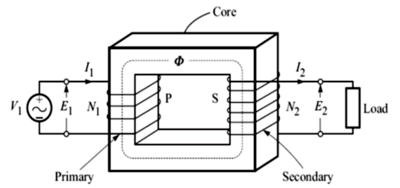
The diagram above refers to
Construction of transformer
Polarity of transformer
Schematic of transformer
Symbol of transformer
What type of transformer is used to increase the voltage from power stations.
Step-down transformer
Step-up transformer
Why transformers work with A.C. current but not D.C.
A.C current produces changing magnetic field.
D.C current produces changing magnetic field.
D.C current is weak
A.C current is powerful
Which of the following does not change in a transformer?
Voltage
Current
Power
Frequency
What is the material used for construction of transformer core?
Aluminium
Copper
Silicon steel
Wood
Instrument transformers are used to ________________.
transform mechanical energy into electrical energy.
isolate or transform voltage or current levels.
transfer DC voltage from the primary winding to the secondary winding.
transfer DC current from the primary winding to the secondary winding.
Which of the following is an instrument transformers?
Potential transformers
Current transformers
All of the above
None of the above
What is a current transformer?
A transformer that is used with an A.C. ammeter
A transformer that is used with a D.C. ammeter
A transformer that is used with an A.C. voltmeter
A transformer that is used with a D.C. voltmeter
What is a potential/voltage transformer?
A transformer that is used with an D.C. ammeter
A transformer that is used with an D.C. voltmeter
A transformer that is used with an A.C. ammeter
A transformer that is used with an A.C. voltmeter
The primary winding of a C.T. has_________________.
no number of turns at all
a few number of turns
a large number of turns
The secondary winding of a C.T. has__________________. It is connected in _____________ to an ammeter.
no number of turns at all, series
a few number of turns, parelel
a large number of turns, series
The primary winding of a P.T. has ____________________.
no number of turns at all
a few number of turns
a large number of turns
The secondary winding of a P.T. has ____________________. A low range voltmeter is connected in _____________ with the secondary winding.
no number of turns at all, series
a few number of turns, parelel
a large number of turns, series
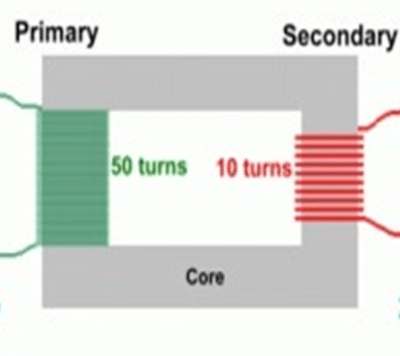
This picture is an example of a ________________.
Motor
Generator
Step-up transformer
Step-down transformer
Ratio of voltages is equal to ratio of _______________________.
number of iron sheets in core
number of coil
number of turns in coil
number of electromagnetic
A transformer has 100 turns in the primary coil and 25 turns in the secondary coil. When a 120 V is applied to the primary coil, what is the voltage in the secondary coil?
480V
30V
20V
450V
The potential transformers are used to measure large voltage using
High range voltmeter
Low range voltmeter
High range ammeter
Low range ammeter

