Wayground logo

Free Printable Worksheets

Font size

S
M
L
XL
Worksheets

Nuclear chemistry review

Total questions: 48

Worksheet time: 1hrs 5mins

Name
Class
Date
1.
What is the symbol for an alpha particle?
a)
42He
b)
0-1e
c)
0+1 e
d)
10n
2.
In the symbol 20682Pb what does 206 stand for?
a)
Mass number
b)
Atomic number
c)
Atomic mass
d)
Number of protons
3.
Balance the following equation:
146C --> 0-1e + ________
a)
145B
b)
146C
c)
147N
d)
42He
4.
Which type of radiation has the greatest penetrating power?
a)
Alpha
b)
Beta
c)
Gamma 
d)
Microwaves
5.

In the symbol 167N what the 7 stand for?

a)

Mass number

b)

Atomic number

c)

Atomic mass

d)

Number of neutrons

6.
In fission neutron is often used to start the reaction and it is also a product of the reaction. This is called a ____
a)
neutron emission
b)
nuclear fusion
c)
domino effect
d)
chain reaction
7.
Which of the following is a fusion reaction?
a)
hydrogen-2 and hydrogen-3 combining to form a helium-4 atom and a neutron
b)
Carbon-14 emitting an alpha particle
c)
uranium-235 absorbing a neutron and breaking into barium-141, krypton-92, and three neutrons
d)
uranium-238 emitting a beta particle
8.
If you start out with 100 grams of a radioisotope, how much remains after 2 half-lives?
a)
100 grams
b)
75 grams
c)
50 grams
d)
25 grams
9.
The least penetrating form of radiation is...
a)
alpha
b)
beta
c)
gamma
d)
neutron
10.
What is another name for an alpha particle?
a)
electron
b)
x-ray
c)
hydrogen nucleus
d)
helium nucleus
11.
A nuclear reaction where a nucleus splits into two smaller nuclei is... 
a)
Fission
b)
Fusion
c)
Gamma decay
d)
Beta decay
12.
What would two different isotopes of an atom have in common?
a)
Number of neutrons 
b)
Number of protons
c)
Atomic weight 
d)
Atomic mass
13.
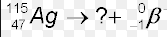
What element is the ?
a)
Ag-115
b)
Cd-115
c)
Pd-115
d)
Not Listed
14.
Two or more nuclei combine to form one larger nucleus in the process of nuclear _____.
a)
Fusion
b)
Fission
c)
Tracing
d)
Decay
15.
The time needed for half of a radioactive sample to decay is called its __________.
a)
decay period
b)
period
c)
transmutation time
d)
half-life
16.
How many neutrons does the isotope of lithium-8 have?
a)
8
b)
3
c)
4
d)
5
17.
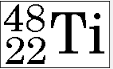
How many protons does this isotope of titanium have?
a)
48
b)
22
c)
26
d)
70
18.
How many neutrons does uranium-235 have?
a)
238
b)
92
c)
146
d)
143
19.
Atoms of the same element must always have the same number of _________
a)
electrons
b)
neutrons
c)
isotopes
d)
protons
20.
During beta decay, a nucleus
a)
gives up two protons and two neutrons
b)
maintains the same number of protons and neutrons
c)
loses a proton and gains a neutron
d)
gains a proton and loses a neutron
21.
Beta particles have a _____ charge
a)
+1
b)
0
c)
-1
d)
+2
22.
How much Iodine-125 will remain after 100 years if the original sample had a mass of 80 grams and the half-life of I-125 is 25 years?
a)
20 grams
b)
2.5 grams
c)
5 grams
d)
10 grams
23.
Which type of nuclear radiation is being emitted here?
a)
Alpha
b)
Beta
c)
Gamma 
d)
none
24.
Which type of nuclear radiation is being emitted here along with Rn
a)
alpha
b)
beta
c)
gamma
d)
none
25.
What does it mean when an element is radioactive?
a)
atom emits radiation
b)
nucei unstable due to uneven p to n ratio
c)
nuclei changes to become stable
d)
all of the above
26.

Subatomic particles with a negative charge

a)

Electrons

b)

Neutrons

c)

Protons

d)

Quarks

27.
subatomic particles found on the outermost shell & responsible for the atom's reactivity
a)
neutrons
b)
valence electrons
c)
isotopes
d)
ions
28.
Subatomic particles with a positive charge
a)
neutrons
b)
atomic mass
c)
protons
d)
isotopes
29.
Electrons are not factored into atomic mass because:
a)
They are so small their mass is negligible
b)
They're not in the nucleus
c)
They're too big
d)
They move so quickly their mass is zero
30.
True or False: The majority of an atom is made up of empty space
a)
True
b)
False
31.
The word "atom" comes from a Greek word that means
a)
Invisible
b)
Indivisible
c)
Undivided
32.
The atomic number for Oxygen is 8, so
a)
there are 8 protons in the atom
b)
the atomic mass is less than 8
c)
the mass of the atom is 8
d)
the atom is decaying
33.
What element is pictured?
a)
Hydorgen
b)
Boron
c)
Beryllium
d)
Arsenic
34.

What is an isotope?

a)

A charged atom

b)

Two atoms of the same element with different amounts of neutrons

c)

Two atoms of the same element with different amounts of protons

d)

A neutral atom

35.

Which two components of an atom contribute to the mass?

a)

Protons and neutrons

b)

Protons and electrons

c)

neutrons and electrons

36.

Which part of an atom is used to identify it?

a)

number of protons

b)

number of neutrons

c)

number of electrons

37.

How many protons are in the isotope pictured above?

a)

29

b)

34

c)

63

d)

92

38.

How many neutrons are in the isotope pictured above?

a)

29

b)

34

c)

63

d)

92

39.

What is the number of protons in phosphorus-31?

a)

15

b)

16

c)

31

d)

46

40.

An unknown element has two naturally occurring isotopes. One has a mass of 10.01 amu and % abundance of 19.8%. The other has a mass of 10.99 amu and % abundance of 80.2%. Calculate the atomic mass.

a)

1079.6

b)

107.95 amu

c)

21 amu

d)

10.8 amu

41.

What is the mass number of an element with 11 protons and 12 neutrons?

a)

1

b)

11

c)

12

d)

23

42.

Rubidium has two common isotopes, 85Rb and 87Rb. If the abundance of 85Rb is 72.2% and the abundance of 87Rb is 27.8%, what is the average atomic mass of rubidium?

a)

85.468 amu

b)

37 amu

c)

85.6 amu

d)

86.4 amu

43.
Atom 1 has Mass=12  Protons=6
Atom 2 has Mass= 14 Electrons=6
Are these atoms isotopes of each other or different elements?
a)
Different Elements - Mg & Si
b)
Different Elements - Ar & Ca
c)
Isotopes of Carbon
d)
Isotopes of Magnesium
44.

Elements in the same group or family have _____________.

a)

the same number of valence electrons and different properties.

b)

the same number of valence electrons and similar properties

c)

different number of valence electrons and similar properties.

d)

different number of valence electrons and different properties.

45.

What is the name of Group 1 elements?

a)

Alkali Metals

b)

Alkaline Earth Metals

c)

Transition Metals

d)

Halogens

46.

What is the name of the elements that are unreactive and have a full octet?

a)

Halogens

b)

Noble Gases

c)

Alkali Metals

d)

Transition Metals

47.

The Halogen group has an oxidation number of -1. Why?

a)

The Halogen group will gain one electron, therefore have an oxidation number of -1.

b)

The Halogen group will lose one electron, therefore have an oxidation number of -1.

c)

The Halogen group will lose seven electrons, therefore have an oxidation number of -1.

48.

Where are metalloids located on the Periodic Table?

a)

In the s block.

b)

In the f block.

c)

In the d block.

d)

The elements that touch the staircase except aluminum.