wayground logo

Free Printable Worksheets

NEW

Font size

S
M
L
XL
Worksheets

Study guide Universe-Force

Total questions: 50

Worksheet time: 2hrs 26mins

Name
Class
Date
1.

Which gravitational pull has the greatest effect on tides?

a)

Sun on Earth

b)

Moon on Earth

c)

Earth on Moon

d)

Sun on Moon

2.

Which of the following correctly describes how the moon affects tides on Earth?

a)

moon's gravity pulls on Earth

b)

moon's rotation creates centripetal force which pulls on Earth

c)

moon's gravity pushes on Earth

d)

moon's rotation creates centripetal force which pushes on Earth

3.
Describe the motion
a)
Slow to fast;   Negative direction
b)
Fast to slow;   Negative direction
c)
Fast to slow;   Positive direction
d)
Slow to fast;   Positive direction
4.
A push or a pull that can move an object is a __________.
a)
gear
b)
lever
c)
force
d)
machine
5.
If an object is stationary (not moving) the forces acting upon it are _____________
a)
unbalanced
b)
weak
c)
balanced
d)
Hulk Smash!
6.
Which of these photos shows a balanced force?
a)
The top Mystery Machine
b)
The middle Mystery Machine
c)
The bottom Mystery Machine
7.
When an object is acted on by unbalanced forces, the object will 
a)
continue in the same direction
b)
continue at the same speed
c)
accelerate in the direction of the unbalanced force
d)
will have no change in motion
8.
Balanced forces are
a)
equal in size and opposite in direction
b)
equal in direction and opposite in size
9.
The greater the mass of the object, the greater the ...
a)
Inertia
b)
Speed
c)
Distance
d)
None of these
10.
How long will it take a car that is moving at 60 miles per hour to travel 120 miles? (speed = distance ÷ time)  
a)
1 hour
b)
2 hours
c)
3 hours
d)
6 hours
11.
Which force attracts any two objects with mass towards each other?
a)
Gravity
b)
Friction
c)
Motion
12.
What is most likely to be found in a nebula?
a)
salt crystals
b)
planets
c)
gas clouds
d)
ateroids
13.
Our solar system began as a -
a)
nebula
b)
quasar
c)
prototype
d)
neutron star
14.
In relation to us, most galaxies are…
a)
Moving toward us
b)
Moving away from us
c)
Not moving
15.
The process that all stars perform is called?
a)
nuclear fission
b)
nuclear fusion
c)
mass expulsion
d)
star tectonic motion
16.
Our sun is currently in this star stage
a)
Protostar
b)
Nebula
c)
Main Sequence
d)
I have literally no idea
17.
This keeps objects in orbit
a)
gravity
b)
magnetism
c)
wavelengths
d)
Cosmic Microwave background Radiation
18.
The more mass an object has, the more gravity it has
a)
True
b)
False
19.
Is the speed constant or non-constant?
a)
constant
b)
non-constant
20.
What is the velocity?
a)
0 m/s
b)
positive m/s
c)
negative m/s
d)
decreasing
21.
Which graph shows the object standing still?
a)
A
b)
B
c)
C
d)
D
22.
Avery likes to walk 30 feet in 10 seconds. What is her speed?
a)
3 feet/sec
b)
6 feet/sec
c)
10 feet/sec
d)
2 feet/sec
23.
What is this graph showing?
a)
Constant Speed
b)
Acceleration (speeding up)
c)
Deceleration (slowing down)
d)
No motion
24.
According to this Hertzsprung-Russell Diagram which stars are brightest?
a)
Purple
b)
Red
c)
Blue
d)
Yellow
25.
The shape of our Milky Way galaxy can be classified as ____________.
a)
Spiral
b)
Elliptical
c)
Irregular
d)
French
26.
A ______ is when the side of the Moon facing Earth appears lite. 
a)
New Moon
b)
Crescent Moon
c)
Full Moon 
d)
Moon Phases
27.
A ________ is when a small section of the Moon facing Earth is lighted. 
a)
New Moon
b)
Crescent Moon
c)
Full Moon
d)
Moon Phases
28.
How long does it take for the Moon to make one full revolution around the Earth? 
a)
one day
b)
one month
c)
one year
d)
never
29.
If the last full moon was on April 4th, when can you expect to see the next full moon? 
a)
April 29th
b)
July 4th
c)
May 4th
d)
September 12th
30.
Which of the following choices has the moon phases in the correct order? 
a)
Full moon, new moon, waxing gibbous, first quarter, waxing crescent, waning gibbous, waning cresent, last quarter
b)
waxing gibbous, new moon, first quarter, waxing crescent, full moon, waning crescent, third/last quarter, waning gibbous
c)
New Moon, Waxing Crescent, First Quarter, Waxing Gibbous, Full Moon, Waning Gibbous, Third/last quarter, Waning Crescent
d)
New Moon, Waning Crescent, First Quarter, Waning Gibbous, Full Moon, Waxing Gibbous, Third/Last Quarter, Waxing Cresecent 
31.
Why does the Moon have phases? 
a)
The moon reflects light from the sun. Sometimes there is a shadow on the moon and we only see part of it. 
b)
Only part of the moon is turned on and shining at a time. 
c)
The Earth is blocking the moon when we don't see it. 
d)
The moon moves out of sight. 
32.
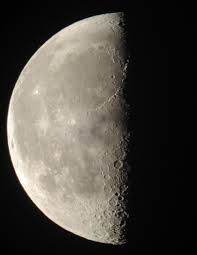
Name the moon phase
a)
First Quarter
b)
Last Quarter or (third quarter)
c)
New Moon
d)
Full Moon
33.
How much of the moon is always lit?
a)
can't tell
b)
always changes
c)
half
d)
3/4
34.
How many phases does the moon go through?
a)
4
b)
8
c)
10
d)
16
35.
As the moon's shape appears to get smaller, we say that the moon is _.
a)
swelling
b)
waxing
c)
waning
d)
disappearing
36.
Phases of the moon in which the moon appears to be getting larger are referred to as _.
a)
waxing
b)
waning
c)
new
d)
eclipse
37.

What is the correct order (starting from the surface) of Earth’s layers?

a)

crust, outer core, inner core, mantle

b)

mantle, outer core, inner core, crust

c)

crust, mantle, outer core, inner core

d)

outer core, inner core, crust, mantle

38.

In sea-floor spreading, molten material rises from the mantle and erupts

a)

along the edges of all the continents.

b)

along mid-ocean ridges.

c)

in deep-ocean trenches.

d)

at the north and south poles.

39.

The process by which the ocean floor sinks beneath a deep-ocean trench and back into the mantle is known as _______

a)

convection.

b)

continental drift.

c)

subduction.

d)

conduction.

40.

Most geologists think that the movement of Earth’s plates is caused by _______

a)

convection.

b)

continental drift.

c)

subduction.

d)

conduction.

41.

Scientists think that convection currents flow in Earth’s

a)

continents.

b)

mantle.

c)

lithosphere.

d)

inner core.

42.

The place where two plates come together is known as a _______

a)

transform boundary.

b)

divergent boundary.

c)

convergent boundary.

d)

rift valley.

43.

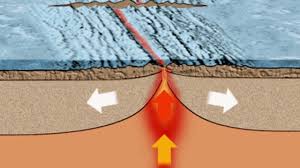
Below is a picture of sea-floor spreading. How are the ocean crusts moving?

a)

Converging

b)

Diverging

c)

Sliding

d)

No movement

44.
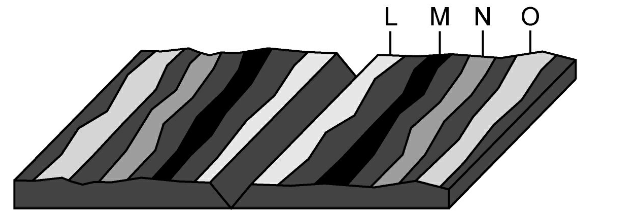
Where would the oldest rock be found?
a)
L
b)
M
c)
N
d)
O
45.

The San Andreas Fault in California is known as an active earthquake area. What type of

boundary is it?

a)

Converging

b)

Diverging

c)

Transform

d)

Sea Floor Spreading

46.
The Himalayas in Asia are an example of what type of plate boundary?
a)
divergent
b)
continent-to-continent convergent
c)
ocean-to-continent convergent
d)
transform
47.
What are Tectonic Plates?
a)
A continent 
b)
The Trees in Vietnam 
c)
ThE PlaTES That MoVE uNdERGRound :)
d)
The Plates that move the Continents
48.
What are the two types of crust?
a)
continental and oceanic
b)
ocean and basin
c)
lower and upper
d)
thick and thin
49.

Which situation below describes velocity?

a)

35 mph north

b)

60 seconds south

c)

100 mph

d)

Moving south west at 12:30pm

50.

The graph above shows the data collected by a student

as he watched a deer run around a field.


When was the deer running the fastest?

a)

Between times 8 and 10 seconds.

b)

Between times 0 and 5 seconds

c)

During times 5 to 8 seconds

d)

Between times 5 and 9 seconds