wayground logo

Free Printable Worksheets

Font size

S
M
L
XL
Worksheets

SECOND TERM FINAL WORKSHEET

Total questions: 53

Worksheet time: 51mins

Name
Class
Date
1.
If there are two forces going in the same direction how would you find the net force?
a)
Subtract
b)
Add
c)
Neither
d)
Multiply
2.
8 N to the left , and 4 N to the right. Find the net force. Is this balanced?
a)
12 N Right  No
b)
4 N Left  No
c)
12 N Right  Yes
d)
4 N Left  Yes
3.
According to Newton's second law, if you increase the force applied to an object :
a)
it accelerates more
b)
it doesn't move
c)
you get more inertia
d)
it decelerates
4.
A 20 kg bike accelerates at 10 m/s2.  What was the force?
a)
25 Newtons
b)
20 Newtons
c)
200 Newtons
d)
10 Newtons
5.

Some objects have more inertia than others. This is because the ______________ of an object affects the inertia of that object.

a)

Momentum

b)

Gravity

c)

Mass

d)

Weight

6.

Which of Newton's Laws states that an object's force depends on an object's mass?

a)

Newton's 1st Law of Motion

b)

Newton's 2st Law of Motion

c)

Newton's 3st Law of Motion

7.

The amount of matter in an object

a)

gravity

b)

mass

c)

net force

d)

inertia

8.
What is the SI unit used to measure force? 
a)
pounds 
b)
grams 
c)
newtons 
d)
friction
9.
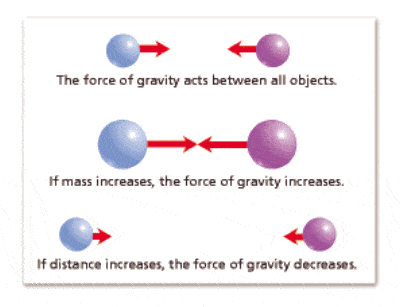
Gravity attracts all objects towards one another.
a)
False
b)
True
c)
It depends
10.
The amount of matter in an object is 
a)
pressure
b)
weight
c)
mass
d)
force
11.
As mass increases, what happens to gravitational force?
a)
increases
b)
decreases
c)
stays the same
d)
i don't know
12.
The force of gravity acting on an object is the object's ______.
a)
mass
b)
matter
c)
weight 
d)
friction 
13.
What elements generally make an ionic bond?
a)
metal and nonmetal
b)
2 nonmetals
c)
metal
d)
none of the above
14.
What elements generally make a covalent bond?
a)
metal and nonmetal
b)
2 nonmetals
c)
metal
d)
none of the above
15.
If an oxygen atom has 8 protons (+) and 10 electrons (-), what is it's charge?
a)
O10-
b)
O8+
c)
O2-
d)
O10+
16.
High Melting & Boiling Points
a)
Ionic
b)
Covalent
17.
A bond that forms when electrons are transferred is called a/an
a)
ionic bond
b)
covalent bond
c)
hydrogen bond
18.
Covalent compounds
a)
Share electrons
b)
transfer electrons
c)
contain a sea of electrons
d)
conduct electricity
19.

Valence electrons are

a)

neutral (no charge)

b)

found in the outer most energy level of the atom

c)

equal to the number of protons

20.

How many different elements are in the C6H12O6

a)

3

b)

6

c)

12

d)

24

21.

How many valence electrons does Oxygen have?

a)

0

b)

16

c)

6

d)

8

22.

How many total atoms are in C6H1206

a)

3

b)

6

c)

12

d)

24

23.

2. Ionic Bonding involves:

a)

The transfer of protons

b)

The transfer of neutrons

c)

The transfer of electrons

d)

None Of the above

24.

This is a correct dot diagram for nitrogen (N)

a)

true

b)

false

25.

A + B --> AB

a)

Synthesis

b)

Decomposition

c)

Single Replacement

d)

Double Replacement

26.

AB --> A + B

a)

Synthesis

b)

Decomposition

c)

Single Replacement

d)

Double Replacement

27.

A + BC --> B + AC

a)

Synthesis

b)

Decomposition

c)

Single Replacement

d)

Double Replacement

28.

AB + CD --> CB + AD

a)

Synthesis

b)

Decomposition

c)

Single Replacement

d)

Double Replacement

29.

C + H2 --> CH4

a)

Synthesis

b)

Decomposition

c)

Single Replacement

d)

Double Replacement

30.

HCl + NaOH --> NaCl + H2O

a)

Synthesis

b)

Decomposition

c)

Single Replacement

d)

Double Replacement

31.
How many atoms of carbon (C) are in C6H12O6?
a)
3
b)
6
c)
12
d)
24
32.
Element or compound?
H2O
a)
element
b)
compound
33.
Which is the correct formula for:
 three hydrogen (H)
one sulfur (S)
four oxygen (O)
a)
H3SO4
b)
HSO4
c)
H4S3O
d)
H2O
34.
The red numbers in the image below represent ________
a)
subscripts
b)
coefficients
c)
I don't know, and don't want to try
d)
None of the answers are correct
35.
The blue numbers in the image below represent ________
a)
I don't know, and don't want to try
b)
coefficients
c)
subscripts
d)
none of the answers are correct
36.
How many atoms are there TOTAL in:
H2SO4
a)
6
b)
5
c)
7
d)
3
37.
How many Sodium (Na) are in 6NaCl?
a)
1
b)
12
c)
6
38.

The covalent compound N2O5 would be named... (SPELLING MATTERS)

(a)  

39.

The chemical formula of dinitrogen textroxide is

(a)  

40.

Write the formula: nitrogen trichloride

(a)  

41.

This is when heat is absorbed, it is an

a)

Exothermic reaction

b)

endothermic reaction

c)

both

d)

none

42.

When heat is released it is an

a)

exothermic reaction

b)

endothermic reaction

c)

both

d)

none

43.

A + Heat -------> C + D

a)

Endothermic

b)

Exothermic

44.

A + B-------> C + Heat

a)

Endothermic

b)

Exothermic

45.

What do all waves transfer?

a)

Matter

b)

Heat

c)

Electricity

d)

Energy

46.

What are the two types of waves?

a)

longitudinal and transverse

b)

sound and light

47.

Which 2 types of waves require a medium to travel?

a)

Electromagnetic

b)

Mechanical

c)

Light

d)

Sound

48.

Which of the following is a mechanical wave?

a)

X-ray

b)

Infrared

c)

Radio waves

d)

Sound

49.

The height of a wave from its resting point (B).

a)

Frequency

b)

Wave speed

c)

Wavelength

d)

Amplitude

50.

The length of a wave, from crest to crest or trough to trough. (D)

a)

Frequency

b)

Wave speed

c)

Wavelength

d)

Amplitude

51.

What is the correct formula for wave speed?

a)

Wave speed = frequency x wavelength

b)

Wave speed = amplitude x wavelength

c)

Wave speed = amplitude x period

d)

Wave speed = frequency x period

52.

The highest part of a transverse wave is

a)

the crest

b)

the trough

c)

the wave point

d)

the hotel transylvania

53.

The lowest part of a transverse wave are the

a)

crests

b)

troughs

c)

wave points

d)

low nodules