
 Worksheets
Evidence for Atomic Structure
Total questions: 15
Worksheet time: 8mins
Who is the philosopher that stated that there must be some indivisible unit and called it an atom?
Democritus
Aristotle
Dalton
Thomson

Atoms combining in whole number ratios was evidence that (select all that apply)
You cannot have a fraction of an atom and it still be the same element
Atoms are the smallest unique division of matter
There must be a a negative and positive particle within the atom
There must be a neutral particle within the atom
His experiments led to the idea of a negative subatomic particle
Bohr
Dalton
Thomson
Rutherford
Experiments with alpha particles and gold foil, led to the discovery of
negative electron
electron energy levels
neutral neutron
a positive nucleus

What accounts for the larger deflections shown in figure 2 as compared to figure 1?
The mass is greater in figure 1
The mass is greater in figure 2
The positive charge is greater in Figure 1
The positive charge is greater in figure 2

Why are the alpha particles passing straight through?
The electrons are too small to stop them.
There is no positive charge to deflect them.
The positive charge is too scattered to deflect them.
The blob looks like a meatball.

Who's model is this?
Millikan
Rutherford
Thomson
Dalton
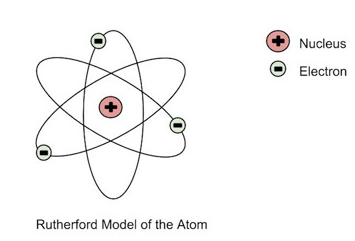


1-JJ Thomson
2-Erwin Schrodinger
3-John Dalton
4-Niels Bohr
5-Ernest Rutherford
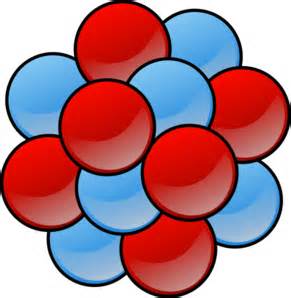
Where are the protons located?
outside the nucleus
inside the nucleus
in the orbitals
within energy levels
Where are the electrons located?
outside the nucleus
inside the nucleus
in the middle of the atom
in areas that contribute to the atom's mass

Which of the following is the BEST statement for proving the positive nature of the nucleus?
the negative electrons are attracted to the positive nucleus
the positive alpha particles get deflected when they come near the nucleus
the greater the thickness of the gold foil, the more the particles bounce back
none of these answers are convincing pieces of evidence
Which of the following is NOT true?
The electron has a negative charge
The proton has a positive charge
Alpha particles have a positive charge
The neutron has a negative charge

