
 Worksheets
Earth's Place in the Universe
Total questions: 25
Worksheet time: 19mins
Name
Class
Date
1.
What is gravity?
a)
a force between objects that pushes them apart
b)
a force between any two objects that pulls them together
c)
a force that causes objects to remain at rest
d)
potato salad
2.
Gravity is responsible for the . . .
a)
sun rotating around the planets
b)
sun revolving around the planets
c)
planets revolving around the sun
d)
planets rotating of a planet around the sun
3.
The ___________ the planet is from the sun, the ____________ it takes to go around the sun.
a)
closer, shorter
b)
farther, shorter
c)
farther, longer
d)
closer, longer
4.
List the order of the planets, starting form the sun.
a)
Mercury, Venus, Earth, Mars, Jupiter, Saturn, Uranus, Neptune
b)
Mercury, Venus, Earth, Mars, Saturn, Jupiter, Neptune, Uranus
c)
Neptune, Uranus, Saturn, Jupiter, Mars, Earth, Venus, Mercury
d)
Mars, Earth, Venus, Mercury, Jupiter, Saturn, Uranus, Neptune
5.
How does the mass of an object effect the gravitational attraction of an object?
a)
The smaller the mass of the object the greater the gravitational force.
b)
The mass of the object has no effect on the gravitational force
c)
The greater the mass of the object the less the gravitational force.
d)
The greater the mass of the object the greater the gravitational force.
6.
Why do the planets continue to orbit the sun and not travel in a straight line?
a)
The gravitational force of the planets is greater than the sun's.
b)
A magnetic field that surrounds the sun.
c)
The sun's gravitational attraction on the planet.
d)
cheesy potato casserole
7.
Which planet has the longest orbit around the sun? How do you know?
a)
Neptune - because it is the farthest from the sun.
b)
Saturn - because it takes longer to travel with rings
c)
Jupiter - because it has the most mass of all the planets
d)
Mars - it just moves really slow
8.
If you used a golf ball, baseball and a basketball to represent the Earth, Mercury and the Sun. Which ball would represent each planet?
a)
Mercury = basketball, Earth = golfball, Sun = baseball
b)
Mercury = golfball, Earth = basketball, Sun = baseball
c)
Mercury = baseball, Earth = basketball, Sun = golfball
d)
Mercury = golfball, Earth = baseball, Sun = basketball
9.
What is the largest body in our solar system?
a)
Jupiter
b)
Earth
c)
Saturn
d)
Sun
10.

Which response is the BEST answer for:
If gravity was not present, which direction would the Earth move?
If gravity was not present, which direction would the Earth move?
a)
Earth would keep revolving around the sun as normal.
b)
Earth would start to orbit around the moon.
c)
Earth would continue moving in a straight line along the path of it's velocity.
d)
Earth would stop rotating, and crash into the sun.
11.

Earth rotates on its axis every...
a)
24 hrs
b)
once per month
c)
Once per year
12.

What moon phase is this picture?
a)
This is the full moon phase.
b)
This is the waxing gibbous moon phase.
c)
This is the waning gibbous moon phase.
d)
This is the first quarter moon phase.
13.

What is this moon phase?
a)
This is the waxing gibbous moon phase.
b)
This is the last quarter moon phase.
c)
This is the first quarter moon phase.
d)
This is the new moon phase.
14.

What moon phase is this picture?
a)
This is the new moon phase.
b)
This is the waxing crescent moon phase.
c)
This is the waxing gibbous moon phase.
d)
This is the waning crescent moon phase.
15.

What moon phase is this image?
a)
This is the full moon phase.
b)
This is the last quarter moon phase.
c)
This is the waxing gibbous moon.
d)
This is the new moon phase.
16.
How many phases does the moon go through?
a)
4
b)
8
c)
10
d)
16
17.
As the moon's shape appears to get smaller, we say that the moon is _.
a)
swelling
b)
waxing
c)
waning
d)
disappearing
18.
Phases of the moon in which the moon appears to be getting larger are referred to as _.
a)
waxing
b)
waning
c)
new
d)
eclipse
19.
The cycle of the moon lasts about a _.
a)
day
b)
year
c)
week
d)
month
20.
Which planet in our solar system is closest to the Sun?
a)
Earth
b)
Jupiter
c)
Mercury
d)
Saturn
21.
Which definition accurately describes the Astronomical Unit (AU)?
a)
The average distance between the planets.
b)
The average distance between Earth and Mars.
c)
The average distance between the Earth and the Sun.
d)
The average size of the Earth compared to the Sun.
22.
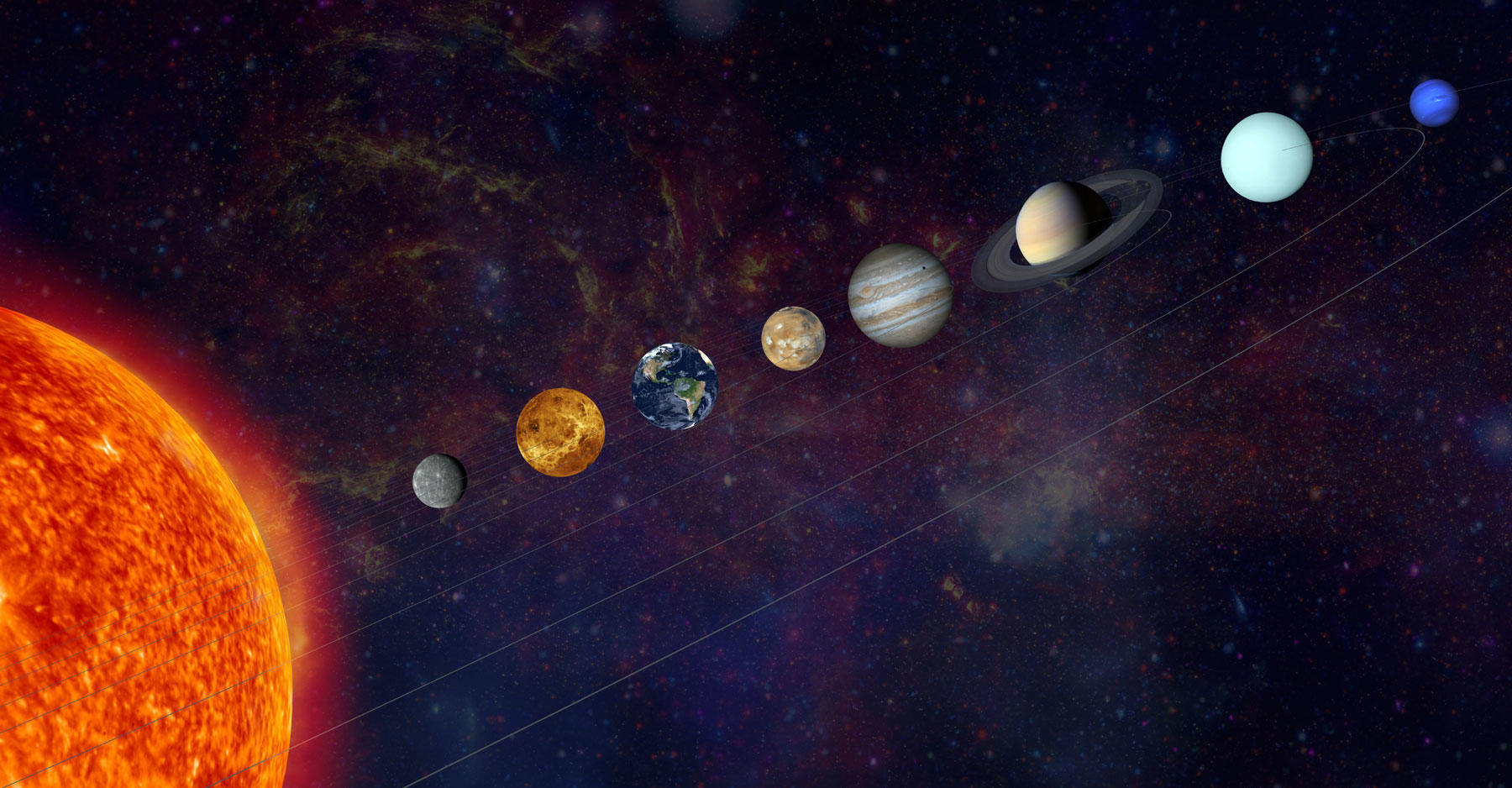
True or False
The planets are all equally distanced from each other.
The planets are all equally distanced from each other.
a)
True
b)
False
23.
Earth's nearest neighboring planets are _____.
a)
Venus and Mars
b)
Mars and Jupiter
c)
Mercury and Venus
d)
Mercury and Jupiter
24.
What is the name of Earth's galaxy?
a)
Starburst
b)
Kepler
c)
Milky Way
d)
Andromeda
25.
What force works opposite to gravity to help hold the planets in their orbits around the Sun?
a)
gravity
b)
speed
c)
inertia
d)
air currents
100 %

