wayground logo

Free Printable Worksheets

NEW

Font size

S
M
L
XL
Worksheets

Weathering, Erosion and Soil

Total questions: 42

Worksheet time: 25mins

Name
Class
Date
1.
The growth of plant roots and animal activity may result in ________________.
a)
erosion
b)
mechanical weathering
c)
chemical weathering
d)
abrasion
2.
The definition of weathering is _______________________.
a)
the carrying away of rock
b)
the leaching of rock
c)
the breaking down of rock
d)
the permeability of rock
3.
The agent of mechanical weathering in which rock is worn away by the grinding action of other rock particles is called _______________.
a)
plant growth
b)
oxygen
c)
abrasion
d)
ice wedging
4.
The most important factors in determining the rate of weathering are _____________________.
a)
carbon dioxide and acid rain
b)
abrasion and acids from plant roots
c)
animal actions and oxygen
d)
rock type and climate
5.
What kind of weathering causes the mineral composition of rock to change?
a)
mechanical weathering
b)
permeable weathering
c)
chemical weathering
d)
general weathering
6.
Mechanical weathering is the removal of rock particles by gravity, wind, water, and ice.
a)
true
b)
false
7.
Which of the following is a type of mechanical weathering?
a)
abrasion
b)
plant growth
c)
freezing and thawing
d)
all of the above
8.
In the fall, Winston noticed a small crack on a boulder where he played in his backyard. The following spring, he saw that the small crack was much larger than he remembered. What most likely caused the change?
a)
gravity had caused the rock to shift
b)
acid rain had caused the crack to erode
c)
winds had caused the rock to break down
d)
water had frozen and thawed inside the rocks
9.
What is the relationship between wind erosion and plant cover?
a)
More plants means less erosion
b)
More plants means more erosion
c)
There is no relationship
d)
Less plant cover means less erosion
10.
When plants, animals, and other organisms die, they break down and become part of the soil. What is this part of the soil called?
a)
sand
b)
silt
c)
clay
d)
humus
11.
Rock samples brought back from the moon show absolutely no evidence of weathering. This is MOST LIKELY due to ______________________________.  
a)
the lack of atmosphere on the moon
b)
extremely low surface temperatures on the moon
c)
lack of biological activity on the moon
d)
lack of running water on the surface of the moon
12.
What force causes all types of mass movement?
a)
convection
b)
temperature
c)
gravity
d)
compaction
13.
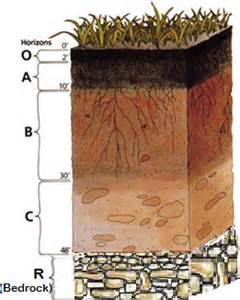
Which layer of soil has more dead things in it?
a)
Top Soil
b)
Sub soil
c)
Parent materials
d)
Bed rock
14.
What layer has lots of rocks?
a)
Top soil
b)
sub soil
c)
Parent materials
d)
Bed rock
15.
Layers of soil are also known as:
a)
Soil Profiles
b)
Soil Horizons
c)
Soil sheets
d)
Soil cores
16.
In which horizon would you find weathered rock?
a)
topsoil
b)
subsoil
c)
bedrock
d)
humus
17.
If wind, water, or ice move sediment from one place to another, it is called...
a)
erosion.
b)
weathering.
c)
a sinkhole.
18.
Which of the following can cause weathering?
a)
fertilizing the land
b)
minerals and humus
c)
water, wind, plants, and animals
19.
Which horizon of soil is closest to the surface?
a)
bedrock
b)
topsoil
c)
subsoil
20.

Which layer of soil has the most humus?

a)

A horizon

b)

Bedrock

c)

Subsoil

d)

Regolith

21.

Which layer in a soil profile would be most affected by weathering & erosion

a)

C horizon

b)

B horizon

c)

R horizon

d)

A horizon

22.

The 4 agents of erosion are________

a)

air, fire, water, & metamorphism

b)

wind, water, gravity, & ice

c)

topographic, sedimentary, igneous, & deposition

d)

igneous, sedimentary, metamorphic, & gravity

23.

The 2 types of weathering are _________

a)

alpha & beta

b)

physical & conventional

c)

conduction & convection

d)

chemical & physical

24.

The Valley & Ridge province of VA has karst geologic features. Which best describes karst features?

a)

Physical weathering of igneous rocks

b)

Chemical weathering of metamorphic rocks

c)

Physical weathering of foliated gneiss rock layers

d)

Chemical weathering of limestone rock layers

25.
A cliff formed near the ocean.  Which statement best describes how this cliff formed?
a)
Warm air melted the rock.
b)
Sun rays evaporated the rock.
c)
Ocean waves washed away rock.
d)
Plant roots pushed away the rock.
26.
How might a weathered mountain appear different than an unweathered mountain?
a)
Weathered mountain would be taller.
b)
Weathered mountain would be rounder and less jagged.
c)
Weathered mountain would be more jagged and less rounded.
d)
Weathered mountain would have no trees.
27.
Which type of climate will have faster chemical weathering?
a)
Hot and Wet
b)
Cold and Dry
c)
Hot and Cold
d)
Cold and Wet
28.
The diagrams shows a rock with water trapped in the cracks during the day and at night. 

Which statement best explains why this process results in weathering?
a)
frozen water acts as a solute
b)
water expands when it freezes
c)
the mass of water increases when it freezes
d)
frozen water dissolves most types of rock
29.
What happens when weathering and erosion work together?
a)
New Mountains are created
b)
The climate changes overnight
c)
Metal objects become rusty
d)
They change the Earth's surface
30.

How do plants weather rocks?

a)

water in the roots causes freezing and thawing

b)

when roots grow into cracks of rocks and expand the rock

c)

when plants are blown by wind they break the rock

d)

Plants don't weather rocks

31.
What is the major cause of weathering and erosion?
a)
wind
b)
ice
c)
glaciers
d)
moving water
32.

As water in a river system or in the ocean slows down, it deposits some of its ____.

a)

rapids

b)

meanders

c)

fish

d)

sediments

33.

Soil formation begins with the weathering of_______.

a)

Humus

b)

Subsoil

c)

Topsoil

d)

Parent Rock

34.
In which horizon is most of the HUMUS?
a)
Horizon A
b)
Horizon B
c)
Horizon C
d)
Horizon D or R
35.
Soil can be lost to erosion by 
a)
only water
b)
only wind
c)
by both water and wind
36.
Erosion in which water running down the side of a slope carves a small stream channel. 
a)
Chemical weathering
b)
Rill erosion
c)
Residual soil
d)
Deposition
37.
Erosion that occurs when a rill channel widens and deepens. 
a)
Gully erosion
b)
Exfoliation
c)
Mechanical weathering
d)
Transported soil
38.
Soil that develops from parent material which is similar to local bedrock.
a)
Residual soil
b)
Soil profile
c)
Erosion
d)
Weathering
39.
Soil that has been moved away from its parent material by wind, water, gravity, or glacier. 
a)
Soil horizon
b)
Transported soil
c)
Exfoliation
d)
Deposition
40.

The weathering of rock caused by ice freezing in the rocks cracks

a)

gravity

b)

frost wedging

c)

abrasion

d)

tree root wedging

41.
the process by which layers or sheets of rock gradually break off
a)
exfoliation
b)
abrasion
c)
erosion
d)
deposition
42.

An example of chemical weathering is -

a)

Ice wedging

b)

Oxidation

c)

Animals burrowing

d)

Crashing waves