Wayground logo

Free Printable Worksheets

Font size

S
M
L
XL
Worksheets

Chemical Bonds

Total questions: 40

Worksheet time: 1hrs 22mins

Name
Class
Date
1.
Ionic bonds are between...
a)
nonmetals and nonmetals
b)
carbon and oxygen
c)
metals and nonmentals
d)
hydrogen and chlorine
2.
Covalent bonds are between...
a)
two or more nonmetals
b)
sodium and chlorine
c)
metals and metals
d)
metals and nonmetals
3.
What is the name for an ion with a positive charge?
a)
cation
b)
anion
c)
onion
d)
union
4.
What kind of bond forms when atoms share electrons?
a)
ionic
b)
covalent
c)
artificial
d)
univalent
5.
What kind of bond forms when atoms exchange electrons?
a)
ionic
b)
covalent
c)
artificial
d)
univalent
6.
What are valence electrons?
a)
sum of the protons and neutrons
b)
protons minus electrons
c)
electrons in the inner shells
d)
electrons in the outer shell
7.
If an atom loses two electrons what charge will it have?
a)
-2
b)
-1
c)
+1
d)
+2
8.
If an atom gains two electrons what charge will it have?
a)
-2
b)
-1
c)
+1
d)
+2
9.
How many valence electrons does oxygen have?
a)
2
b)
4
c)
5
d)
6
10.
An electron has what kind of charge?
a)
positive
b)
negative
c)
neutral
d)
none of these
11.
A _______ is a charged particle because it has more or fewer electrons than protons.  When an atom _____ an electron, it becomes a positively charged ion.  When an atom ____an electron, it becomes a negatively charged ion.
a)
isotope, gains, loses
b)
isotope, loses, gains
c)
ion, loses, gains
d)
ion, gains, loses
12.
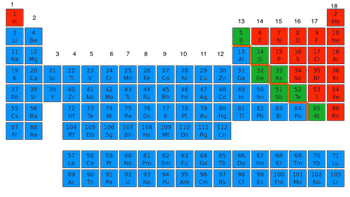
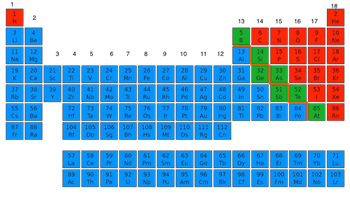
Group numbers on the periodic table help us determine 
a)
The number of valence electrons
b)
Color of the elements
13.
Where are metals located on the periodic table?
a)
Blue
b)
Green
c)
Red
14.
Where are the nonmetals located on the periodic table? 
a)
Blue
b)
Red
c)
Green
15.

All but Hydrogen and Helium want how many valence electrons?

a)

1

b)

2

c)

8

d)

0

16.

Why do atoms bond?

a)

to find a date

b)

to become bigger

c)

to go to dog jam

d)

to become stable

17.
What is the proper name for CaCl2?
a)
Calcium dichloride
b)
Monocalcium dichloride
c)
Calcium chloride
d)
Calcium chlorine
18.

What is the correct name for Mg(OH)2?

(OH) is the polyatomic ion "hydroxide"

a)

Magnesium dihydroxide

b)

Magnesium Oxyhydride

c)

Magnesium Oxygen dihydride

d)

Magnesium hydroxide

19.
Predict the bond that will form between Be and F.
a)
Ionic
b)
Covalent
20.
Predict the bond that will form between Se and Cl.
a)
Ionic
b)
Covalent
21.

What type of diagram is this?

a)

Electron Dot / Lewis Dot Diagram

b)

Bohr Model

c)

Alkali Diagram

d)

Chemical Diagram

22.
How many valence electrons in this structure?
a)
6
b)
5
c)
4
d)
7
23.

For metals (groups 1-3), its easier to _____ electrons to have a full outer shell.

a)

gain

b)

lose

c)

share

24.

All binary compounds end with_____.

a)

-ous

b)

-ate

c)

-ide

d)

-ite

25.

What is the correct chemical formula for magnesium iodide?

a)

MgI2

b)

Mg2I

c)

MgI

d)

Mg2I2

26.

What is the correct formula of the potassium oxide?

a)

KO

b)

K2O

c)

KO2

d)

K2O2

27.
What molecule is this?
a)
CO
b)
CO2
c)
C2O
d)
C2O2
28.
How many electrons should Nitrogen have around its Lewis dot model?
a)
1
b)
3
c)
4
d)
5
29.
What is the formula of Sodium oxide?
a)
Na2O
b)
NaO2
c)
Na2O2
d)
Na2O
30.
What kind of chemical bond forms between a metal and a nonmetal?
a)
ionic
b)
covalent
c)
fake
d)
metallic
31.
What is the proper name for S2O2?
a)
Sulfur oxide
b)
Sulfur dioxide
c)
sulfur (II) oxide
d)
disulfur dioxide
32.
Which of the following is a compound?
a)
Silver
b)
Oxygen
c)
Argon
d)
Carbon Dioxide
33.
Why do the noble gases not react with other elements?
a)
They don't want to
b)
They need many electrons
c)
They have 8 valence electrons
d)
Their protons and electrons are balanced
34.
The octet rules states that the atom is most stable when its valence electrons number is equal to
a)
32
b)
18
c)
12
d)
8
35.

Which of the following does not apply to an oxidation number of 2-

a)

2 electrons were affected

b)

electrons were gain

c)

electrons were lost

36.

Give the proper name for this compound: Ru2S

a)

Rubidium sulfate

b)

Rubidium sulfite

c)

Rubidium (II) sulfide

d)

Rubidium sulfide

37.

Give the proper name for this compound: P2O5

a)

phosphorus oxide

b)

phosphorus (II) oxide

c)

diphosphorus pentoxide

d)

phosphorus pentoxide

38.
Which of the following has a full valence shell?
a)
Oxygen
b)
Neon
c)
Barium
d)
Carbon
39.
What is the ionic compound formed between K and F?
a)
KF
b)
K2F
c)
KF2
d)
K2F2
40.

Which of the following describes covalent bonds?

a)

Bonds form because of opposite charges

b)

electrons are shared to fill outer electron shells

c)

Electrons are transferred between atoms

d)

Covalent bonds are magical