
 Worksheets
US1.6: American Revolution
Total questions: 46
Worksheet time: 46mins
Name
Class
Date
1.
What colony did not send delegates to the First Continental Congress?
a)
South Carolina
b)
Georgia
c)
New York
d)
Massachusetts
2.
Who was the British king during the Revolutionary War?
a)
Henry VIII
b)
James I
c)
Charles IV
d)
George III
3.
Great Britain eventually recognized American independence by signing the –
a)
Stamp Act
b)
Declaration of Independence
c)
Treaty of Paris
d)
Proclamation of 1763
4.
When British soldiers fired upon the crowd during a protest, some protestors were killed. This was called -
a)
The Boston Tea Party
b)
The Boston Massacre
c)
The Surrender at Yorktown
d)
The Colonial Terror
5.
Who was the Commander of the Continental Army during the American Revolution?
a)
George Washington
b)
Lord Cornwallis
c)
Patrick Henry
d)
Sam Adams
6.
What happened at Yorktown, VA?
a)
The British won the Revolutionary War
b)
Boston Tea Party
c)
That marked the end of the Revolutionary War
d)
the signing of the Declaration of Independence
7.
Colonists opposed taxes from Great Britain because the –
a)
colonies had no representation in Parliament
b)
taxes were not high enough
c)
British people had no representation in Parliament
d)
colonists wanted American Indians 16 17 and French to pay all the taxes
8.
What European country sent troops to help the Americans fight the British?
a)
Denmark
b)
Italy
c)
France
d)
Switzerland
9.
Paul Revere became famous as a patriot who –
a)
gained Spain’s support for American independence
b)
was a member of the Continental Congress
c)
saved the lives of many patriots as a battlefield doctor
d)
made a daring ride to warn colonists of the British arrival in Lexington
10.
What outspoken member of the House of Burgesses said, "Give me liberty or give me death" ?
a)
Patrick Henry
b)
Thomas Jefferson
c)
John Adams
d)
Benjamin Franklin
11.
People have certain ______ rights to life, liberty and the pursuit of happiness.
a)
alienable
b)
alien
c)
unalienable
d)
unalienability
12.
Government derives its power from the ___________.
a)
petunias
b)
people
c)
Parliament
d)
elite citizens
13.
"Unalienable rights" means...
a)
no aliens allowed
b)
rights that cannot be taken way
c)
rights that are flexible
d)
rights that are temporary
14.
Was this a colonial advantage (one reason why the colonies defeated Great Britain): Some colonists' defending their own land, principles, and beliefs.
a)
Yes, it was an advantage.
b)
No, it was not an advantage.
15.
Was this a colonial advantage (one reason why the colonies defeated Great Britain): The colonies received additional support from Germany.
a)
Yes, this was an advantage.
b)
No, this was not an advantage.
16.
Was this a colonial advantage (one reason why the colonies defeated Great Britain): The colonies had strong leadership.
a)
Yes, this was an advantage.
b)
No, this was not an advantage.
17.
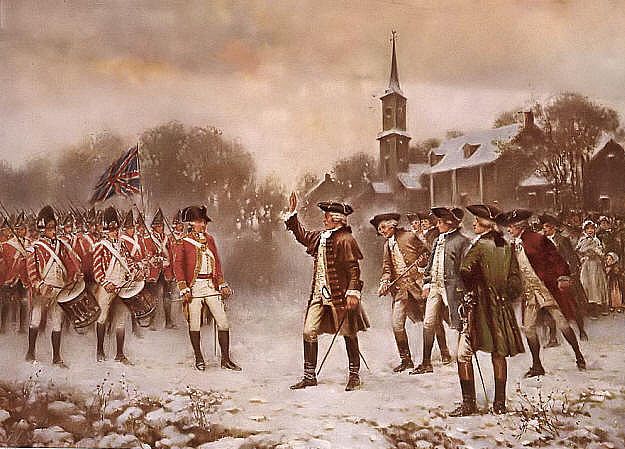
What is another name for British soldiers?
a)
Redcoats
b)
Patriots
c)
Minutemen
d)
Continental Soldiers
18.

What did we call colonists who did NOT want independence from England?
a)
Minutemen
b)
Traitors
c)
Militia
d)
Loyalists
19.

"No ________ without representation"
a)
voting
b)
taxation
c)
rights
d)
liberty poles
20.

What was the purpose of the Boston Tea Party?
a)
to punish merchants for selling imported tea.
b)
to see who could throw a barrel further.
c)
to frame the Native Americans.
d)
to protest taxes
21.

Who were the Minutemen?
a)
Patriots who were ready to fight at a minutes notice
b)
British soldiers who were ready to fight at a minutes notice
c)
Sons of Liberty who were ready to fight at a minutes notice
d)
Hessians who were ready to fight at a minutes notice
22.
Which side had more resources and training at the beginning of the war?
a)
British
b)
Colonists
23.
Who won the American Revolution?
a)
The British
b)
The American Colonists
24.

This American victory was the turning point in the American Revolutionary war and encouraged the French to join forces with them (the Americans).
(Turning point is a big change in a situation)
(Turning point is a big change in a situation)
a)
Saratoga
b)
Yorktown
c)
Bunker Hill
d)
Lexington and Concord
25.

This patriot made a daring ride through Lexington, Massachusetts to warn colonists, militia, and Minutemen that British soldiers were approaching by sea.
a)
Patrick Henry
b)
Paul Revere
c)
Phillis Wheatley
d)
Samuel Adams
26.

Where were the first armed conflicts of the American Revolution?
a)
Yorktown
b)
Saratoga
c)
Lexington and Concord
d)
Bunker Hill
27.

Surrounded by French and Continental(Armies) armies, a large British army led by General Cornwallis surrendered here.
a)
Saratoga
b)
Yorktown
c)
Bunker Hill
d)
Lexington and Concord
28.
This was a tax on molasses and sugar to reduce smuggling.
a)
Stamp Act
b)
Sugar Act
c)
Townshend Act
d)
Tea Act
29.
This was a tax on all printed materials in the 13 Colonies.
a)
Stamp Act
b)
Sugar Act
c)
Tea Act
d)
Townshend Act
30.
Finish this American Colonist Motto, "No Taxation without..."
a)
Transportation
b)
Relaxation
c)
Representation
d)
Sensation
31.
Why were the American Colonist taxed after the French and Indian War?
a)
Britain was in debt and needed money
b)
That was the agreement with the Native Americans
c)
They made too much money
d)
Townshend Acts
32.

What was this poster's meaning?
a)
The Colonies needed to be united
b)
Serpents can grow back together
c)
Colonies need to be independent
d)
Ben Franklin didn't know why he made this
33.
How did the colonist protest against the tea tax?
a)
Dressed up like Native Americans
b)
Boston Massacre
c)
Dumped tea into Boston harbor
d)
Didn't pay the tax on the East India Tea
34.
Which was the punishment for the Boston Tea Party?
a)
Intolerable Acts
b)
Sugar Acts
c)
Quartering Acts
d)
Stamp Acts
35.
Who was the first choice to command the Continental Army?
a)
Thomas Jefferson
b)
Benjamin Franklin
c)
Thomas Paine
d)
George Washington
36.
Pamphlet that sparked the independent spirit within the colonies during the revolution.
a)
Common Sense
b)
Catching Fire
c)
Declaration of Independence
d)
Mayflower Compact
37.
Declaration of Independence was created July 4th of what year?
a)
1607
b)
1773
c)
1781
d)
1776
38.
Colonists were forbidden to settle west of the Appalachian Mountains.
a)
Proclamation line of 1763
b)
Proclamation boundary
c)
Manifest Destiny
d)
Borderlands
39.
Life, Liberty and the pursuit of happiness were...
a)
Unalienable rights
b)
Bill of Rights
c)
Freedom to live
d)
Will Smith movie
40.
"Give me Liberty or Give me Death" meant
a)
I live to die
b)
I want freedom from slavery
c)
I will die for my freedom
d)
death is the only freedom
41.
Whose writings inspired Thomas Jefferson with the Declaration of Independence?
a)
Thomas Paine
b)
Benjamin Franklin
c)
John Locke
d)
George Washington
42.
Why did France decide to help?
a)
the colonists helped during the French and Indian War
b)
They were also under control of the British
c)
France considered England an enemy, too
43.
How did France help win the war?
a)
Send ships, supplies, and soldiers
b)
Send food
c)
They didn't help
44.

The Battle of Saratoga was a turning point in the war because it
a)
brought France into the war as an American ally.
b)
ended General Burgoyne's career.
c)
liberated Georgia from British control.
d)
forced the British to leave Canada.
45.

In the Treaty of Paris, the Americans won their independence and
a)
the right to strip Loyalists of their property.
b)
a pledge that future conflicts with Britain would be settled peacefully.
c)
the return of all taxes collected by Britain before the war.
d)
all the territory lying to the east of the Mississippi River.
46.

In which state did the Battle of Yorktown take place?
a)
New York
b)
Georgia
c)
New Jersey
d)
Virginia.
100 %

