
 Worksheets
Proteins VCE
Total questions: 33
Worksheet time: 55mins


An Alpha Helix, is an example of a _____________ structure.
Quaternary
Secondary
Tertiary
Primary
Quinary
It is necessary to consume __________ amino acids, while ___________ amino acids are produced by the body.
not-important, very important
tertiary, quaternary
synthetic, natural
non-essential, essential
essential, non-essential
Pepsin is an endopeptidase that breaks down proteins into smaller peptides. It is produced in the stomach and is one of the main digestive enzymes in the digestive systems of humans and many other animals, where it helps digest the proteins in food.
What is meant by 'denaturation"?
Formation of a secondary structure by hydrogen bonding between partially positive -NH2 groups and partially negative -C=O groups
Binding of an enzyme to its complementary substrate
Refers to when an enzyme has undergone a change in its 3D shape so it is unable to bind to act as a catalyst or bind to a substrate.
Refers to the dipolar nature of the N-terminal and the C-terminal
An enzyme-substrate complex
Which of the following will increase the rate of an enzyme catalyzed reaction?
Increasing concentration of substrate
Decreasing concentration of enzymes
Increasing pH
Decreasing temperature
Which of the following is not present in a tertiary structure?
Covalent bonding between C=O and NH
Ionic bonding between COO- and NH3+
Disulphide bridges
Amide groups
Polypeptides are formed by __________ reactions. Choose all that apply.
Esterification
Condensation
Substitution
Polymerisation
Combustion
The C-terminus is located towards the left end of a polypeptide chain.
True
False
Which of the following statements about enzymes is not true? (VCAA, 2009)
Enzymes can only be denatured by an increase in temperature.
Enzymes may form temporary ion-dipole bonds with substrate molecules.
Enzymes speed up reactions by holding substrate molecules in positions necessary for reaction.
The tertiary structure of an enzyme may be altered if one amino acid in its primary structure is substituted for another, different amino acid.

Which of the following describes the secondary structure of proteins?
The sequence of amino acids
The α-helix and β-pleated sheet folding
The folding of the polypeptide chain due to the 'R' groups
The joining of different protein molecules to make one big molecule
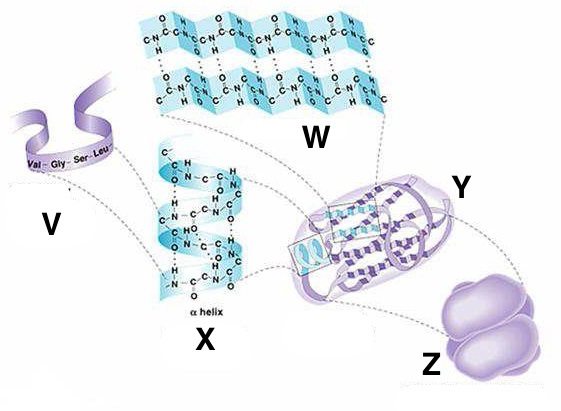
What is one of the functions of a protein?
cell energy
enzymes
long term energy storage
contain genetic information
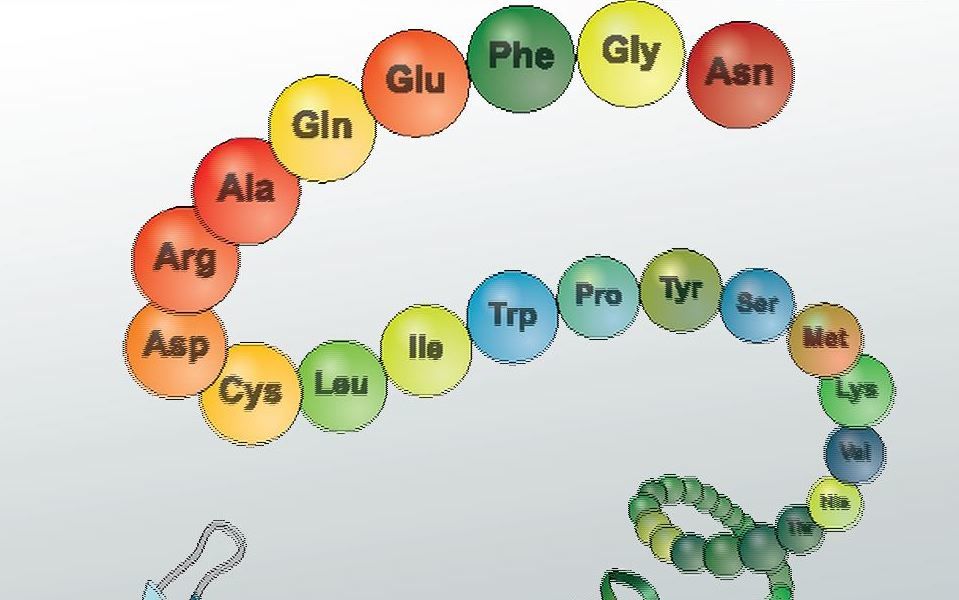

Why is folding so important in proteins?
It gives them a unique, functional shape
It makes them look tidier
It makes every protein molecule different from the next even if they are the same type
The folding is random so is not that important at all

The main bonding in the secondary structure of a protein is due to.....
covalent bonding
ionic bonding
hydrogen bonding
polar bonding

The tertiary structure folding in proteins is primary due to the interactions of....
the 'R' groups
the 'P' groups
the 'A' groups
the 'S'

How many monomers can a protein molecule contain?
10
100
1,000
10,000+

Our bodies can synthesize some of the essential amino acids we need, but where can we get all the ones we cannot synthesize?
eating animal protein
taking a supplement
eating plant protein
drinking plenty of water

What gives a protein its unique shape?
the unique sequence of amino acids in its polypeptide chain
the unique folding due to the sequence of amnio acids in the polypeptide chain
hydrogen bonding & unique interactions between the 'R' groups
all of these
Two or more polypeptides attached together and work as one unit
Primary
Secondary
Tertiary
Quaternary

The diagram shows a bond forming between two amino acids. What is the name of this reaction?
Condensation
Hydrolysis
Pepysis
Oxidation
tick the correct box
Secondary - silk, Tertiary - enzymes, Quaternary - haemoglobin
Secondary - haemoglobin, Tertiary - enzymes, Quaternary - silk
Secondary - Enzymes Tertiary - haemoglobin, Quaternary - silk
Secondary - Silk, Tertiary - haemoglobin, Quaternary - enzymes

