
 Worksheets
HW - Electron Configuration
Total questions: 17
Worksheet time: 34mins
Name
Class
Date
1.
What atom matches this electron configuration?
1s22s22p63s23p64s23d10
1s22s22p63s23p64s23d10
a)
Zinc
b)
Copper
c)
Nickel
d)
Germanium
2.
What electron configuration matches an oxygen atom?
a)
1s22s22p63s2, 3p64s23d104p5
b)
1s22s22p4
c)
1s22s22p6
d)
1s22s22p63s23p64s23d1
3.

How many electrons does Si contain? (click to see image)
a)
14
b)
28
c)
2
d)
4
4.
How many electrons can the first energy level hold?
a)
1
b)
2
c)
8
d)
0
5.
There are 4 different types of subshells s,p,d,f
a)
true
b)
false
6.
What is the maximum number of electrons that an orbital can have?
a)
1 electron
b)
2 electrons
c)
3 electrons
d)
4 electrons
7.
How many d orbitals are there in a given sublevel?
a)
1
b)
3
c)
5
d)
7
8.
How many p orbitals are there in a sublevel?
a)
2
b)
1
c)
4
d)
3
9.
What atom matches this electron configuration?
[Xe] 6s2 4f14 5d9
[Xe] 6s2 4f14 5d9
a)
Mercury
b)
Gold
c)
Platinum
d)
Thallium
10.
What is the shorthand electron configuration for Sulfur atom?
a)
[Ar] 3p4
b)
[He] 3s23p4
c)
[Ne] 3s23p4
d)
[Na] 3s23p3
11.

Which element is pictured?
a)
neon
b)
fluorine
c)
magnesium
d)
argon
12.
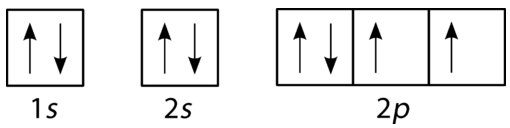
This orbital diagram represents:
a)
C
b)
B
c)
N
d)
O
13.

What is incorrect about this orbital diagram?
a)
Both arrows in the 2p box should be pointing up
b)
There is nothing incorrect with this diagram
c)
In the there should only be 1 orbital in the first 2p box and one in the 2nd 2p box
d)
All the arrows should be pointing up.
14.
The maximum number of electrons that can be placed in an d orbital.
a)
2
b)
6
c)
10
d)
14
15.
In an orbital diagram, an arrow represents:
a)
an electron
b)
an orbital
c)
an element
16.
An electron occupies the lowest energy orbital that can receive it.
a)
Hund’s rule
b)
Pauli exclusion principle
c)
Bohr model of the atom
d)
Aufbau principle
17.
All orbitals of equal energy are occupied by one electron before any single orbital is occupied by a second electron.
a)
Aufbau principle
b)
Pauli exclusion principle
c)
Hund’s rule
d)
Core Notation
100 %

