wayground logo

Free Printable Worksheets

Font size

S
M
L
XL
Worksheets

Fall Semester Quiz Review US History 8th Grade

Total questions: 143

Worksheet time: 3hrs 51mins

Name
Class
Date
1.

What major event occured in 1776.

a)

Second Continental Congress meets

b)

Constitution Ratified

c)

Declaration of Independence is drafted

d)

Washington Becomes President.

2.

What best completes the "?" on the timeline?

a)

The Boston Massacre

b)

The Sugar Act

c)

The Declaration of Independence

d)

French and Indian War ends

3.

Click on all the responses that are examples of Self-government in the colonies?

a)

Virginia House of Burgesses

b)

Mayflower Compact

c)

Fundamental Orders of Connecticut

d)

Town Meetings

4.

Which of the following correctly completes the blank box on the timeline?

a)

Battle of Yorktown

b)

Boston Tea Party

c)

French and Indian War

d)

Whiskey Rebellion

5.

Why was the French and Indian War the first cause of the American Revolution?

a)

The colonist were required to give up their land.

b)

British Parliament required colonist to stop all trade.

c)

British Parliament passed a series of taxes to pay for the debt incurred during the war.

d)

The colonist could not move passed the Mississippi River

6.

What was the effect of British policies on the Colonist like the Sugar Act, Stamp Act, Writs of Assistance, townshend acts, and tea act?

a)

The colonist were allowed to trade with other countries besides Britain.

b)

The Colonist had an increase in wealth and trade due to the policies.

c)

The policies led the colonist to seek independence from Great Britain.

d)

It encouraged most colonist to move to Canada to seek religious freedom.

7.

Which of the following answers gives the best explanation why religious freedom was included in the first amendment?

a)

Americans belonged to several different religions that they wanted to keep their churches separate from the government.

b)

Most Americans did not attend church during the 1700s.

c)

Americans could not agree on what type of church to lead the country.

d)

Americans did not want to be taxed by a government church.

8.

Which document gives people the freedom of speech, right to bear arms, no quartering of troops?

a)

Declaration of Indpendence

b)

Fundamental Orders

c)

The Federalist Papers

d)

Bill of Rights

9.

Patrick Henry believed the Constitution was designed to allow the people to have control of the government. What principle of government does this reflect?

a)

Federalism

b)

Limited Government

c)

Separation of Powers

d)

Popular Sovereignty

10.

What was the major effect the Anti-Federalist had on the constitution?

a)

States chose to keep the Articles of Confederation

b)

The Bill of Rights was added to the Constitution.

c)

The added an executive branch to the Constitution.

d)

They contributed to shay's rebellion.

11.

What was the main purpose of the Proclamation of 1763?

a)

To prevent colonist from talking about the King

b)

To help colonist trap fur in the Ohio River Valley

c)

To forbid colonist from moving across the Appalachian Mountains

d)

To give all colonist born in 1763 a free birthday dessert at their favorite restaurant

12.

Patrick Henry once said, "Your President (central government) may easily become king. Your rights will be in the hands of a small minority." HENRY must have been a....

a)

Federalist

b)

Anti-Federalist

13.

Which group argued for a stronger national government?

a)

Federalist

b)

anti-federalist

c)

-

d)

-

14.

Which group believed that the principles of federalism, separation of powers, and limited government would keep the government from becoming too powerful?

a)

Federalist

b)

Anti- Federalist

c)

-

d)

-

15.

Powers not given to the Federal government are reserved for the states or to the people is which amendment in the constitution?

a)

second amendment

b)

Third Amendment

c)

ninth amendment

d)

Tenth Amendment

16.

According to the DOI, how did the Americans justify their separation from Britain?

a)

the Americans did not think King George III was very intelligent

b)

the King had violated the rights of Americans, therefore they had the right to overthrow the government

c)

the Americans were tired of being ruled by a king who was 3,000 miles away

d)

King George was doing an adequate job as a ruler, but the Americans were ready for a change

17.

"For quartering large bodies of armed troops among us". This quote from the DOI likely refers to which complaint?

a)

having colonial governments dissolved

b)

having to house British troops

c)

having to pay taxes on certain goods

d)

having no say in the British government

18.

No Soldier shall, in time of peace be quartered in any house, without the consent of the Owner, nor in time of war, but in a manner to be prescribed by law.


Which amendment is this?

a)

1st Amendment

b)

2nd Amendment

c)

3rd Amendment

d)

4th Amendment

19.

What is the purpose of the following lines from the declaration?

"He has dissolved our legislative assemblies"

“ He has kept among us, in times of peace, standing armies ” “For imposing taxes on us without consent”

“ For depriving us in many cases, of the benefits of trial by jury”

a)

To justify independence by giving examples of complaints about rights violated by King George and the British government

b)

To give examples of complaints against the American government, asking King George III to fix them

c)

To request that the king protect certain rights and complain about rights that colonists didn't have

20.
Which provision of the U.S. Constitution addressed the grievance listed above?
a)
"The Senators and Representatives shall receive a Compensation for their Services, to be ascertained by Law, and paid out of the Treasury of the United States..."
b)
"Every Order, Resolution, or vote to which the [agreement] of the Senate and House of Representatives may be necessary shall be presented to the President of the United States."
c)
"He shall have power, by and with the advice and consent of the Senate, to make Treaties...."
d)
"The Congress shall have power to lay and collect taxes, duties, imposts and excises to pay the debts and provide for the common defense and general welfare of the United States."
21.

Which image clearly represents separation of powers?

a)
b)
c)
22.
Which principle of government does this picture represent?
a)
federalism
b)
separation of powers
c)
popular sovereignity
d)
limited government
23.
Which principle of government does this picture represent?
a)
checks and balances
b)
limited government
c)
federalism
d)
popular sovereignity
24.

The people exercise their rights by voting for their political representatives.

a)

Federalism

b)

Popular Soverignity

c)

Republicanism

d)

Democratic

25.

Which branch creates laws?

a)

Legislative

b)

Executive

c)

Judicial

26.

Which branch enforces the law?

a)

Legislative

b)

Executive

c)

Judicial

27.

Powers shared between the central government and state governments are called ___________.

a)

Divided powers

b)

Central powers

c)

Communicative Powers

d)

Concurrent powers

28.

Which branch is the President apart of?

a)

Executive

b)

Judicial

c)

Legislative

29.

What event proved that the Articles of Confederation were weak?

a)

Boston Massacre

b)

The Revolutionary War

c)

Shay's Rebellion

d)

The Boston Tea Party

30.
Which branch is divided into the House and the Senate?
a)
Legislative
b)
Executive
c)
Judicial
31.

What is required to amend the constitution?

a)

Proposal by a 3/4s vote in both houses of congress and ratification by 3/4s the eligible voters?

b)

Proposal by a 2/3s vote in both houses of congress and ratification by 3/4s the electoral college?

c)

Proposal by a 3/4s vote in both houses of congress and ratification by 3/4s the Supreme Court?

d)

Proposal by a 2/3s vote in both houses of congress and ratification by 3/4s the State legislature?

32.
How many states must approve of a proposed amendment before it becomes part of the Constitution?
a)
2/3s
b)
34
c)
3/4
d)
37.5
33.
How many states must approve of a proposed amendment before it becomes part of the Constitution?
a)
2/3s
b)
34
c)
3/4
d)
37.5
34.
The largest problem facing Washington when he became president was - 
a)
lack of military experience
b)
where to put the national capital
c)
national debt
d)
Native Americans
35.
Which two members of Washington's cabinet were considered political rivals?
a)
Alexander Hamilton & Thomas Jefferson
b)
Edmund Randolph & Henry Knox
c)
Thomas Jefferson & Edmund Randolph
d)
John Adams & Alexander Hamilton
36.
In his Farewell Address, George Washington warned against 2 things.  What were they?
a)
political parties and native americans
b)
permanent alliances & native americans
c)
political parties and permanent alliances
d)
native americans and the national bank
37.
One of the main domestic issues Washington had to face as President was stopping the - 
a)
French & Indian War
b)
Whiskey Rebellion
c)
Shay's Rebellion
d)
Great Awakening
38.
What was Washington's view on foreign policy?
a)
Set up permanent alliances  with other nations
b)
Do not set up permanent alliances with other countries
c)
Do not let foreign ships into harbors without paying taxes
d)
Letting ships freely enter U.S. waters will promote trade
39.

What year did the Louisiana Purchase take place?

a)

1802

b)

1803

c)

1804

d)

1805

40.

Who was the 3rd President of the United States?

a)

John Adams

b)

James Monroe

c)

Thomas Jefferson

d)

James Madison

41.

What number correctly identifies the Louisiana Purchase?

a)

2

b)

3

c)

7

d)

5

42.

The Louisiana Purchase in 1803 was significant because...

a)

it meant we defeated the French

b)

it meant we could kick Spain out of North America

c)

it doubled the size of the United States

d)

it cut the size of the U.S. in half

43.

Founding of Jamestown, first permanent English settlement in North America

a)

1607

b)

1620

c)

1492

d)

1689

44.

Pilgrims land at Plymouth and write the Mayflower Compact to establish self-government

a)

1607

b)

1619

c)

1700

d)

1620

45.

Thomas Jefferson writes the Declaration of Independence

a)

1770

b)

1783

c)

1787

d)

1776

46.
Who is associated with the XYZ Affair? 
a)
Washington
b)
Adams
c)
Jefferson
47.
Who passed the Embargo Act to band trade with other countries? 
a)
Washington
b)
Adams
c)
Jefferson
48.
In which landmark Supreme Court case was the power of Judicial Review established? 
a)
McCulloch v. Maryland
b)
Roe v. Wade
c)
Marbury v. Madison
d)
Gibbons v. Ogden
49.
How did Thomas Jefferson go against his own political party beliefs when purchasing the Louisiana Territory from France in 1801?
a)
He interpreted the Constitution strictly to purchase land
b)
He interpreted the Constitution vaguely to purchase land
c)
Because he was weakening the Federal Government
50.
What prohibited trade with other countries? 
a)
The Embargo Act
b)
The Sedition Act
c)
Hamiliton's tariffs
51.
Democratic Republicans believed in state governments and 
a)
a national bank
b)
high tariffs 
c)
rule by the people
d)
rule by the elite
52.
Under which law did Congress establish the federal courts? 
a)
Marbury v. Madison
b)
The Judiciary Act of 1789
c)
The Whiskey Rebellion 
d)
The Jay Treaty
53.

What is the "big idea" of the Whiskey Rebellion?

a)

the weakness of the Articles of Confederation

b)

It is the right of the people to rebel

c)

people hate being taxed

d)

the strength of the federal government
54.
How would a typical southern farmer feel about protective tariffs?
a)
They would like protective tariffs because they protect their crops
b)
They would dislike protective tariffs because they reduce the markets for them to sell their crops
c)
They would like protective tariffs because they build foreign markets free of taxes
d)
The would dislike protective tariffs because they protect businesses, not farmers
55.
Which Supreme Court case dealt with trade issues on the Hudson River?
a)
Marbury v. Madison
b)
Jackson v. New York
c)
McCulloch v. Maryland
d)
Gibbons v. Ogden
56.
Which of the following is a term for tax on goods coming into a country?
a)
interstate commerce
b)
tariff
c)
protectorate
d)
dumping
57.
Protective tariffs are taxes placed on imported goods. They are designed to protect
a)
American businesses
b)
American farmers
c)
American banks
d)
American gov’ts
58.
Who is fighting in the War of 1812?
a)
France and America
b)
Britain and America
c)
Britain and the Native Americans
d)
America and Spain
59.

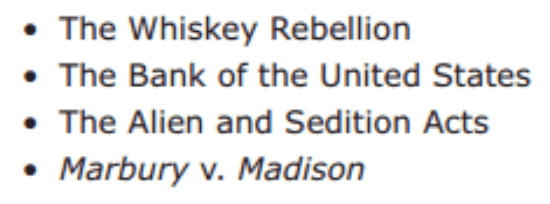
This list provides examples of -

a)

topics discussed during the Second Constitutional Convention

b)

domestic issues faced by the leaders of the new republic

c)

weakness of the government under the Articles of Confederation

d)

issues leading to the ratification of the first constitutional amendments
60.

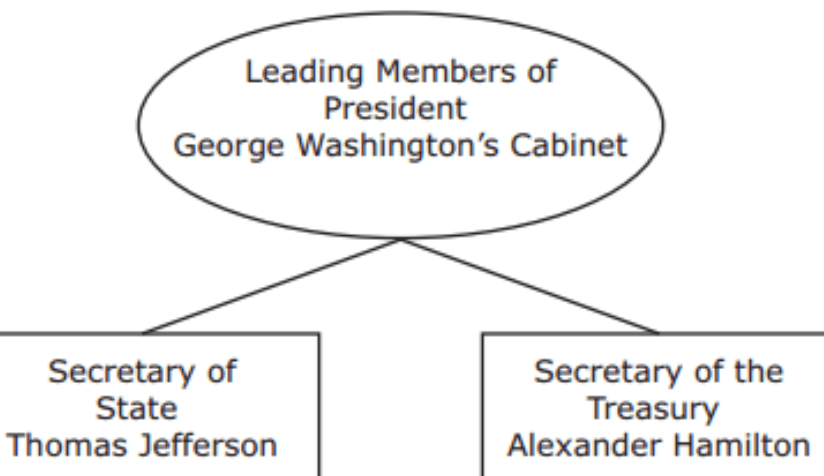
Disagreements between these two cabinet members led to -

a)

the creation of reservations for American Indians

b)

a struggle to ratify the Bill of Rights

c)

the establishment of the first U.S. political parties

d)

a compromise over slavery in western territories

61.

Strict interpretation of the Constitution

a)

Federalists

b)

Democratic Republicans

62.

Strong Federal Government

a)

Federalists

b)

Democratic Republicans

63.

Alexander Hamilton

a)

Federalists

b)

Democratic Republicans

64.

Flexible interpretation of the Constitution

a)

Federalists

b)

Democratic Republicans

65.

Thomas Jefferson

a)

Federalists

b)

Democratic Republicans

66.
What is the defintion of IMPRESSMENT?
a)
British capturing American sailors
b)
Showing off to the person next to you
c)
Forcing Native Americans west of the Mississippi
d)
British giving guns and ammunition to Native Americans 
67.
Who won the War of 1812?
a)
England
b)
United States
c)
France
d)
No one won. It was a stalemate.
68.

The War of 1812 finally established the U.S. reputation as a what?

a)

Independent

b)

Open territory

c)

World power

d)

French territory

e)

Pushovers

69.
Monroe said no more European colonies could start in the Americas.
a)
True
b)
False
70.

WhAt was the cause of the Monroe Doctrine?

a)

United States and Britain were concerned over the possibility of European colonial expansion in the Americas

b)

Just cause they felt like it

c)

Promoted U.S interests

d)

It was interesting

71.
What power was given to the Supreme Court in the court case Marbury v. Madison?
a)
Judicial Review
b)
Make Laws
c)
Supremacy Clause
d)
Execute Laws
72.

What was the result of the Supreme Court decisions made by Chief Justice John Marshall in the following cases:

  • Marbury vs. Madison
  • McCullough vs. Maryland
  • Gibbons vs. Ogden
a)

the court upheld the rights of the workers.

b)

the court abolished the system of slavery.

c)

the court protected the rights of children.

d)

the court ruled in favor of strengthening the federal government.

73.

John Marshall was Chief Justice over what branch of the federal government?

a)

Executive

b)

Legislative

c)

Judicial

d)

Presidential

74.
A person who supported colonial independence from England was called a
a)
Loyalist
b)
Patriot
c)
Neutralist
d)
Tory
75.
A person who wished to stay a British colony and supported the King was called a
a)
Loyalist
b)
Patriot
c)
Neutralist
d)
Kingsman
76.

Why were the First and Second Continental Congress held?

a)

To vote for the first president

b)

To decide when to go to war with Great Britain

c)

To discuss a solution to the colonists’ complaints of Great Britain

d)

To write the Constitution

77.
American naval commander and war hero who is famously quoted saying "I have not yet begun to fight!".  Who am I?
a)
Thomas Paine
b)
James Armistead
c)
Crispus Attucks
d)
John Paul Jones
78.
As a French officer, I helped Americans fight against Great Britain.  I was a good friend to George Washington and became an honorary US citizen.
a)
Jean LaFitte
b)
Charles de Montesquieu
c)
Frere Jacques
d)
Marquis de Lafayette
79.
I am known as the "Father of American Democracy" and aided in the adoption of the Fundamental Orders of Connecticut in 1639.  
a)
Thomas Hooker
b)
Thomas Jefferson
c)
Thomas Jackson
d)
Thomas Blackstone
80.
I am considered the author of the Declaration of Independence and was the third US President.  
a)
John Adams
b)
John Quincy Adams
c)
Benjamin Franklin
d)
Thomas Jefferson
81.
My most famous quote is "Give me Liberty or give me death."  
a)
John Paul Jones
b)
Alexander Hamilton
c)
John Wilkes Boothe
d)
Patrick Henry
82.
I was a slave, but George Washington trusted me to spy on the British at Yorktown
a)
Bernardo de Galvez
b)
Marquis de Lafayette
c)
James Armistead
d)
John Paul Jones
83.
I was the 1st patriot killed at the Boston Massacre in 1770
a)
Samuel Adams
b)
John Adams
c)
Patrick Henry
d)
Crispus Attucks
84.
My pamphlet, Common Sense, encouraged the colonies to break with England and become independent
a)
John Adams
b)
Thomas Jefferson
c)
Thomas Paine
d)
King George III
85.
The British considered me a pirate, but winning battles at sea earned me the nickname “Father of the U.S. Navy”
a)
Thomas Paine
b)
John Adams
c)
John Paul Jones
d)
James Armistead
86.
First Battle of the American Revolution 
a)
Saratoga 
b)
Valley Forge 
c)
Lexington and Concord 
d)
Yorktown
87.
The French began to support the Americans after this battle
a)
Lexington and Concord
b)
Yorktown
c)
Saratoga
d)
Treaty of French 
88.
Soldiers froze here because of the harsh winter
a)
Paris
b)
Valley Forge
c)
Rio Grande Valley 
d)
Yorktown 
89.
What year does the American Revolution end?
a)
1776
b)
1783
c)
1607
d)
1738
90.
In what chronological order did the battles occur?
a)
Valley Forge, French & Indian War, Battle of Saratoga, Battle of York Town
b)
Lexington & Concord, Battle of Saratoga, Valley Forge, Battle of Yorktown
c)
Battle of Saratoga, Valley Forge, French & Indian War, Lexington & Concord
d)
Yorktown, French & Indian War, Saratoga, Valley Forge
91.
The "shot heard 'round the world" was which battle?
a)
Battle of Bunker Hill
b)
Battle of Saratoga
c)
Battle of Trenton
d)
Battle of Lexington & Concord
92.
The "shot heard 'round the world" was which battle?
a)
Battle of Bunker Hill
b)
Battle of Saratoga
c)
Battle of Trenton
d)
Battle of Lexington & Concord
93.
Which battle is considered the Turning Point of the American Revolution?
a)
Battle of Trenton
b)
Battle of Saratoga
c)
Lexington & Concord
d)
Battle of Bunker Hill
94.
Which battle ended the American revolution?
a)
Battle of Lexington and Concord
b)
Battle of Saratoga
c)
Battle of Yorktown
d)
Battle of Trenton
95.
Why is the Battle of Saratoga called the turning point of the Revolutionary War?
a)
The Spanish decide to become American allies
b)
British General Cornwallis surrender at this battle
c)
the French decide to become American allies
96.
How did cotton relate to slavery?
a)
The desire to grow cotton led to increased slavery
b)
It did not relate to slavery
c)
All slaves were required to grow cotton
d)
Cotton was traded for slaves in Africa
97.
Many slaves worked on large farms called ______.
a)
plantations
b)
villages
98.
The _____ is the voyage of slave ships across the Atlantic Ocean
a)
Triangular trade
b)
Middle Passage
c)
overseer
d)
master
99.
Where were most slaves in the West Indies and British North Americans put to work?  
a)
Gold and silver mines
b)
household kitchens
c)
grain mills
d)
sugar and tobacco plantations
100.

A person who sells their labor for passage to American then works off their debt is a

a)

slave

b)

indentured servant

c)

overseer

d)

slave trader

101.
The Northwest Ordinance provided a pathway for territories to apply for
a)
statehood
b)
federal funding
c)
infrastructure grants
102.

What area contained present day Ohio, Indiana, Illinois, Wisconsin, Michigan, and parts of Minnesota.

a)

Canada

b)

U.S.A.

c)

13 colonies

d)

Northwest Territory

103.

What did the Northwest Ordinance allow the United States to do?

a)

It allowed the United States to grow larger in size.

b)

It allowed the United States to gain a pathway to peace with Great Britain.

c)

It allowed the American to bring slaves into the Northwest territories.

104.
What was the name Congress gave to the lands that were won from the British after the Revolution?
a)
Northwest Territory
b)
Indian Territory
c)
Canada
d)
Black Swamp
105.

Which early American political party are these facts describing?

a)

the Whigs

b)

the Federalists

c)

the Know-Nothings

d)

the Democratic-Republicans

106.

Why was the port of New Orleans so important?

a)

It was the best place to go fishing

b)

It was a party town

c)

It was the Catholic headquaters

d)

It was the main center for trade along the Mississippi river

107.

What caused the 1st political parties in America?

a)

disagreements over the national bank and hamilton's overall financial plan.

b)

Dispute over slavery

c)

differences between how to elect the president

d)

Differences over how long to serve as president.

108.

What colony was NOT established for religious reasons?

a)

Rhode Island

b)

Massachusetts

c)

Pennsylvania

d)

Maryland

e)

Virgina

109.

At the Constitutional Convention, small states and large states disagreed over representation in the Legislative branch. How was this settled?

a)

The great compromise- created a bicameral legislature

b)

The great compromise- created a unicameral legislature

c)

The 3/5ths compromise

d)

Three branches of government.

110.
Which statement best summarizes the reasons for the founding of the first two English colonies? 
a)
Colonists in Jamestown expected riches while those at Plymouth desired to practice their own religion.
b)
Jamestown and Plymouth were established as safe places for imprisoned debtors and convicts.
c)
Jamestown and Plymouth were founded as safe havens for people of all religious beliefs.
d)
Colonists in both Jamestown and Plymouth traveled to America to convert the American Indians to Catholicism.
111.
Which characteristic is correctly matched with a number in the table?
a)
1: Indigo
b)
2: Moderate 
c)
3: Rocky soil
d)
4: Ships
112.

Most of the New England colonies were started for ____ reasons.

a)

economic

b)

social

c)

religious

d)

political

113.

This colony was a safe place for Catholics.

a)

Maryland

b)

Georgia

c)

New York

d)

Pennsylvania

114.

This Colony was established by Puritans.

a)

Virginia

b)

New Jersey

c)

Massachusetts

d)

South Carolina

115.

Tobacco and rice were important crops in which colonial region?

a)

Southern

b)

Middle

c)

New England

116.

Poor farming conditions made this region a center for fishing and shipbuilding.

a)

Southern

b)

Middle

c)

New England

117.

Slavery was common in this colonial region.

a)

Southern

b)

Middle

c)

New England

118.

This region was nicknamed "the Breadbasket" of the colonies.

a)

Southern

b)

Middle

c)

New England

119.

This colony was created for economic reasons?

a)

Massachusetts

b)

Georgia

c)

Virginia

d)

Pennsylvania

120.
Distance from Great Britain
Need for lawmaking structure
Traditional rights of Englishmen
All of these contributed to American colonists ...
a)
creating general councils to manage the colonies.
b)
experiencing strict control by Parliament.
c)
establishing their own representative institutions.
d)
appointing governors who reported to the king
121.
Which of the following was a primary reason France sought to colonize North America?
a)
To reduce overpopulation in Europe.
b)
to create communities founded on religious tolerance.
c)
To profit from trading in furs and other goods.
d)
To create joint ventures with other European countries.
122.
The Southern colonial region...
a)
factories, rocky soil, and mild winters.
b)
hot and humid climate, cattle, and rivers.
c)
hot and humid climate, cash crops such as cotton/tobacco/indigo, and fertile land.
d)
cold harsh winters, swift rivers, and ship building.
123.
Which colonial region is best known for its diversity?
a)
New England Colonies
b)
Middle Colonies
c)
Southern Colonies
124.
Mercantilism is an economic theory that says the wealthier you are, the more powerful you are.
a)
True
b)
False
125.
Which group are the New England colonies?
a)
Connecticut 
New Hampshire
Rhode Island
Massachusetts
b)
North Carolina
South Carolina
Virginia
Maryland
Georgia
c)
Pennsylvania
Deleware 
New York
New Jersey
d)
Illinois
Indiana
Ohio
Wisconsin
126.
Which group are the Middle colonies?
a)
Connecticut 
New Hampshire
Rhode Island
Massachuttes
b)
North Carolina
South Carolina
Virginia
Maryland
Georgia
c)
Pennsylvania
Delaware
New York
New Jersey
d)
California
Arizona
New Mexico
Washington
127.
Which group are the Southern colonies?
a)
Connecticut 
New Hampshire
Rhode Island
Massachuttes
b)
North Carolina
South Carolina
Virginia
Maryland
Georgia
c)
Pennsylvania
Delaware
New York
New Jersey
d)
Florida
Georgia
Louisiana
Alabama
128.

In March of 1770, a group of redcoats were jeered and taunted by restless colonists. The redcoats retaliated by firing at the colonists, killing five. The event became known as the -

a)

Battle of Bunker Hill

b)

Boston Massacre

c)

Declaratory Act

d)

Battle of Lexington and Concord

129.

The tax laws imposed on the colonists by the British government were viewed as unfair and created support for declaring independence because -

a)

British merchants were taxed at a higher rate than colonial merchants

b)

Parliament passed the laws to deregulate the trade of imports

c)

the laws only applied to those foreign subjects of the British crown

d)

colonists were taxed without direct representation in Parliament

130.

The cartoon above reflects the colonists' frustration with -

a)

having to pay to house British soldiers

b)

being forced to stay east of the Appalachian Mountains

c)

being taxed without any voice in government

d)

not being protected from the Native Americans

131.

*Born in Boston, Massachusetts

*Leader of the Sons of Liberty

*Signer of the Declaration of Independence

*Governor of Massachusetts 1794 - 1797


The chart above best describes the accomplishments and contributions of -

a)

Samuel Adams

b)

Thomas Paine

c)

Benjamin Franklin

d)

Crispus Attucks

132.

Haym Salomon was a Polish born Jewish immigrant and his greatest contribution during the American was the he -

a)

served as the highest ranking colonial spy during the war effort and continually provided Washington with British plans

b)

was the prime financier of the American Revolution and converted foreign loans into cash to support the cause

c)

advised the committee of five on the grievances to include in the drafting of the Declaration of Indpendence

d)

worked with Washington and Cornwallis to negotiate the surrender of the British at the siege of Yorktown


133.
The New Jersey Plan, also known as the "Small State" Plan wanted what type of representation based on a states population?
a)
Equal Representation 
b)
Proportional Representation 
134.
This Compromise called for a 2 House legislative branch with 1 house based on proportional representation and 1 house based on equal representation. 
a)
3/5 Compromise 
b)
Missouri Compromise
c)
The Great Compromise 
d)
Compromise of 1850
135.
This compromise said that for every 3 our of 5 slaves would count towards a states population for representation. 
a)
3/5 Compromise
b)
The Great Compromise 
c)
Missouri Compromise
d)
Compromise of 1850
136.
Which two groups argued over the ratification (passing) of the Constitution?
a)
Loyalists vs Patriots
b)
Democrats vs Republicans
c)
Whigs vs Loyalists
d)
Federalists vs Anti-Federalists 
137.
What type of government did the Federalist want under the Constitution? 
a)
A weak national government, strong state government 
b)
A strong national government, a weak state government 
138.
Which of the following was an Anti-Federalist? 
a)
George Washington
b)
George Mason 
c)
Alexander Hamilton 
139.
a)
Federalism
b)
Popular Sovereignty
c)
Separation of Powers
d)
Individual Rights 
140.
The Constitution provides 2 ways to propose an amendment. Which of the following is one of those ways?
a)
The president officially requests that Congress propose the amendment.
b)
Three-fourths of state governors sign a petition in favor of proposing the amendment.
c)
A majority of citizens vote on favor of proposing the amendment.
d)
Two-thirds of both congressional houses vote in favor of proposing the amendment.
141.
Which of the following events caused the Articles of Confederation to be seen as weak and needing revision?
a)
Shays Rebellion
b)
Boston Tea Party
c)
Whiskey Rebellion
d)
Yorktown Marathon
142.
When citizens report for jury duty, they are helping to uphold a constitutional right guaranteed by the ...
a)
First Amendment
b)
Second Amendment
c)
Sixth Amendment
d)
Ninth Amendment
143.
What term means the idea citizens elect people to represent them in government?
a)
Republicanism
b)
Federalism
c)
Checks and Balances
d)
limited government