wayground logo

Free Printable Worksheets

NEW

Font size

S
M
L
XL
Worksheets

Benchmark 2 Practice 2019

Total questions: 50

Worksheet time: 2hrs 34mins

Name
Class
Date
1.
What is the formula for force?
a)
F=M/A
b)
F=A/M
c)
F=M*A
d)
F=M*F
2.
A student pushes a box to right with a force of 10N while a young boy pushes the box to the left with a force of 8N. What is the sum of all forces on the box? 
a)
18N left
b)
18N right
c)
2N right
d)
2N left
3.
If net force acting on object is 0, then the force is considered to be..
a)
Balanced
b)
Unbalanced
c)
Equal in Direction
d)
Distance/Time
4.
What is Newton's First Law known as? The Law of
a)
Friction
b)
Mass
c)
Inertia
d)
Gravity
5.
Newton's third law states that any action will have a(n) _______ and ______ reaction
a)
Equal and similar
b)
Equal and opposite
c)
Equal and different
d)
Greater and opposite
6.
Which of Newton's laws is illustrated when a magician pulls a tablecloth out from under the dishes without disturbing them?
a)
first
b)
second
c)
third 
d)
fourth
7.
A person is pushed forward into their seat belt when a car stops.  Which law is this?
a)
1st
b)
 2nd
c)
2 and 3
d)
3rd 
8.
Which of Newton's laws are illustrated with a rocket launch?
a)
1st Law, the Law of Inertia. 
b)
2nd Law, the Law of Acceleration.
c)
3rd Law, the Law of Action Reaction
d)
The Law of Conservation of Mass
9.
Which of Newton's Laws is illustrated with a large mass and a small mass accelerating?
a)
1st Law, the Law of Inertia.
b)
2nd Law, the Law of Acceleration
c)
3rd Law, the Law of Action Reaction
d)
The Law of Conservation of Mass
10.
An object is resting motionless on a surface. According to Newton's 1st Law, the object will only start to move if
a)
the net forces on the object equal zero
b)
an unbalanced force is applied to the object
c)
the upward force of the object is equal to its acceleration
d)
two forces that are equal and opposite are applied to the object
11.
As the wheels of a train push down on the track, the track pushes back against the wheels. Which of Newton's laws is used to explain these forces.
a)
An object at rest tends to stay at rest unless acted upon by an unbalanced force.
b)
The net force of an object is its mass times its acceleration.
c)
For every action, there is an equal and opposite reaction.
d)
Any 2 objects exert a gravitational force of attraction on each other.
12.
A truck that is travelling at a constant speed is carrying some boxes.  If the truck comes to a sudden stop, what will most likely happen to the boxes?
a)
They will stay in the middle of the truck.
b)
They will slide toward the front of the truck.
c)
They will slide toward the back of the truck.
d)
They will fall off the side of the truck.
13.
A person steps out of the boat and onto the dock.  As the person moves forward onto the dock, the boat moves backward.  Which statement best describes the backward motion of the boat as the person steps forward?
a)
For every action there is an equal and opposite reaction.
b)
Every mass exerts a force on every other mass.
c)
An object at rest tends to stay at rest.
d)
Friction opposes the motion of an object.
14.
The force that draws all objects towards Earth.
a)
friction
b)
gravity
c)
mass
d)
acceleration
15.
A rubbing together force that slows things down and stops them.  It works against motion.
a)
acceleration
b)
mass
c)
gravity
d)
friction
16.
Waves move ___ through vibrations
a)
Energy
b)
Matter
c)
Mass
d)
Weight
17.
Longitudinal waves are ______.
a)
Parallel
b)
Perpendicular
c)
Crazy
18.
Transverse waves are ___.
a)
Parallel
b)
Perpendicular
c)
Weird
19.
Which is the wavelength?
a)
1
b)
2
c)
3
d)
4
20.
If the frequency gets higher, the wavelength gets 
a)
longer
b)
shorter
21.
If the wavelength gets longer, the frequency gets 
a)
higher
b)
lower
22.
The loudness of the sound depends on
a)
wavelength
b)
amplitude
c)
frequency
23.
Which EM wave has the lowest frequency?
a)
radio
b)
xray
c)
gamma
d)
infrared
24.
Which EM wave has the longest wavelength?
a)
light
b)
radio
c)
ultraviolet
d)
red
25.
The highest point on a wave is:
a)
the crest
b)
the trough
c)
the top
d)
the coast 
26.
The number of wavelengths that pass a point each per second is:
a)
frequency
b)
period
c)
longitudinal 
d)
transverse wave 
27.
Which is the correct equation for calculating the speed of a wave?
a)
T = 1/f
b)
Speed= Wavelength x Period
c)
Speed = Wavelength/Frequency
d)
Speed= Wavelength x Frequency
28.
1.  A wave has frequency of 50 Hz and a wavelength of 10 m. What is the speed of the wave?
a)
500 m/s
b)
50 m/s
c)
5 m/s
d)
0.5 m/s
29.
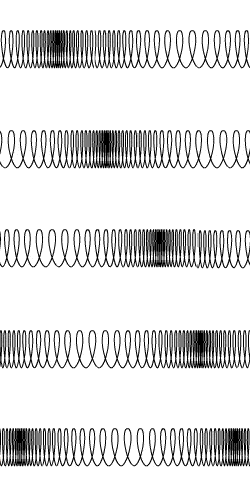
What type of wave is this?
a)
Longitudinal
b)
Transverse
30.
Which part of a longitudinal wave is where particles are packed closely together?
a)
compression
b)
rarefaction
c)
crest 
d)
amplitude
31.

A Mechanical Wave needs a _____________ to travel.

a)

Force

b)

Vibration

c)

Medium

d)

Amplitude

32.

The height of a wave is called the _____________________.

a)

wavelength

b)

amplitude

c)

frequency

d)

crest

33.
A primary wave moves
a)
parallel
b)
perpendicular
c)
in circles
34.
A secondary wave moves
a)
parallel
b)
perpendicular
c)
in circles
35.
What scale is used to measure the 
a)
Ricther Scale
b)
A big scale
c)
Seismic Scale
36.
Which type of wave is the most destructive wave?
a)
Primary Wave
b)
Secondary Wave
37.

Main type of seismic waves that can only travel through the surface of the Earth.

a)

seismic waves

b)

surface waves

c)

body waves

d)

primary waves

38.

Primary (P) Waves can pass through...

a)

solids only

b)

liquids only

c)

gases only

d)

solids, liquids, and gases

39.

Rank the seismic waves in order of appearance when an earthquake first occurs as measured by a seismograph.

a)

S waves, P waves, then surface waves

b)

P waves, S waves, then surface waves

c)

S and P waves at the same time, then surface waves

d)

Surface waves, then S and P waves at the same time
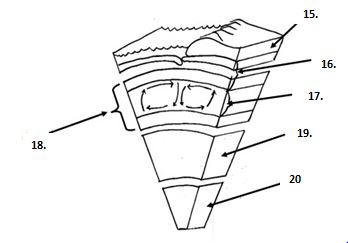
40.
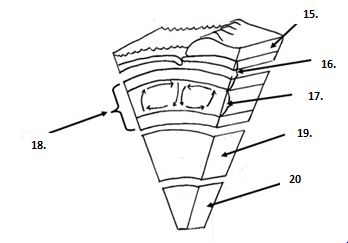
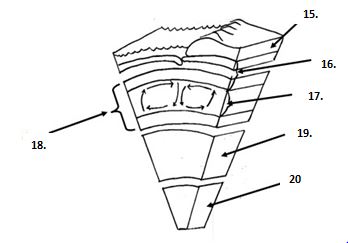
Identify each layer - #20.
a)
mantle
b)
asthenosphere
c)
inner core
d)
outer core
41.
Identify each layer - #15.
a)
Lithosphere
b)
Mantle
c)
Crust
d)
Asthenosphere
42.
Identify each layer - #19.
a)
mantle
b)
lithosphere
c)
inner core
d)
outer core
43.
Temperature _____________________ as you go deeper into the earth.
a)
increases
b)
decreases
c)
goes up and down depending on the layer
d)
stays the same
44.
Pressure ______________________ as you go deeper into the Earth
a)
increases
b)
decreases 
c)
goes up or down depending on the layer
d)
stays the same
45.
Which layer of Earth is solid and why?
a)
The inner core is solid because of movement of the outer core.
b)
The inner core is solid because of the freezing temperatures.
c)
The inner core is solid because of the extreme pressure from the other layers.
d)
The outer core is solid because of the extreme pressure from the other layers.
46.
Which layer of earth is molten?
a)
inner core
b)
outer core
c)
crust
d)
lithosphere
47.

Divergent means to

a)

come together

b)

to push apart

c)

to slide past each other

48.

Transform means to

a)

slide past each other

b)

come together

c)

to push apart

49.

Convergent means

a)

To slide past each other

b)

To push apart

c)

To come together

50.

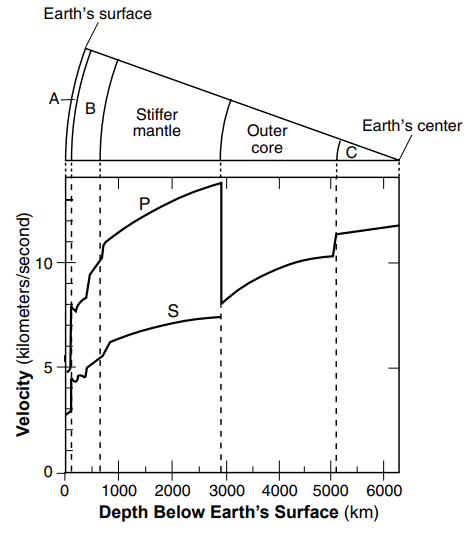
Scientists know about the Earth Layers due to _________.

a)

volcanic activity

b)

seismic waves

c)

magnetic properties