wayground logo

Free Printable Worksheets

NEW

Font size

S
M
L
XL
Worksheets

East 3D Art

Total questions: 68

Worksheet time: 34mins

Name
Class
Date
1.
What are all the stages of clay?
a)
Plastic, Leatherhard, Bone dry, Fired
b)
Plastic, Leatherhard, Bone dry, Bisque, and Glazed
c)
Wet, Leatherhard, Bone dry, bisque
d)
Wet, Dry and Fired
2.

The mixture of clay and water used to attach clay and sometimes to decorate is called

a)

slab

b)

score

c)

slip

3.

The process of heating ceramics to a very high temperature is called

a)

cooking

b)

blasting

c)

baking

d)

firing

4.

When attaching clay, it is important to _____________, or rough up, both of the attaching surfaces and apply slip before pressing together

a)

cut

b)

score

c)

slip

d)

polish

5.

Clay that is brand new, soft and easily molded

a)

ceramic

b)

leather hard

c)

plastic

d)

bisqueware

6.

Before clay has been fired, it is known as

a)

bisqueware

b)

glaze

c)

greenware

7.

Clay that has been fired in the kiln is called

a)

bisqueware

b)

greenware

c)

slip

d)

slab

8.

Clay that is partially dry, but can still be carved or have pieces added to it

a)

plastic

b)

ceramic

c)

bone dry

d)

leather hard

9.

method of kneading clay to get rid of air pockets in clay

a)

wedging

b)

walloping

c)

squishing

d)

washing

10.

Clay that is completely dry and is very fragile

a)

bone dry

b)

leather hard

c)

plastic

d)

bisqueware

11.

Rolling clay into long cylinders is called

a)

wheel thrown

b)

pinch

c)

coil

d)

slab

12.

Constructing clay with flat pieces of clay is called

a)

slab

b)

coil

c)

pinch

d)

wheel throwing

13.

Squeezing clay between your thumb and forefingers is called

a)

slab

b)

pinch

c)

coil

d)

wheel throwing

14.

To "score" in ceramics, means _____________________.

a)

to sculpt on the clay surface.

b)

to add points to your class grade.

c)

to incise lines into clay.

d)

to stamp a design into clay.

15.

Glaze is made out of

a)

sand

b)

plastic

c)

clay

d)

glass

16.
What is this tool?
a)
wire loop tool
b)
wire cutter
c)
modeling tool
d)
rib
17.
What are these tools?
a)
modeling tools
b)
wire loop tools
c)
ribs
d)
needle tools
18.
What is this tool?
a)
rib
b)
needle tool
c)
wire cutter
d)
modeling tool
19.
What are these tools?
a)
ribs
b)
wire cutters
c)
wire loop tools
d)
modeling tools
20.
What is this?
a)
oven
b)
cairn
c)
kiln
d)
coffin
21.
What are the 4 reasons a project blows up in the kiln?
a)
fire, awesome, thin, air up in there 
b)
Air pockets, too much clay, solid clay, too dry
c)
Too dry, on point, too sharp, air pockets
d)
too thin, too thick, too wet, air pockets or bubbles
22.

What must you remember to do to glaze successfully?

a)

three coats of glaze, dry between layers, glaze the bottom

b)

three coats of glaze, don't let it dry between layers, don't glaze the bottom

c)

three coats of glaze, dry between layers, don't glaze the bottom

d)

three coats of glaze, don't let it dry between layers, glaze the bottom

23.

After using the clay and tools, what is it necessary to do before you leave the class?

a)

Leave everything the way it is.

b)

Put everything away, and wipe your table with a wet paper towel.

c)

Pour water on the table.

d)

Tell all your friends to clean up.

24.

Made mostly of colored pigment and binders to keep it suspended as a liquid and can be applied to greenware

a)

underblaze

b)

colored slip

c)

underdog

d)

underglaze

25.

A ceramic paint typically composed of opaque or transparent colors which becomes vitreous when fired.

a)

slip

b)

acrylics

c)

glaze

d)

tempera

26.
An element of art that refers to the lightness and darkness of a color.
a)
hue
b)
value
c)
movement
d)
contrast
27.
A mark with length and direction, created by a point that moves across a surface.
a)
line
b)
value
c)
contrast
d)
form
28.
The empty or open area between, around, above below and within objects.
a)
form
b)
balance
c)
color
d)
space
29.
Any three dimensional object that can be measured by height, width and depth.
a)
emphasis
b)
space
c)
form
d)
shape
30.
The element of art that refers to the surface quality of an object or the way something feels such as rough-smooth
a)
shape
b)
texture
c)
color
d)
line
31.
A flat figure created when actual or implied lines surround a space-can be geometric or organic
a)
line
b)
form
c)
shape
d)
space
32.
Element of art produced when a wavelength of light strikes an object and reflects back to the eyes.
a)
primary
b)
secondary
c)
teriary
d)
color
33.
Another name for related colors-have one color in common. Colors that appear next to each other on the color wheel.
a)
analogous colors
b)
shape
c)
texture
d)
color
34.
Colors that are directly opposite on the color wheel.  When mixed together, they makes neutral gray or brown.
a)
complementary
b)
texture
c)
analogous
d)
color
35.
Area in a work of art that catches and holds the viewers attention.
a)
space
b)
unity
c)
emphasis
d)
balance
36.

A 3-D work of art created by shaping or combining materials.

a)

Form

b)

Additive

c)

Sculpture

d)

Utilitarian

37.

Taking away or carving material to create a sculptural form

a)

Subtractive

b)

Additive

c)

Manipulative

d)

Mixed Media

38.

Building up or attaching pieces of material together to create a form or sculpture.

a)

Functional

b)

Assemblage

c)

Additive

d)

Manipulative

39.

A sculpture where the forms come out from a flat background.

a)

Free Standing

b)

Subtractive

c)

Relief

d)

Additive

40.

A sculpture that is viewed from all sides, it is surrounded by space.

a)

Relief

b)

In-The-Round

c)

Cast

d)

Functional

41.

Kinetic Sculpture shows

a)

Movement

b)

Contrast

c)

Stability

d)

Pattern

42.
This is a...
a)
Kinetic Sculpture
b)
Relief Sculpture 
c)
Linear Sculpture
d)
Assemblage
43.

This is a...

a)

Kinetic Sculpture

b)

Sculpture in the Round

c)

Linear Sculpture

d)

Assemblage

44.
This is a...
a)
Kinetic Sculpture
b)
Sculpture in the Round
c)
Relief Sculpture
d)
Assemblage
45.
What part of the pot is labeled A?
a)
Foot
b)
Belly
c)
Shoulder
d)
Mouth
46.
What part of the pot is labeled B?
a)
Foot
b)
Neck
c)
Shoulder
d)
Mouth
47.
What part of the pot is labeled C?
a)
Foot
b)
Belly
c)
Shoulder
d)
Mouth
48.
What part of the pot is labeled D?
a)
Foot
b)
Belly
c)
Neck
d)
Mouth
49.
What part of the pot is labeled E?
a)
Foot
b)
Belly
c)
Shoulder
d)
Mouth
50.
What color harmony is shown?
a)
Primary Colors
b)
Secondary Colors
c)
Neutral Colors
d)
Monochromatic Colors
51.
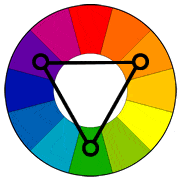
What color harmony is shown?
a)
Split Complementary Colors
b)
Neutral Colors
c)
Complementary Colors
d)
Tertiary Colors
52.
A Color plus its Tints (White) and Shades (Black)
a)
 Primary Colors
b)
Analogous Colors
c)
Complementary Colors
d)
Monochromatic Colors
53.

Mixing a Primary and a Secondary color makes __________?

a)

Monochromatic Colors

b)

Primary Colors

c)

Tertiary Colors

d)

Neutral Colors

54.
Three or more colors touching on the color wheel?
a)
Tertiary Colors
b)
Analogous Colors
c)
Neutral Colors
d)
Monochromatic Colors
55.
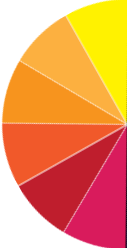
What color harmony is shown?
a)
Cool Colors
b)
Warm Colors
56.
What color harmony is shown?
a)
Cool Colors
b)
Warm Colors
57.
When two Primary Colors are mixed they make a _______?
a)
Primary Colors
b)
Monochromatic Colors
c)
Tertiary Colors
d)
Secondary Colors
58.
Colors across from each other on the color wheel?
a)
Primary Colors
b)
Complementary Colors
c)
Secondary Colors
d)
Tertiary Colors
59.
These colors can NOT be made by mixing other colors.
a)
Secondary Colors
b)
Monochromatic Colors
c)
Primary Colors
d)
Analogous Colors
60.
Three colors equally spaced on color wheel?
a)
Analogous Colors
b)
Color Triad
c)
Monochromatic Colors
d)
Primary Colors
61.
How pure or dull a color is, this can change by mixing a color with its complement.
a)
Intensity
b)
Monochromatic
c)
Cool Colors
d)
Shade
62.
Any color mixed with black...
a)
Primary
b)
Tint
c)
Complementary
d)
Shade
63.
Any color mixed with white...
a)
Shade
b)
Tint
c)
Complementary
d)
Primary
64.

...is a work of art that is produced by carving or shaping stone, wood or clay

a)
b)
c)
d)
65.

...is the the skills, job or process of creating durable images by recording light or other electromagnetic radiation

a)
b)
c)
d)
66.

...is the practice of applying paint, pigment color or other medium to a solid surface

a)
b)
c)
d)
67.

... the act of making a picture with a pencil or pen

a)
b)
c)
d)
68.

... the process of forming vessels and other objects with clay and other ceramic materials

a)
b)
c)
d)