
Font size
 Worksheets
Acids, bases and salts
Total questions: 40
Worksheet time: 27mins
Complete the following word equation:
Metal + Acid -->
Salt + water
Salt + hydrogen
Salt + Water + Carbon dioxide
What colour does the solution turn when sulfuric acid is added to copper carbonate?
Blue
Green
Clear
Purple
How do you remove the water to leave solid copper sulfate crystals?
Filter
Evaporate
Distill
What does the word insoluble mean?
Does dissolve
Doesn't dissolve
Is part of a solid

Which salt would be formed by reacting cobalt carbonate and hydrochloric acid?
Cobalt sulfate
Cobalt chloride
Cobalt hydroxide
Cobalt sulfide
When a soluble salt is formed from an acid and an insoluble base, how do you know when an excess of a base has been added?
When bubbles of gas appear
When the reactant all dissolves
When some of the reactant is left unreacted/undissolved
When a colour change happens
Why do you add excess of the insoluble reactant when making a soluble salt?
To make sure all the acid is used up
To separate the solid from the solution
To make sure a reaction occurs
To have the reaction happen faster
How do you separate an excess insoluble reactant from a solution?
Filtration
Precipitation
Crystalisation
Evaporation
Which of the following values would represent the pH of a strong base?
1
8
7
13
Which of the following values would represent the pH of a strong acid?
1
6
7
13
What range of values on the pH scale represent solutions with a higher ratio of hydroxide (OH-) ions?
below 7
7
above 7
0-14

The products of a neutralization reaction are usually...
salt and water
an acid and a base
a neutral solution
carbon dioxide and oxygen
What acid is needed to make copper nitrate?
Hydrochloric
Nitric
Sulfuric
Phosphoric
Complete this equation:
sulfuric acid + potassium hydroxide -->
potassium oxide + hydrogen
potassium chloride + water
potassium sulfate + hydrogen
potassium sulfate + water
Bryan wants to prepare silver chloride in the science laboratory. Which of the following reactants should he use?
silver + hydrochloric acid
silver hydroxide + hydrochloric acid
silver nitrate + potassium chloride
silver + chlorine gas
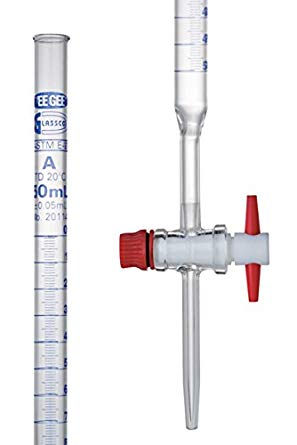
What is this piece of apparatus called
Pipette
Burette
Janette
Cuvette

What is the reading on this burette?
24.0cm3
25.8cm3
24.2cm3
23.9cm3

What is this piece of apparatus called
Pipette
Burette
Janette
Cuvette
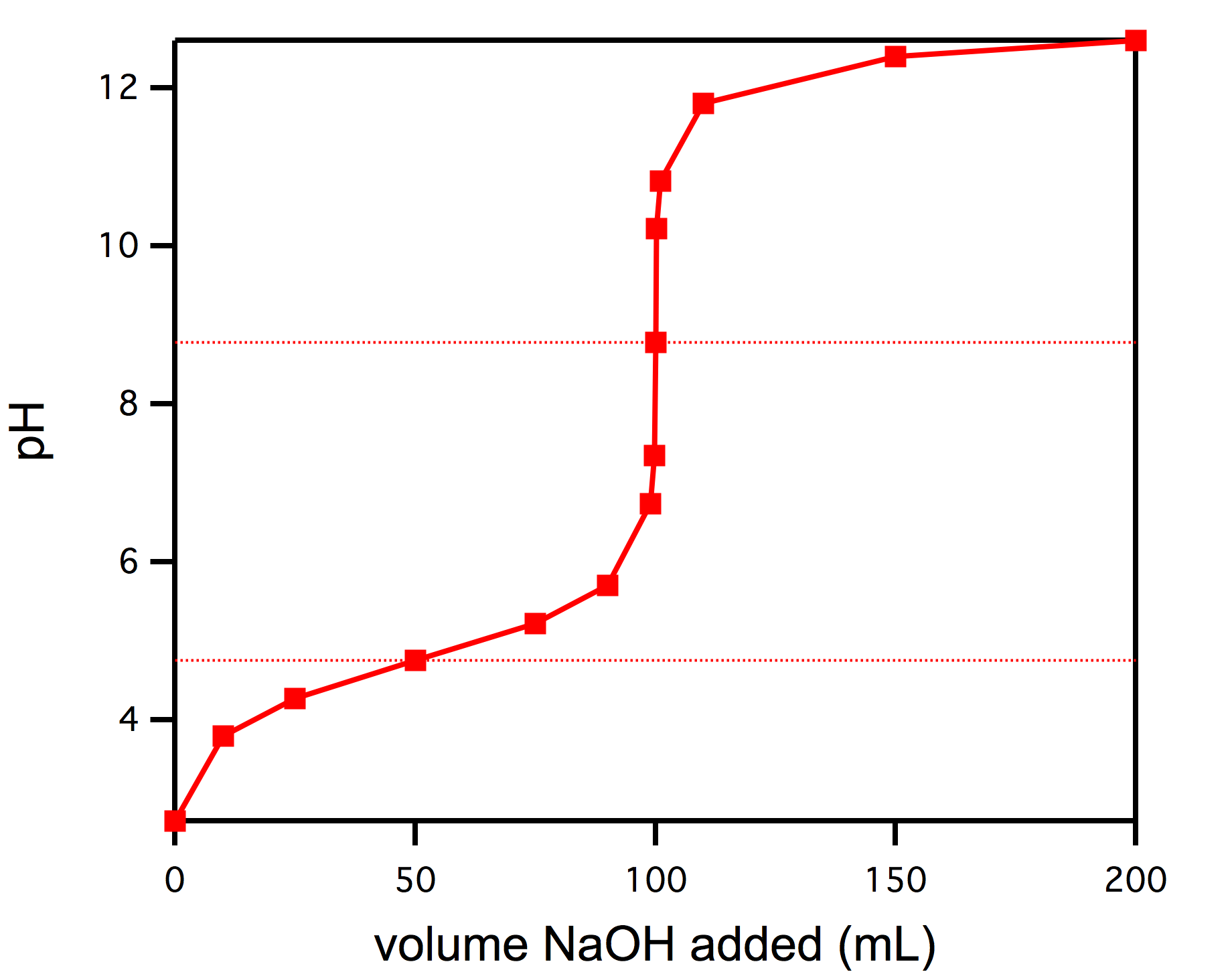
What is the pH at the equivalence point.
The pH is approximately 5
The pH is approximately 6
The pH is approximately 8
The pH is approximately 9
What does the following equation represent ?
H+ + OH- --> H2O
Titration
Acid reaction
Hydration
Neutralisation
What completely ionizes in solution?
Weak acids
Strong acids
Strong Salts
Neutral salts

Which of these is an example of an insoluble salt?
Copper sulfate
Magnesium sulfate
Lead Iodide
Lead Nitrate
What is general equation for the reaction of metal with an acid?
metal + acid → salt + hydrogen
metal + acid → salt + water
metal + acid → salt + alkali
metal + acid → salt + water + carbon dioxide
Use the words from the list to give the names of two substances that are insoluble in water.
Potassium iodide
Lead(II) sulfate
Ammonium carbonate
Silver nitrate
Silver chloride
Only certain metals will react with an acid because...
They must be more reactive than Hydrogen
The must be less reactive than Hydrogen
Mendeleev made it all up
Salts can only be produced with some metals.
What is the formula for copper(I) sulfate?
CuSO3
CuSO4
Cu2SO3
Cu2SO4
Which of the following is not true?
All nitrate salts are soluble.
All group I salts and Ammonium salts are soluble.
All carbonates are not soluble except group I and ammonium salts.
All sulphates are soluble except Copper (II) sulphate, Barium sulphate and Lead (II) sulphate.
Which of the following salts is insoluble?
Aluminium chloride
Copper (II) Sulphate
Sodium chloride
Calcium carbonate

