
 Worksheets
Metals, Non- metals, and Metalloids
Total questions: 25
Worksheet time: 13mins
The way an object reflects light is called
brittle
luster
mallable
ductile
Which of the following is NOT an example of a physical property of metals?
shiny luster
solids, liquids, or gas
solids only
are ductile
An object is solid, does NOT conduct, malleable, and is a shiny silver color. The object is Most Likely a -
metalloid
non-metal
metal
both metal and non-metal
The ability to be shaped or formed by hammering and pressure is called
brittle
conductibility
ductile
malleable
Can be drawn into a wire is called
malleable
luster
ductile
reactivity
Which answer choice is NOT a physical property of non-metals?
located on the right side of periodic table
malleable and ductile
are soft, and brittle
can be solids, liquids, or gases
Mr. Devers is examining a pale, yellow, brittle solid, with no shine. The sample is Most Likely a-
non-metal
metal
neither metal, non- metal, or metalloid
metalloid
Elements Aluminum, Silver, and Platinum are listed under this group
metals
metalloids
non-metals
physical change
This group are semi-conductors that are located along the zig-zag line. Most likely this group is-
both metals and metalloids
metalloids
non-metals
metals
Hardin Electric Corporation is designing a new product that conducts electricity and can be made into thin sheets. Which material would BEST fit their needs?
metalloids
metals
non-metals
semi-conductors
What would be the BEST title for this list : luster, ductility, conductivity?
chemical properties
physical properties
reactive properties
observable properties
Which of these is a property of a non-metal?
not ductile
solid at room temperature
good conductor of thermal energy
malleable
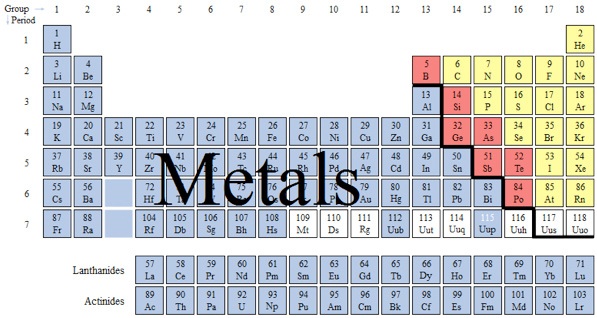
Which color identifies as the group non-metals?
neither color
blue
red
yellow
Brad is trying to classify materials by their physical properties. When he is observing that are found to be at room temperature, what type of substance is he observing?
metals
non-metals
ceramic
metalloids

Which color is identifies as metalloids?
red
yellow
grey
blue
Cell phones, lab-tops, and televisions are considered to be -
entertainment
non-metals
metalloids
metals
Hydrogen, Helium, and Fluorine are all listed as -
semi-metals
non-metals
metalloids
metals
Which of the following answer choices BEST describes non-metals?
ductile, shiny luster, solid and malleable
can be ductile, or non ductile, semi-conductor
shiny luster, solid only, good conductor
brittle, insulators, solids, liquids, or gases, located on right side of periodic table
Wood, plastic, glass, and rubber are considered
insulators
semi-conductors
conductors
semi- insulators

Fill in both blank spaces with correct answer choice for Iron.
dull and hard
shiny and hard
dull and brittle
shiny and brittle

Fill in the blanks with correct answer choices for aluminum
metal, shiny, and solid
metal, dull, and brittle
metalloid, hard, dull
metalloid, hard and shiny
Boron, Silicon, and Arsenic are considered to be
metalloids, semiconductors
metalloids, insulators
metals, semi-conductors
metalloids, conductors

Which of the following would be appropriate physical characteristic of Copper?
hard, brittle, and shiny luster
hard, shiny, and conductor
brittle, soft, and dull luster
dull, insulator, and solid

Elements Li, Ni, and Cu are listed on periodic table as
insulators
metals
metalloids
non-metals
Elements located along the zig-zag line are
metals
physical elements
non-metals
metalloids

