

wayground logo

Free Printable Worksheets

Font size

S
M
L
XL
Worksheets

Benchmark 2 Review

Total questions: 75

Worksheet time: 38mins

Name
Class
Date
1.
Where did Islam originate?
a)
Abrabian peninsula
b)
China
c)
North Africa
d)
India
2.
These include prayer, fasting, and charity
a)
the five pillars of Islam
b)
the Twelve Rightly Guided Caliphs 
c)
the Orthodox Articles of Faith
d)
the Ten Commandments 
3.
What is the Holy book of Islam? 
a)
Vedas
b)
Torah
c)
Bible
d)
Qur'an
4.
Which European nation did the early Islamic Empire include? 
a)
Germany
b)
France
c)
Spain
d)
Italy
5.
Besides being great conquerors, what else did the Islamic Empire influence?  
a)
Trade
b)
Nature
c)
Sports 
d)
Technology 
6.
Which of the following was NOT one of the major accomplishments of Islamic scholars?
a)
Translation of ancient Greek texts into Arabic
b)
Advancements in astronomy
c)
Medicine
d)
The invention of gunpowder
7.
What river did all West African Trading Kingdoms develop around?
a)
Nile
b)
Niger
c)
Congo
d)
Zambezi
8.

What goods did the West African kingdoms trade? (choose 2)

a)

gold

b)

salt

c)

oil

d)

silver

e)

silk

9.
1.  Muslim ____________________ became a part of African culture.
a)
language
b)
religion
c)
architecture
d)
religion & architecture
10.
1.  Which city became the center of learning in Mali?
a)
Ghana
b)
Timbuktu
c)
Cairo
d)
Nigeria
11.
This Muslim leader in Mali started to spread Islam through west Africa:
a)
Sundiata
b)
Mansa Musa
c)
Askia the Great
d)
Muhammad Ture
12.
The people of West Africa preserved the record of their past through the use of
a)
oral histories
b)
cuneiform writings
c)
stories written on scrolls
d)
hieroglyphics
13.
The kingdoms of Ghana, Mali, & Songhai prospered primarily due to their 
a)
exchanges with Indian ports
b)
direct access to the Arabian Sea
c)
control of trade routes
d)
abundance of diamonds
14.
At which point is the Sahara Desert located?
a)
E
b)
F
c)
G
d)
H
15.
At what point is the Niger River located?
a)
D
b)
E
c)
F
d)
G
16.
Where did Mansa Musa make a pilgrimage to with 80,000 people?
a)
The Holy Land
b)
Jerusalem
c)
Medina
d)
Mecca
17.
Which of the following was NOT an invention of the Chinese?
a)
Paper
b)
Magnetic Compas
c)
Gunpowder
d)
Columns
18.

The Yuan Dynasty was established by who?

a)

The Chinese

b)

The Mongols

c)

The Tibetians

d)

The Yuanese

19.
The grandson of Genghis Khan who took power and defeated the Song army in 1279, giving the Mongols control over all of China. 
a)
Genghis Khan
b)
Kublai Khan
c)
Marco Polo
d)
Zheng He
20.
The admiral of the imperial Ming dynasty who made seven voyages to India, the Arabian Peninsula, and Africa. 
a)
Genghis Khan
b)
Kublai Khan
c)
Marco Polo
d)
Zheng He
21.
The Mongol leader who united the Mongol tribes around A.D. 1206 and began a campaign of conquest, forging an empire that covered northern China and Central Asia. 
a)
Genghis Khan
b)
Kublai Khan
c)
Marco Polo
d)
Zheng He
22.
The Venetian trader who traveled the Silk Roads and became an advisor to Kublai Khan.
a)
Genghis Khan
b)
Kublai Khan
c)
Marco Polo
d)
Zheng He
23.
The Grand Canal connected the Yangtze River and the.. 
a)
Nile River 
b)
Mississippi River 
c)
Yellow River 
24.
Which physical features creates a natural boundary between India and China?
a)
Taklamakan Desert
b)
Yangtze River
c)
Himalayan Mountains 
d)
Plateau of Tibet
25.
Which physical feature separates northern China from Mongolia?
a)
Taklamakan Desert
b)
Yellow River
c)
Gobi Desert
d)
Plateau of Tibet
26.
What Chinese school of thought teaches respect to elders and the law as the best way to maintain a peaceful society?
a)
Taoism
b)
Christianity
c)
Confucianism
d)
Buddhism
27.

Put the dynasties in the correct order:

a)

Tang, Song, Yuan, Ming

b)

Song, Yuan, Ming, Tang

c)

Yuan, Ming, Tang, Song

d)

Ming, Tang, Song, Yuan

28.

What was the MOST powerful position in the Japanese Feudal system?

a)

The Emperor

b)

The Shogun

c)

The Diamyo

d)

The Samurai

29.

Why was the Emperor often described as a "figurehead" in Japanese Feudalism?

a)

The Emperor was at the top of the social pyramid and held all the power

b)

The Emperor technically owned all of the land in Japan

c)

The Emperor had few real powers in Japan

d)

The Emperor had complete control of the military

30.

Which members of the social hierarchy were considered members of the warrior class in Feudal Japan?

a)

Shogun

b)

Artisans

c)

Daimyos

d)

Samurai

31.

Which members of the social hierarchy were considered to be the least important people in Feudal Japan?

a)

Merchants

b)

Artisans

c)

Peasants

d)

Farmers

32.
What is feudalism?
a)
A system where lords allow people to work on their land in exchange for service
b)
Where people are elected to power
c)
Where everybody has the same amount of power
d)
Where peasants work as warriors
33.
What did the peasants get in return for serving and working for their local lord?
a)
Protection from invaders
b)
A long, happy life
c)
The right to vote for the king
d)
Lots of food and weekends off
34.

These three things flourished in Japan during the Heian Period.

a)

literature

b)

singing

c)

art

d)

drama

35.

Which religion is indigenous to Japan?

a)

Hinduism

b)

Shinto

c)

Buddhism

d)

Islam

36.

What were the two main religions that were practiced in Medieval Japan?

a)

Buddhism

b)

Confucianism

c)

Shintoism

d)

Christianity

37.
Which religion/philosophy does NOT follow the teachings of one man? 
a)
Shintoism
b)
Confucianism
c)
Buddhism
d)
Islam
38.
Which religion is monotheistic?
a)
Buddhism
b)
Hinduism
c)
Shintoism
d)
Islam
39.

Which of the following BEST describes the city of Constantinople?

a)

Built by the Muslims, poor economy, quickly was abandoned for a new capital

b)

Easy to attack and defeat, along a missionary route, united under one culture

c)

Easy to defend, multicultural, along trade routes

d)

Large city, large army present, accepted no outsiders
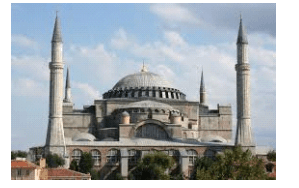
40.
What was the name of the code that unifed Byzantine and western Roman empire?
a)
Hammurabi's Code
b)
Justinian's Code
c)
Theodora's Code
d)
Byzantine's Code
41.
Identify this Byzantine Church that was commissioned by Justinian.
a)
Hagia Sophia
b)
National Cathedral
c)
Notre Dame
d)
Taj Mahal
42.
What was the capital city of the Byzantine Empire? 
a)
Rome 
b)
Athens 
c)
Constantinople 
d)
Italy 
43.

Which group conquered Constantinople?

a)

Persians

b)

Huns

c)

Ottoman Turks

d)

Carthage

44.

Which narrow body of water separates France and England?

a)

Atlantic Ocean

b)

Pacific Ocean

c)

English Channel

d)

Mediterranean Sea

45.

What is located at 2?

a)

Atlantic Ocean

b)

English Channel

c)

Mediterranean Sea

d)

North Sea

46.

What is located at 3?

a)

Alps Mountains

b)

Ural Mountains

c)

North European Plain

d)

Carpathian Mountains

47.

What is located at 5?

a)

Alps Mountains

b)

Ural Mountains

c)

Rocky Mountains

d)

Carpathians Mountains

48.

What is located at 6?

a)

Ural Mountains

b)

Alps

c)

North European Plain

d)

Swiss Plains

49.

What is the warm ocean current flowing northeast, under the influence of prevailing winds, from the Gulf of Mexico towards NW Europe and warming its climate?

a)

South Gulf Stream

b)

North Atlantic Drift

c)

South Pacific Drift

d)

Gulf Stream Drift

50.

Who is the leader of the Roman Catholic Church?

a)

the Pope

b)

the Archbishop

c)

the Cardinal

d)

the King

51.

Why were popes able to exercise power over kings during the Middle Ages?

a)

The threat of excommunication

b)

The threat of taxing the king

c)

The threat of jailing the king

d)

The threat of replacing the king

52.

Monasteries during medieval Europe was MOST important for

a)

Expanding the scientific knowledge brought by the Muslims

b)

Training people to become priests.

c)

Spreading Christianity to rural areas of Europe

d)

Allowing armies to retake Islamic territories

53.

Which is the BEST description of how medieval monks contributed to Western culture and civilization?

a)

organized and led bands of "Crusaders" who defended Europe from Muslim attackers

b)

their artwork served as the inspiration for the "Renaissance" that developed in Italy.

c)

re-wrote the Bible and changed many of its original stories

d)

helped preserve the learning, writing, and culture of the early Greeks, Romans, and Christians

54.

What institution was a constant and provided stability during the Middle Ages?

a)

Guilds

b)

Feudal Society

c)

the Monarchy

d)

the Roman Catholic Church

55.

Who was a highly trained, mounted (on a horse) warrior in the service of his lord?

a)

A noble

b)

A knight

c)

A peasant

d)

A king

56.

How would you define manor?

a)

a medieval town

b)

A self-sufficient economic system with a lord's castle at the center

c)

A place of prayer and worship

d)

A group of people with the same occupation

57.

The political and social system that took over Europe in the Middle Ages.

a)

Democracy

b)

Capitalism

c)

Communism

d)

Feudalism

58.

What is a serf?

a)

a peasant

b)

a rank of nobility

c)

a person tied to the lord's land and is not allowed to leave

d)

a person taken from their homeland and forced to work for others

59.

Who was the highest ranking in Feudal Europe society?

a)

Church officials

b)

King

c)

Knight

d)

Peasants

60.

Who was the lowest ranking in Feudal Europe society?

a)

Church officials

b)

King

c)

Knight

d)

Peasants

61.

A series of military expeditions from Christian Europe to Palestine between the 11th and 13th century

a)

Clergy

b)

Crusade

c)

Reconquista

d)

Religious Order

62.

The series of campaigns, ending in A.D. 1492 by which Christen armies drove Muslims rulers out of Spain

a)

Clergy

b)

Crusade

c)

Reconquista

d)

Religious Order

63.

The head of the Roman Catholic Church from 1073 to 1085, who struggled with Emperor Henry IV for power

a)

Francis of Assisi

b)

Pope Gregory VII

c)

Edward the Confessor

d)

Thomas Aquinas

64.

A court established by the Roman Catholic Church in A.D. 1542 to investigate people who may have strayed from Roman Catholic faith and to strengthen the power of the Church.

a)

Crusade

b)

Inquisition

c)

Reconquista

d)

Seljuk Turk

65.

A military leader who united Muslims to fight the Christians in Palestine during the 12th century A.D.

a)

Francis of Assisi

b)

Henry IV

c)

Saladin

d)

Thomas Aquinas

66.

After Charlemagne died and his government collapsed, most of the power shifted to the _________________.

a)

bishops

b)

kings

c)

missionaries

d)

nobles

67.

What was the main battle between the English and William the Conqueror?

a)

Battle of Bull Run

b)

Battle of Hastings

c)

Battle of Normandy

d)

Battle Royale

68.

What system did William the Conqueror bring to England in the 11th century?

a)

Protestantism

b)

industrialism

c)

Judaism

d)

feudalism

69.
Who fought in the Hundred Years' War?
a)
England and the U.S.
b)
England and France
c)
France and Spain
d)
Germany and France
70.
Who was the teen peasant girl who rallied the French troops to fight back against the English in the Hundred Years War?
a)
Joan of Arc
b)
Queen Isabella
c)
Robin Hood
d)
Queen Elizabeth
71.

What English king renewed the fighting during the Hundred Years War in the early 1400s?

a)

Henry V

b)

John

c)

Robert

d)

Henry VIII

72.
Where did the Black Plague first entered Europe?
a)
Through port cities first because of trade routes.
b)
The Black Death took several centuries to spread throughout Europe.
c)
The Black Death spread from Europe to Asia in 1854.
d)
The Black Death did not affect northern Europe the most.
73.

The plague is thought to have started where?

a)

Australia

b)

Asia

c)

Africa

d)

Europe

74.
How did the plague impact Europe?
a)
People started to question the church
b)
1/3 of the population died
c)
It contributed to the decline of feudalism
d)
All are correct
75.
How did the Bubonic Plague spread?
a)
Bad water
b)
Fleas on rats
c)
Looking at people
d)
Alignment of the stars
