wayground logo

Free Printable Worksheets

Font size

S
M
L
XL
Worksheets

Algebra 2 Final Exam Review - 1st Semester

Total questions: 200

Worksheet time: 14hrs 49mins

Name
Class
Date
1.

Which of the following polynomials is written in standard form?

a)

y = 7x3 − 5x2 + 2x + 7

b)

y = 8 − 4x2 + 3x + 2x3

c)

y = 10x2 − 5x5 + 2x + 20

d)

y = 1 + 2x2 − 3x3 + 4x4

2.

A degree three polynomial is also known as a:

a)

monomial

b)

quartic

c)

quadratic

d)

cubic

3.

What is the leading coefficient for the polynomial given by:

y = 3x2 + 9x5 − 4 + 10x8 + 2x9 ?

a)

2

b)

10

c)

9

d)

3

4.

The degree of the polynomial given by

y = 3x2 + 9x5 − 4 + 10x8 + 2x9 is:

a)

8

b)

9

c)

5

d)

-4

5.

What is the DEGREE of the polynomial 3x3 + 2x4 + 5x ?

a)

1

b)

2

c)

3

d)

4

6.

What is the DEGREE of the polynomial 17x + 4

a)

0

b)

1

c)

2

d)

3

7.
The following polynomial is written in standard form:
7x3 - 11x2 + 8x - 5
a)
True
b)
False
8.

The following polynomial is written in standard form:

10x2 - 11x6 + 18x - 15

a)

True

b)

False

9.

Classify by the DEGREE (first name):

-3x2 + 5 - 6x4 + 2x2

a)

Monomial

b)

Quadratic

c)

Cubic

d)

Quartic

10.

Classify by number of terms:

3x3 – 6x + 42

a)

Monomial

b)

Binomial

c)

Trinomial

d)

4-Term Polynomial

11.

Name this graph.

a)

linear

b)

quadratic

c)

cubic

d)

quartic

12.

Name this graph.

a)

linear

b)

quadratic

c)

cubic

d)

quartic

13.
Simplify the expression.
(4a3 - 8a - 4a2) + (7a3 - 7 - 6a)
a)
11a3 - 4a2 - 14a - 7 
b)
5a3 - 4a2 - 14a - 7 
c)
5a3 - 4a2 - 20a - 7 
d)
5a3 - 9a2 - 20a - 7
14.
Find the sum.
(3y2 + y3 - 5) + (4y2 -4y + 2y3 + 8)
a)
3y+ 7y- 4y + 3
b)
4y2 + 3y3 - y + 3
c)
-y4 + 2y-y - 4
d)
4y+ 3y-3y + 1
15.
When a polynomial is written in standard form, the coefficient of the first term is called the _____________.
a)
Boss coefficient
b)
Leading coefficient
c)
Best coefficient
d)
Greatest common coefficient
16.
Name and Classify the Polynomial:
x² − 4
a)
quadratic binomial
b)
quadratic monomial
c)
linear binomial
d)
linear monomial
17.
Find the sum. 
(3 - 2x + 2x2) + (4x - 5 + 3x2)
a)
7x - 7x + 5x2
b)
5x+ 2x - 2
c)
5x2
d)
5x2 + 6x + 8
18.
(4x+1)(5x−2)
a)
20x2 + 3x − 2
b)
20x2 − 11x + 5
c)
20x2 − 18x + 2
d)
20x2 − 3x − 2
19.

Simplify:

5(3x+2)

a)

3x+10

b)

15x+10

c)

15x-10

d)

3x-10

20.
-5x6(3x2 - 12x + 30)
a)
-15x+ 60x- 150x6
b)
15x- 60x- 150x6
c)
8x- 17x + 35
d)
-8x+ 17x - 35x2
21.

Simplify the product.

(2x – 6)2

a)
4x2 – 24x + 36
b)
4x2 – 8x + 36
c)
4x2 + 36
d)
4x2 – 12x + 36
22.
Find the area of a rectangle with length (x-5) and width (3x+1).
a)
3x2+16x-5
b)
3x2-14x+5
c)
3x2-14x-5
23.
Find the difference. 
(3- 2x + 2x2) - (4x -5 +3x2)
a)
x2 + 6x + 8
b)
2x+ 5x - 7
c)
-x2 -6x + 8
d)
-2x2 + 11x - 4
24.
(5x- 4x- 2x2 + x - 19) - (x+ 5x3 + 8x2 + x + 5)
a)
4x- 9x- 10x- 24
b)
4x- 9x3 - 10x- 2x - 24
c)
4x4 - 9x3 - 10x2 + 2x - 24
d)
-4x4 - 9x3 - 10x2 - 24
25.
What is the perimeter for the given rectangle:
a)
6x3 - 9x2 + 10x - 15
b)
6x2 + 1x - 15
c)
6x2 + 4x + 4
d)
6x3 + 1x2 - 15x
26.
(2x + 3)(x2 + 4x + 1)
a)
2x3 + 10x2 + 14x + 4 
b)
2x3 + 11x2 + 14x + 3 
c)
-2x3 - 11x2 + 14x + 5 
d)
x3 - 11x2 + 14x + 3 
27.
Simplify the expression
(x - 3)2
a)
x2 - 6x + 9
b)
x2 + 9
c)
x2 + 6x - 9
d)
x2 + 6x + 9
28.
Multiply
x2(2x+3)
a)
x2+2x+3
b)
2x+3
c)
2x2+3x
d)
2x3+3x2
29.
(2x+6)(2x-6)
a)
4x2+24x-36
b)
6x+12
c)
4x2-36
d)
2x+6+2x-6
30.
Simplify:
(3x - 5) ( 4x2 - 2x - 3)
a)
12x3 - 26x2 - 25x + 15
b)
12x3 - 20x2 - 5x + 15
c)
12x3 - 20x2 - 6x + 15
d)
12x3 - 26x2 + x + 15
31.
a)

x+7

b)

x+2

c)

X-10

d)

X-7

32.
a)

2x2 + 3x + 8 + -57/x-4

b)

2x2 - 13x - 56

c)

2x2 + 3x + 8 +7/x-4

d)

2x2 - 3x - 16 + -89/x-4

33.
(2x3 + 7x2 - 6x - 8) ÷ (x+ 4)
a)
2x2 - x - 2
b)
2x3 - x2 - 2x
c)
2x2 + 15x + 54 + 208/x+4
d)
2x3 + 15x2 + 54x + 208
34.
Which would be better to use?
a)
Long division
b)
Synthetic division
35.
a)
This is correct
b)
This is incorrect
36.

(x3-8x2+6x+41)÷(x-4)

a)

x2-4x-7, R 2

b)

x2-4x-11, R 1

c)

x2-2x-12, R 3

d)

x2-4x-10, R 1

37.

What is the remainder when a3 - 4 is divided by a+2?

a)

-2

b)

-6

c)

-12

d)

4

38.
f(x)=4x+5
f(4)=
a)
21
b)
-11
c)
-31
d)
25
39.
f(x)=x+3
f(x) = -5
a)
-2
b)
-1
c)
-8
d)
7
40.
f(x)=x2-5x
f(4)=
a)
-4
b)
126
c)
24
d)
84
41.
Evaluate f(t)=-2t2+ 1 for f(-3)
a)
19
b)
37
c)
-17
d)
-11
42.
Evaluate y = 4x - 1 when y = 19.
a)
39
b)
41
c)
5
d)
38
43.
What is the value of f(0)?
a)
-2
b)
2
c)
4
d)
0
44.
What is f(2)?
a)
-4
b)
8
c)
0
d)
5
45.
For what value of x does f(x) = -2?
a)
0
b)
-5
c)
3
d)
-3
46.
Given f(x) = -4x - 10 and f(x) = 10. Find x
a)
x = -5
b)
x = 5
c)
x = -50
d)
x = 30
47.

What is the value of x when f(x) = 16?

a)

x = 4 only

b)

x = 4 and x = 8

c)

x = 16

d)

Not on the graph

48.
f(x) = 9-3x
g(x) = 5x-7
Find f(x)+g(x). 
a)
14x-10
b)
-8x+2
c)
2x+2
d)
2x-2
49.
f(x) = x2+9
g(x) = x-9
Find f(x)-g(x). 
a)
x2+x+9
b)
x2-x+9
c)
x2-x
d)
x2-x+18
50.
f(x) = 4x+8
g(x) = x+3,
Find f(x) * g(x)
a)
4x2+24
b)
4x2+20x+24
c)
4x2+12x+24
d)
4x2+4x+24
51.
f(n)=n2+4n
g(n)=-n-5
Find f(n)+g(n)
a)
n2+3n-5
b)
-n3+2n-7
c)
n3+3n-3n
d)
n2-3n-5
52.
f(x) = 3x + 10
g(x) = x - 2
Find f(g(5))
a)
19
b)
23
c)
-10
d)
None of these.
53.
f(x) = 3x + 10
g(x) = x - 2
Find f(g(0))
a)
16
b)
4
c)
-4
d)
None of these.
54.
All of the x values or inputs are called what?
a)
Domain
b)
Range
c)
Relation
d)
Function
55.
Given that f(x) = x2 + x and g(x) = 3x + 1, find the value of f(g(4)).
a)
182
b)
40
c)
61
d)
None of the Above
56.
Given
f(x) = 3x2 + 7x and g(x) = 2x2 - x - 1, find (f + g)(x).
a)
11x2 - 1
b)
5x4 + 6x2 - 1
c)
5x2 + 6x - 1
d)
5x2 + 8x - 1
57.

Given f(x) = 2x and g(x) = x2 + 3

find f(g(x)).

a)

x2 + 2x + 3

b)

4x2 + 3

c)

2x2 + 3

d)

2x2 + 6

58.

When f(x) = x2 - 9

and g(x) = x + 3 ,

find f(x) / g(x).

a)

x - 3

b)

x + 3

c)

x - 12

d)

x - 6

59.

f(x) = 4x + 8

g(x) = x + 3,

Find f(x) ⋅ g(x)

a)

4x2 + 24

b)

4x2 + 20x + 24

c)

4x2 + 12x + 24

d)

4x2 + 4x + 24

60.

p(x) = 3x + 4

q(x) = 2x2

Find p(q(x))

a)

10x2

b)

18x2 + 4

c)

6x2 + 4

61.
f(x)=x2-4
h(x)=3x+3
f(h(x))
a)
3x2-9
b)
12x2+8x+5
c)
16x2-36x+20
d)
9x2+18x+5
62.
Find the inverse of f(x) = -4x - 12
a)
f-1(x) = 4x - 3
b)
f-1(x) = -1/4x - 3
c)
f-1(x) = 1/4x + 3
d)
f-1(x) = -4x - 3
63.

Are the following inverses of each other? Use composition of functions. fog(x) and gof(x)

a)

True

b)

False

64.
Was the inverse function found correctly?
a)
no,
b)
yes
65.
Was the inverse function found correctly?
a)
no,
b)
yes
66.
Find the inverse of
f(x) = 1/4x - 7
a)
f-1(x) = 4x + 7
b)
f-1(x) = -4x + 28
c)
f-1(x) = -4x - 7
d)
f-1(x) = 4x + 28
67.
What does it mean to find the inverse of a function?
a)
the x's and y's are switched
b)
the x's and y's are divided by 2
c)
the x's and y's are made negative
d)
the x's and y's are the same
68.
a)

Inverse Functions

b)

Not Inverse Functions

69.
a)

Inverse Functions

b)

Not Inverse Functions

70.

What operation allows us to verify if functions are inverses?

a)

Multiplying

b)

Dividing

c)

Adding

d)

Composing

71.
Find the inverse of f(x) = x2 - 5
a)
f-1(x) = √(x) + 5
b)
f-1(x) = ∛(x-5)
c)
f-1(x) = ±√(x+5)
d)
f-1(x) = x2 - 5
72.
Are these functions inverses?
a)
Yes
b)
No
73.
What is the inverse of the points
(1,3)(2,4)(6,8)
a)
(3,1)(4,2)(8,6)
b)
(-3,-1)(-4,-2)(-8,-6)
c)
(1,3)(2,4)(6,8)
d)
(-1,-3)(-2,-4)(-6,-8)
74.
Are these functions inverses?
a)
No
b)
Yes
c)
No way to tell
75.
Are these inverse functions?
a)
no
b)
yes
c)
no way to tell
76.
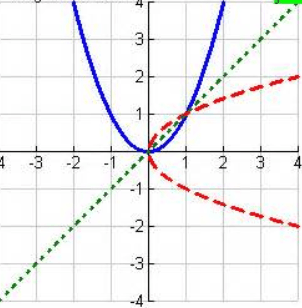
Are the blue and red graphs inverse functions?
a)
yes
b)
no
c)
no way to tell
77.
What's the name of the inverse of g(x)?
a)
f(x)
b)
f-1(x)
c)
y
d)
g-1(x)
78.

Where is point B located?

a)

2 + i

b)

-3

c)

2i

d)

-1 - i

79.

Where is point C located?

a)

2 + i

b)

-3

c)

2i

d)

-1 - i

80.

Where is point A located?

a)

2 + i

b)

-3

c)

2i

d)

-1 - i

81.

(3 + 2i) + (4 - 5i)

a)

7 + 7i

b)

1 - 3i

c)

1 - 7i

d)

7 - 3i

82.

(-7 + 9i) + (2 - 10i)

a)

-5 + i

b)

-5 - i

c)

-9 + 1

d)

9 - i

83.

(4 - 2i) - (3 + 6i)

a)

7 - 4i

b)

1 + 4i

c)

1 - 8i

d)

7 - 8i

84.
Choose the correct answer for the operation pictured.
a)
7-13i
b)
7-i
c)
1-13i
d)
1-i
85.

What does i2 equal?

a)

-1

b)

√-1

c)

1

d)

-√1

86.
The expression (2 + 3i)2 is equal to
a)
-5
b)
-5 + 12i
c)
13
d)
13 + 12i
87.

(3 + 8i)(-2 - i)

a)

2-19i

b)

23-i

c)

34+5i

d)

23-i

88.

Simplify

a)

(-10+6i)/17

b)

(1+50i)/61

c)

(-23+36i)/25

d)

(-21+33i)/34

89.

(-5 + 10i)(-5 - 10i) = 125

a)

True

b)

False

90.
√-36
a)
6
b)
-6
c)
-6i
d)
6i
91.

What letter represents an imaginary number?

a)

a

b)

i

c)

j

d)

x

92.

Simplify.

a)
b)
c)
d)
93.
Simplify   i23
a)
i
b)
-1
c)
1
d)
-i
94.
(2i)(3i)
a)
5i
b)
-5
c)
6i
d)
-6
95.
Simplify:
-3i(4 + 2i)
a)
6 - 12i
b)
6 + 12i
c)
-12i - 6i2
d)
-12i + 6i2
96.
√-81
a)
9i
b)
-9i
c)
-9
d)
9
97.
Find the product
(1+3i)(2-i)
a)
5+5i
b)
5-5i
c)
2-3i
d)
5+7i
98.

How do you write a complex number?

a)

a-bi

b)

a+bi

c)

ai+b

d)

ai-b

99.
Simplify -4√-63
a)
3i√7
b)
-12i√7
c)
-12√7
d)
36√7
100.
Simplify
2i - 7i + 10
a)
-5i+10
b)
5i
c)
9i+10
d)
5i+10
101.
i52
a)
i
b)
-i
c)
1
d)
-1
102.
What complex number is represented by the graph?
a)
-3-i
b)
-3+i
c)
1+3i
d)
1-3i
103.

What complex number is shown on the graph?

a)

(-2,-3)

b)

-2-3i

c)

2-3i

d)

3i-2

104.

What is i?

a)

1

b)

-1

c)

√-1

d)

√1

105.

Write in standard form: (5 + 3i)(5 - 3i)

a)

34

b)

16

c)

25 - 30i + i2

d)

24 - 30i

106.

What is the conjugate of 5 - 2i?

a)

5 + 2i

b)

-5 - 2i

c)

5 - 2i

d)

-5 + 2i

107.
a)
A
b)
B
c)
C
d)
D
108.
a)
A
b)
B
c)
C
d)
D
109.

Simplify 

 99\sqrt{99}  

a)

 3333\sqrt{33}  

b)

4 11\sqrt{11}  

c)

 3113\sqrt{11}  

d)

2 11\sqrt{11}  

110.

Simplify

 2749\sqrt{\frac{27}{49}}  

a)

 237\frac{2\sqrt{3}}{7}  

b)

 337\frac{3\sqrt{3}}{7}  

c)

 37\frac{3}{7}  

d)

 277\frac{\sqrt{27}}{7}  

111.
a)
b)
c)
d)
112.

 Write 2+5i3+i Write\ \frac{2+5i}{3+i}\   as a single complex number.

a)

 2+5i2+5i  

b)

 1110+1310i\frac{11}{10}+\frac{13}{10}i  

c)

 310+1310i\frac{3}{10}+\frac{13}{10}i  

d)

 118+138i\frac{11}{8}+\frac{13}{8}i  

113.

Find:  52i\left|5-2i\right|  

a)

 2929  

b)

 29\sqrt{29}  

c)

 333\sqrt{3}  

d)

 33  

114.
i6 × i15 =
a)
i
b)
- 1
c)
- i
d)
1
115.

Solve the following quadratic equation...


x2 + 3x + 2 = 0

a)

x = -1

x = -2

b)

x = 1

x = 2

c)

x = -1

x = 2

d)

x = 1

x = -2

116.

Solve the following quadratic equation...


x2 + 7x + 12 = 0

a)

x = -2

x = -6

b)

x = -3

x = -4

c)

x = -1

x = -12

d)

x = 2

x = 6

117.
Factor x2-6x-40
a)
(x-10)(x+4)
b)
(x+10)(x-4)
c)
(x-8)(x+5)
d)
(x+8)(x-5)
118.
Complete the Square and write in Vertex Form:
f(x) = x2 + 6x + 5
a)
(x + 3)2 - 4
b)
(x + 6)2 - 4
c)
(x + 3x)2 - 4
d)
(x + 3)2 + 9
119.
Solve by completing the square.
x2 + 4x= 12
a)
x = 2 and -2
b)
x = -6 and 2
c)
x = 6 and -2
d)
x = 1 and -1
120.
Solve by completing the square. 
 x2 − 10x - 11= 0
a)
x = −1 and 11
b)
x = 1 and −11
c)
x = −10 and 11
d)
x = −5 and 25
121.
ax2+bx+c=0  is the standard form of a quadratic equation.
a)
True
b)
False
122.
What should you do first in solving this equation?
x2 + 6x - 13 = 3
a)
Get factored form
b)
Write down: a=1, b=6, c=-13
c)
Make it equal 0 by subtracting 3 on each side
d)
Type it all in a calculator.
123.
Determine the values of
a, b, and c for
the quadratic equation: 
4x2 – 8x = 3
a)
a = 4, b = -8, c = 3
b)
a = 4, b =-8, c =-3
c)
a = 4, b = 8, c = 3
d)
a = 4, b = 8, c = -3
124.
What is the vertex of the graph?
a)
(2, 4)
b)
(3, -1)
c)
(0, 8)
d)
(4, 2)
125.
a)
±81
b)
±9
c)
±3
d)
No real solution
126.
a)
±√9
b)
±3
c)
±1
d)
No real solution
127.
a)
±23.25
b)
±5
c)
±25
d)
No real solution
128.
a)
± 1
b)
± 4/3
c)
± 3/4
d)
No real solution
129.
a)
-6, -2
b)
-2, 6
c)
2, 6
d)
-6, 2
130.
a)
±1.5
b)
1.5
c)
±1
d)
No real solution
131.
What is the discriminant?
a)
b²-4ac
b)
b2/2a
c)
4ac
d)
b2±4ac
132.
If the discriminant equals 0, then the quadratic has:
a)
1 Real Solution
b)
2 Real Solutions
c)
Half a Solution
d)
No Real Solution
133.
If the discriminant is negative, then the quadratic has:
a)
1 Real Solution
b)
2 Real Solutions
c)
Half a Solution
d)
No Real Solutions
134.
If the discriminant is positive, then the quadratic has:
a)
1 Real Solution
b)
2 Real Solutions
c)
Half a Solution
d)
No Real Solution
135.
If the graph of a quadratic does not intercept the x axis at any point, then it has:
a)
1 Real Solution
b)
2 Real Solutions
c)
Half a Solution
d)
No Real Solution
136.
Convert x2-9x+20 to factored form and solve.
a)
(x-10)(x+2); x=-2, 10
b)
(x+4)(x+5); x=-5, -4
c)
(x-4)(x-5); x=4, 5
d)
Not factorable
137.
Solve:
x2 - 49 = 0
a)
x = -7, x = 7
b)
x = -7
c)
x = 7
d)
x = -7, x = 1
138.

Solve 2x² - 7x + 6 = 0 by factoring

a)

x = -3/2 and x = -2

b)

x = -3 and x = -2

c)

x = 3 and x = 2

d)

x = 3/2 and x = 2

139.

Solve Using the method of your choice.

x2 + 4x - 40 = -8

a)

-10 & -4

b)

-4 & 10

c)

-8 & 4

d)

8 & -4

140.
Which answer correctly factored for the equation below?
a)
(x + 7)(x - 2) = 0
b)
(x - 7)(x + 2) = 0
c)
(x - 7)(x - 2) = 0
d)
(x + 7)(x + 2) = 0
141.
Find the zeros.
a)
0 and 4
b)
0 and -4
c)
0
d)
-4
142.
True or false:
The solution, root, x-intercept, and zero of a problem are all the same thing.
a)
True
b)
False, because the solution and root are the same but the x-intercept and zero are different
c)
False, because the x-intercept and root are the same but the zero and solution are different
d)
False, they are all different
143.
Factor 6x2-27x
a)
(6x+1)(x+3)
b)
3x(2x-9)
c)
6x(x-9)
d)
(3x-9)(2x+3)
144.
What is another name for the x-intercepts of a quadratic?
a)
y-intercept
b)
Zeros
c)
x-axis
d)
They don't have another name
145.
x- 25
a)
( x + 5 ) ( x - 5 ) 
b)
( x - 5 ) ( x - 5 ) 
c)
( x + 5 ) ( x + 5 ) 
d)
Prime
146.
x- 16
a)
Prime
b)
( x - 4) ( x + 4) 
c)
( x - 8) ( x + 8) 
d)
( x - 4) ( x - 4) 
147.
What is another word for zeros?
a)
y-intercepts
b)
roots
c)
vertex
d)
axis of symmetry
148.
How many zeros does this parabola have? 
a)
3
b)
2
c)
0
d)
1
149.
What are the solutions of this graph?
a)
x=-2 and x=3
b)
x=-1/2 and x=-6
c)
x=-2 and x=-6
d)
x=3 and x=-6
150.
What is another word for zeros?
a)
y-intercepts
b)
solutions
c)
vertex
d)
axis of symmetry
151.
How many solutions (x-intercepts) does the quadratic have?
a)
Two Solutions
b)
One Solution
c)
0 Solutions
d)
I don't know
152.
What property would you use to solve the following?
(x-3)(x+2)=0
a)
Commutative Property
b)
Associative Property
c)
Zero Product Property
d)
Inverse Property
153.

Solve using Zero-Product Property.

(2x - 2)(5x + 5) = 0

a)

x = -1

b)

x = -1 or x = 1

c)

x = 1

d)

x = -2 or x = 5

154.
What is this formula?
a)
This is the speed of light formula.
b)
This is the quadratic formula.
c)
This is the zero product property.
d)
This is scary.
155.

Solve the following for x by using the Quadratic Formula


2x2+6x=7

a)
b)
c)
156.

Solve by the Extraction of Roots method: (x - 2) 2 = 49

a)

9 or -5

b)

± 9

c)

± 5

d)

± 7

157.
What is the first step to solving THIS equation by completing the square?
a2 + 10a + 21 = 0
a)
Set the equation equal to zero
b)
Divide 10 by 2 and add the result to both sides
c)
Add a2 and 10a together
d)
Subtract the 21
158.
Find the missing value "c" to create a perfect square trinomial:
x2 – 8x  + ___ 
a)
-4
b)
16
c)
4
d)
8
159.

Solve by ANY method you have learned: x2−2x+11=0

a)

1±i√10

b)

1±√10

c)

-1±i√10

d)

-1±√10

160.
Complete the square.
x2 + 14x + ____
a)
x2 + 14x - 196
b)
x2 + 14x + 49
c)
x2 + 14x - 49
d)
x2 + 14x + 196
161.

Solve using the Quadratic Formula:


2x2 − x − 3 = 0

a)

x = −3/2, 1

b)

x = 3/2, −1

c)

x = −3/2, & −1

d)

x = 3/2, 1

162.

Solve using the Quadratic Formula:


x2 + 6x + 9 = 0

a)

x = −3, 3

b)

x = −3

c)

x = 3

d)

No Solution

163.
Use the graph to determine the solutions.
a)
-1 and -3
b)
1 and -3
c)
1 and 3
d)
-1 and 3
164.

Solve the quadratic equation by using the quadratic formula.

2x2 -3x = -4

a)
b)
c)
d)
165.

Solve by factoring. (HINT: Factor GCF 1st)

a)

x = 3, x = -6

b)

x = 0, x = 2

c)

x = 2, x = 3

d)

x = -2, x = 1

166.
Factor Completely: 
3x2 + 18x +15
a)
3(x2 + 6x + 5)
b)
(x + 5)(x + 1)
c)
3(x + 5)(x + 1)
d)
Prime
167.

When solving a quadratic equation, when do you use the plus or minus (±) symbol?

a)

After taking the square root of both sides

b)

After adding the square to both sides

c)

After taking half of b

d)

After setting the equation equal to zero

168.
Factor completely:
2x+ 5x2 - 8x - 20
a)
(x2 - 4)(2x + 5)
b)
(2x - 5)(x2 + 4)
c)
(2x2 - 4)(x + 5)
d)
(x - 2)(x + 2)(2x + 5)
169.
Find all zeros for the polynomial
P(x) = x3 -3x2-5x+15
a)
3, √5 
b)
3, √5, -√5
c)
-3, √5, -√5
d)
-3, 5i, -5i
170.
FInd all zeros for the polynomial
f(x) = x4+8x2-9
a)
-1, ⅓, ±3i
b)
½, -1, ±3i
c)
1, -1, ±i√11
d)
1, -1, ±3i
171.

What are the remaining factors for

(x3 +x2 -17x +15) if (x -1) is a factor? (use synthetic division)

a)

(x-1) (x+5) (x-3)

b)

(x-1) (x+5) (x + 3)

c)

(x+1) (x+5) (x-3)

d)

(x+1) (x-5) (x-3)

172.
Factor: x- 169 
a)
( x - 13) ( x + 13) 
b)
( x + 13) ( x + 13) 
c)
( x - 13) ( x -13) 
d)
x - 13x + 13
173.

Solve for the values of x:

(2x - 1)(x + 4) = 0

a)

x = 1/2, -4

b)

x = 1/2, 4

c)

x = 2, -4

d)

x = -2 4

174.
What is the first step in solving 
(x + 2)(x - 3) = 0      ?
a)
Plug in zero for x
b)
Solve for x
c)
FOIL
d)
Set each binomial factor equal to zero
175.

What are the zeros in (x-5)(x+4)

a)

4 and -5

b)

5 and -4

c)

-4 and -5

d)

no zeros

176.

What is the GCF in 3x3 + 15x2 + 30x

a)

3

b)

3x

c)

5

d)

x

177.
How many zeros does the polynomial function
 P(x) = 3x4+4x-8 have?
a)
1
b)
2
c)
3
d)
4
178.
a)
A
b)
B
c)
C
d)
D
179.

Is (x-1) a factor of f(x)= x3-8x2+14x-4?

a)

Yes, (x-1) is a factor. There is a remainder.

b)

No, (x-1) is not a factor. The remainder is zero.

c)

Yes, (x-1) is a factor. The remainder is zero.

d)

No, (x-1) is not a factor. There is a remainder.

180.

What are the three factors for

(x3 +3x2 -4x -12) ÷ (x + 2)?

a)

(x-2) (x+2) (x+3)

b)

(x-2) (x-2) (x+3)

c)

(x+2) (x+2) (x+3)

d)

(x-2) (x+2) (x-3)

181.

What are the three factors for

(x3 +x2 -17x +15) ÷ (x -1)?

a)

(x-1) (x+5) (x-3)

b)

(x-1) (x+5) (x + 3)

c)

(x+1) (x+5) (x-3)

d)

(x+1) (x-5) (x-3)

182.

Decide if (x+3) is a factor of 3x3+10x2-x-12

a)

Yes, it is a factor!

b)

No, it is not a factor!

183.

If 𝒙2+𝟑𝒙+𝟕 is divided by 𝒙-𝟐, then what is the remainder?

a)

0

b)

-3

c)

17

d)

5

184.
Use the Fundamental Theorem of Algebra to determine the total number of solutions.
a)
A
b)
B
c)
C
d)
D
185.
Find all the zeros of the polynomial. 
a)
A
b)
B
c)
C
d)
D
186.
Find the zeros of the polynomial given one factor.
a)
X= 3,4,5
b)
x=-3,-4,-5
c)
x=-3,4,5
d)
x= 3, -4, -5
187.
What is the Fundamental Theorem of Algebra?
a)
The degree of the polynomial determines what the x value will be
b)
The degree of the polynomial tells us how many solutions the polynomial will have.
c)
The number of possible rational zeros
d)
States that a complex number and its conjugate are solutions
188.
Which of the following is a 5th degree trinomial with a leading coefficient of -2? 
a)
-2x5 + 3x - 1
b)
5x-2 +3x - 1
c)
-2x5 + 3x4 + 2x3 + x2 - 10
d)
2x + 5
189.
Find all rational zeros, one zero has been given.
f(x) = x3-5x2-2x+24;   -2
a)
-2,1,0
b)
-2,-3,-4
c)
4,3,-2
d)
0,0,0
190.
Find all zeros. One zero has been given.
f(x) = x4 + 8x3 + 14x2 - 8x - 15; x = -5
a)
-2,1,-1,-5
b)
-3,1,-1,-5
c)
3,-3,4,0
d)
-1,1-5,3
191.

 a+bi\left|a+bi\right|  is defined as:

a)

 a2+b2\sqrt{a^2+b^2}  

b)

 a2b2\sqrt{a^2-b^2}  

c)

 a2+(bi)2\sqrt{a^2+\left(bi\right)^2}  

d)

 a2(bi)2\sqrt{a^2-\left(bi\right)^2}  

192.

Find 3  2i\left|3\ -\ 2i\right|   

a)

13

b)

 13\sqrt{13}  

c)

5

d)

5i

193.
f(x)=(x+4)(x-3)(x-2)
List the zeros for this function.
a)
x= -4, x=3, x= -2
b)
x= -4, x=3, x=2
c)
x= -4, x=3, x=2
d)
x=4, x= -3, x= -2
194.
Identify the zeros:
a)
x=-2, x=-1, x=0
b)
x=-2, x=0
c)
x=-1, x=0, x=2
d)
x=-2, x=0, x=1
195.
a)
y=-(x+1)(x-2)(x-4)
b)
y=(x+1)2(x-3)(x-1)3
c)
y = 3x3 – 2x + 1
d)
y=(x+1)3(x-3)(x-1)2
196.
State the degree, type, and leading coefficient for this polynomial.
a)
Degree is 4, quartic, leading coefficient is 2
b)
Degree is 3, cubic, leading coefficient is √14
c)
Degree is 2, quadratic, leading coefficient is ⅓
d)
Degree is 2, cubic, leading coefficient is 4
197.
Use the rational zero test to determine all the p/q values for  f(x) =
 x4 - 3x3 + 6x2 - 8x - 28 
a)
±1, 2, 4, 8, 12, 14, 28 
b)
± 1∕4, 1∕2, 1, 2, 4, 7, 14, 28
c)
±1, 2, 4, 7, 14, 28
d)
±1, 28
198.
How could you determine    if x-2 is a factor of 2x³-5x²+x-2?
a)
Use synthetic division and see if the quotient is even
b)
Ask the person sitting next to me
c)
Use synthetic division and see if the remainder is zero
d)
Flip a coin
199.
Which of the following is a COMPLETE  list of all possible Rational Zeros?
f(x) = 3x3 + 2x2 - 6x + 7
a)
±1, ±7, ±1/3, ±7/3
b)
±1, 7
c)
±1, ±3, ±7, ±7/3
d)
±1, ±3, ±7, ±1/3, ±7/3
200.
a)
f(x) = ⅕ (x+3) (x+4) (x-8)
b)
g(x) = ½ (x-4) (x+3) (x-6)
c)
h(x) = ⅕ (x-3) (x-4) (x+8)
d)
p(x) = ½ (x+4) (x-3) (x+6)