
 Worksheets
Solids, Liquids, Gases
Total questions: 41
Worksheet time: 22mins
Measure of the average kinetic energy of the particles in an object
thermal energy
temperature
kinetic energy
Changing from a gas to a liquid
condensation
vaporization
sublimation
melting
Changing directly from a solid to a gas
condensation
vaporization
sublimation
melting
An example of a liquid is
honey
a stapler
a water bottle
True or false: Gases can be compressed or forced into a smaller space
True
False
When a thermometer is heated, the red liquid inside the thermometer moves up. This is mainly because:
The red liquid is thin.
The molecules move faster and get a little further apart.
Hot liquid is lighter.
The glass of the thermometer gets hot.
An increase in temperature increases molecular motion and increases the distance between atoms and molecules in liquids.
true
false
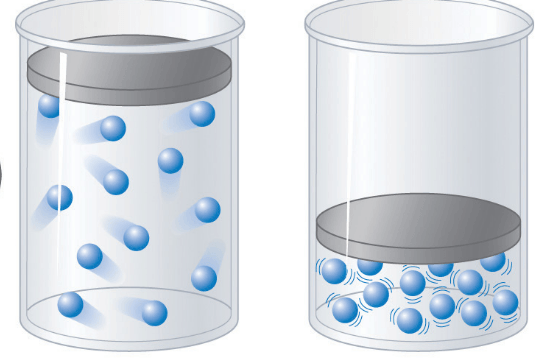
IF we are using Charles' law and our Volume goes UP, what must our temp do?
Go UP
Go DOWN
Stay the same
Wrong law.
If you increase the temperature of a gas inside a balloon, the balloon will....
Expand (increase in volume)
Deflate (decrease in volume)
Not change
Pop
Which of the following is NOT a property of a gas involved in the gas law relationships?
Pressure
Temperature
Volume
Viscosity
Which of the following will cause the volume of a gas to decrease?
Increased temperature
Decreased pressure
Increased pressure
Increasing, then decreasing pressure
When a sample of gas is heated, the energy of its molecules...
Increases
Decreases
Stays the same
Increases, then decreases

The diagram below shows a glass containing a liquid and ice cubes. Which process causes water droplets to form on the outside of the glass?
Condensation
Evaporation
Freezing
Melting
The force of a gas' outward push on the walls if its container is called its...
Temperature
Pressure
0oC
100oC

Which two processes in the diagram below increase the motion of the molecules?
A & B
C & D
B & C
A & D

Which graph above shows the correct change in pressure (P) as the volume (V) increases?
(a)
(b)
(c)
(d)
(e)
The force of a gas' outward push on the walls if its container is called its...
Pressure
Temperature
Volume
Shape

