NEW
Font size
 Worksheets
Review & Recap
Total questions: 35
Worksheet time: 1hrs 3mins
1. They have a rattle on the end of their tail to warn other animals.
2. They feed on rodents, squirrels, rabbits, and small animals.
3. They hibernate in the winter and come out in the spring.
4. Most of the time there are 8-10 babies born at once.
Which of these facts best describes how rattlesnakes depend on other animals to survive?
Fact 1
Fact 2
Fact 3
Fact 4
· A seagull catching a fish.
· A crab digging a tunnel in the sand.
· A child playing with their dog.
· A shrimp hiding in seaweed.
Which of these living organisms was interacting with a nonliving part of the environment?
Seagull
Shrimp
Child
Crab
In a food chain, energy does not flow directly from –
producer to consumer
consumer to producer
consumer to decomposer
producer to decomposer
The antelope in a zoo always walk toward the fence when people come by. The antelope wait to be fed cookies by the people visiting the zoo. This is an example of –
an inherited trait
an inherited behavior
an instinct
a learned behavior
All of the following are inherited traits found in plants except –
the color of a plant’s flower
the number of insects that pollinate it
the type of root structure
the shape of a plant’s leaves

The pictures above show the same area before and after water was released from a dam. Which process happened more quickly because the water was released from the dam?
Deposition
Erosion
Precipitation
Weathering by wind
Extreme weather changes can cause a rock to break into slabs. This happens when the rock is heated by the sun and expands. When the temperature falls, the rock cools and contracts. This cycle of heating and cooling (expansion and contraction) is an example of -
Deposition
Erosion
Precipitation
Weathering

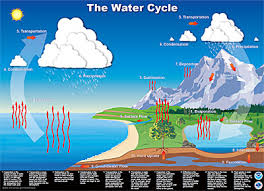
During which stage of the water cycle would you expect to see the most erosion?
Stage 1
Stage 2
Stage 3
Stage 4
Some processes that change landforms are constructive and some are destructive. Which of the following is an example of a constructive process shaping a landform?
Rivers carry sediment and build deltas.
Earthquakes move land and rocks.
Wind weathers rock into sand.
Glaciers carve the land as they move.

What is the most likely explanation for the formation of the valley pictured below?
Erosion by a glacier
Deposition by wind
Weathering by wind
Erosion by water

Explain how the stalagmites in a cave are formed.
Wind deposits dust and rocks into caves which build up over time.
Water drips slowly to the cave floor and deposits minerals as it evaporates.
Moving water erodes shapes as it washes through the cave.
Ice forms overnight and cracks the rocks into shapes before it melts away.

The diagram below shows a glacial landscape. What evidence suggests that ice created this landscape?
U-shaped valleys
the landslide near the river
sediment near the river
stream flowing into the river

The diagram below shows the sequence of the processes that turn solid rock into sandstone. Which two processes best complete this diagram?
Weathering and eroding
Compacting and cementing
Eroding and compacting
Dissolving and cementing
What processes turn sediments into sedimentary rocks?
heat and weathering
compaction and cementation
rapid heating and cooling
volcanic eruptions and erosion
Which is the best explanation for how fossil fuels form?
Dead organisms are buried beneath sediment and exposed to heat and pressure over millions of years.
Dinosaurs are buried in hot tar, adding their bodies to the mass of fossil fuel.
Plants die in swamps and their bodies change into fossil fuels.
Ocean water turns dead plants and animals into fossil fuels.
Fossil fuels are nonrenewable resources formed from the remains of dead organisms. Which statement best explains why fossil fuels are nonrenewable resources?
heat and pressure from sediments cover the dead organisms
they are found trapped in sedimentary rocks
burning them releases energy from the Sun stored in dead organisms
they take millions of years to form
Sam washed his favorite pair of jeans. He hung the wet jeans on a clothesline outside. An hour later the jeans were dry. What happened to the water that was in the wet jeans an hour later?
It disappeared and no longer exists
It went up to the Sun
It moved up to the clouds
It soaked into the ground
A student collected information about rainfall in Austin, Texas for 30 years. He averaged the amount of rainfall for each month and created a graph. Weather or Climate?
Weather
Climate