
NEW
Font size
 Worksheets
Photosynthesis
Total questions: 22
Worksheet time: 21mins

Which organelle is responsible making food (Glucose) using sunlight?
Ribosomes
Nucleus
Chloroplast
Mitochondria
What is the green pigment that "traps" sunlight?
Chlorophyll
Chloroplasts
Photosynthesis
ATP
CO2 + light + H2O --> O2 + C6H12O6
CO2 + C6H12O6 + H2O --> O2 + light
O2 + light + H2O --> CO2 + C6H12O6
CO2 + O2 + H2O --> Light+ C6H12O6


reflects green light.
Plants need carbon dioxide from their environment to produce glucose during which stage of photosynthesis?
The Calvin Cycle or (light independent cycle)

What molecule supplies the electron in Photosystem II when it is broken into two substances?
ATP
Which early scientist discovered that plants release oxygen by using a candle and bell jar?
Jan Van Helmont
Joseph Priestly
Jan Ingenhousz
Melvin Calvin
Both plants and animals utilize energy stored in ATP?
True
False
Which of these molecules provide the greatest amount of energy?
ADP
ATP
glucose
NADPH

What is water's role in photosynthesis?
To create a liquid solute for oxygen to be made.
To provide electrons and hydrogen, to energize ATP and NADPH.
To help plants with gas exchange, such as diffusion of CO2.
To hydrate plants and removes harmful waste products.

What do pigments do?
Absorb specific wavelengths(color) of visible light for energy.
Absorb CO2 in the Stroma to create sugar.
Transports e- in the electron transport chain.
Transports energy between plant cells.

As the intensity of light increases, the rate of photosynthesis will...
increase
increase exponentially
remain constant
decrease

Which of the following statements is true about pigments?
Chlorophyll is best at absorbing green and yellow light
Chlorophyll-a makes some plants look red
Carotenoid is best at absorbing yellow, orange, and red light
Chlorophyll-b is best at absorbing blue-violet light
The electron transport chain is part of which photosynthetic process?
Light Dependent Reactions
Calvin Cycle
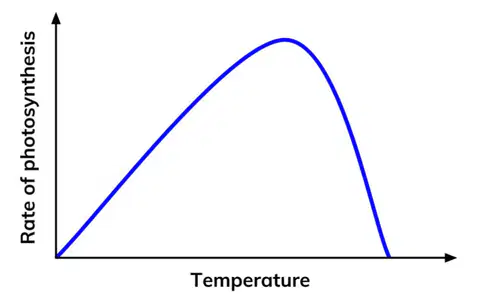
What does this graph illustrate about the rate of photosynthesis and temperature
Temperature has no effect on the rate of photosynthesis
Photosynthesis slows down as temperatures increase
Photosynthesis increases steadily then plummets at high temperatures
Photosynthesis peaks as temperatures cool

