wayground logo

Free Printable Worksheets

NEW

Font size

S
M
L
XL
Worksheets

Marine Biology Midterm

Total questions: 40

Worksheet time: 33mins

Name
Class
Date
1.
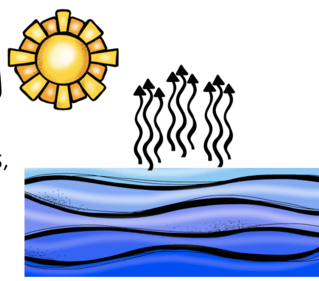
Which of these is an example of precipitation?
a)
snow
b)
air
c)
clouds
d)
vapor
2.
What is it called when plants give off water vapor as a waste product?
a)
condensation
b)
evaporation
c)
sublimation
d)
transpiration
3.
Evaporation happens when the sun ___________ water and turns it into vapor.
a)
cools
b)
heats up
c)
freezes
d)
lights up
4.
What is B?
a)
Evaporation
b)
Condensation
c)
Precipitation
d)
Runoff
5.
What is A?
a)
Evaporation
b)
Condensation
c)
Precipitation
d)
Runoff
6.
What two elements make up water?
a)
Helium and oxygen
b)
Hydrogen and oxygen
c)
helium and carbon
d)
oxygen and carbon
7.
molecule in which opposite ends have opposite electric charges
a)
cohesion
b)
polar molecule
c)
hydrogen bond
d)
solution
8.

Capillary Action

a)

The property of water that allows ice to float

b)

The property of water that allows it to dissolve substances

c)

When water molecules stick to other surfaces

d)

The property of water that allows water to move up a thin tube such as a straw
9.
What is the top of a wave?
a)
trough
b)
crest
10.
What is the bottom of a wave?
a)
trough
b)
crest
11.
What is the distance between crests or troughs?
a)
amplitude
b)
wavelength
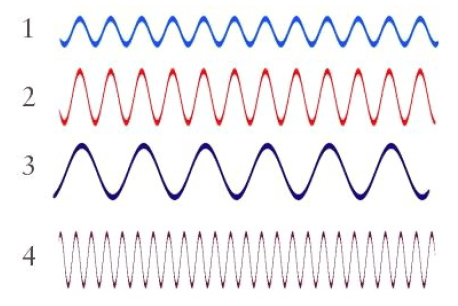
12.
Which wave in the diagram has the greatest frequency?
a)
1
b)
2
c)
3
d)
4
13.

What term is associated with the moons that are increasing in size (more light on them) each day?

a)

Waxing moons

b)

Waning moons

c)

Crescent moons

d)

Gibbous moons

14.
What is the correct order of the Moon Phases?
a)
1st Quarter, 3rd Quarter, New, Full
b)
New, 1st Quarter, Full, 3rd Quarter
c)
New, Full 1st Quarter, 3rd Quarter
15.

What is the name of this phase?

a)

3rd quarter

b)

New Moon

c)

waxing crescent

16.
As the moon's shape appears to get smaller, we say that the moon is _.
a)
swelling
b)
waxing
c)
waning
d)
disappearing
17.
Does this picture represent a waxing or waning moon?
a)
waxing 
b)
waning
18.

During which moon phases will Earth experience the strongest tides also known as spring tides?

a)

New Moon and Full Moon

b)

First Quarter and Last Quarter

19.

During which moon phases will Earth experience the least difference between high and low tides known as neap tides?

a)

New Moon and Full Moon

b)

First Quarter and Last Quarter

20.

Salinity is

a)

A type of plankton

b)

The difference in temperature between surface and deep water

c)

The amount of salt in sea water

d)

A type of surface current

21.

Deep water currents are a result of salinity and temperature. Water moves like a conveyor belt across the globe. This process is called...

a)

Thermometer Currents

b)

Deep water currents

c)

Thermohaline Circulation

d)

Salinity Currents

22.

An increase in Earth's average surface temperature.

a)

weather

b)

pollution

c)

Global warming

23.

The death or expulsion of the algae that live in coral reefs and give the coral its bright color.

a)

Ocean acidity

b)

Coral bleaching

c)

Diseases

24.

The Mariana __________ is the deepest known place on Earth

a)

Volcanoe

b)

Seamount

c)

Ridge

d)

Trench

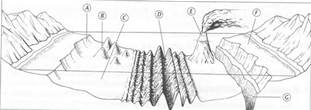
25.
What is letter A?
a)
Cont. Shelf
b)
Cont. Slope
c)
Seamount
d)
Abyssal Plain
26.

Oceans cover about ______ of the surface of the earth.

a)

60%

b)

70%

c)

80%

d)

90%

27.

Whales, eels, dolphin and squid are examples of

a)

benthos

b)

nekton

c)

zooplankton

28.

Lobsters, starfish, warms and snails are examples of

a)

zooplankton

b)

benthos

c)

nekton

29.

Which ocean zone allows plants to grow??

a)

midnight zone

b)

sunlight zone

c)

twilight zone

30.
Is a weather an abiotic or biotic factor? 
a)
abiotic
b)
biotic
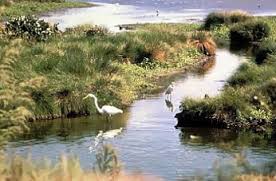
31.
What are the abiotic factors in this image? 
a)
water, sunlight, dirt, air
b)
birds and plants
c)
water, plants, and birds 
32.
Which of the following lists has ONLY biotic factors?
 
a)
snail, algae, guppy, sunlight
b)
temperature, Daphnia (water flea), snail, guppy (fish)
c)
snail, guppy (fish), Daphnia (water flea), algae
d)
temperature, pH, conductivity, nitrite concentration
33.

Where do green plants get most of the energy they need to make their own food?

a)

carbon dioxide

b)

oxygen

c)

sunlight

d)

water

34.

What type of organism is at the beginning of every food chain?

a)

predator

b)

carnivore

c)

producer

d)

herbivore

35.
What is this called?
a)
Food Web
b)
Food Chain
c)
Abiotic Factors
36.

What is this called?

a)

Food Web

b)

Food Chain

c)

Food Pyramid

37.
The rabbit in this food web would be considered a:
a)
Decomposer
b)
Producer
c)
Secondary Consumer
d)
Primary Consumer
38.
In the energy pyramid below, which organism has the least amount of energy available?
a)
Producers
b)
Herbivores
c)
Carnivores
d)
Top Predator
39.
How much water on Earth is drinkable?
a)
31%
b)
97%
c)
3%
d)
4%
40.
Water pollution is good
a)
True
b)
False