
 Worksheets
Circular Motion
Total questions: 35
Worksheet time: 40mins
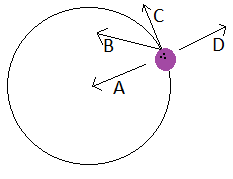
Which vector represents the direction of the acceleration of a ball traveling in a circular path?
A
B
C
D
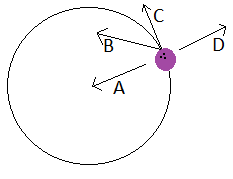
Which of the following vectors depict the velocity of a ball traveling in a circular path?
A
B
C
D
What would the force between them be if the distance between them were doubled?
Two objects are attracted to each other with 36 N of gravitational force.
What would the force between them be if the distance between them was reduced to half its original distance?
9
18
72
144
What would the force between them be if one of the masses were doubled?
What would the force between them be if both of the masses were doubled?
What's the acceleration of gravity of a planet with a mass of 1 x 1025 kg and a radius of 5x10⁶ meters?
.267 m/s2
2.67 m/s2
26.7 m/s2
267 m/s2
Two object each have masses of 9 x 10⁶ kg and are 1 meter apart from each other. What's the force of gravity between them?
5402 N
6320 N
7541 N
7945 N
What's the centripetal acceleration of a 0.2 kg yoyo spun in a circle with a radius of 0.7 meters at a velocity of 3 m/s?
8.23 m/s2
10.54 m/s2
12.86 m/s2
17.39 m/s2
What's the centripetal force of a 0.2 kg yoyo spun in a circle with a radius of 0.7 meters at a velocity of 3 m/s?
2.05 N
2.57 N
2.90 N
3.13 N
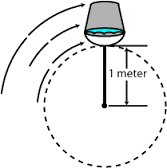
The drum of a washing machine rotates 1800 times in 3 minutes. What is the period?
0.1 s
0.2 s
0.3 s
0.5 s
A 10kg car travels at a constant speed of 20.0 m/s around a horizontal circular track. Which diagram correctly represent the direction of the car's velocity (v) and the direction of the centripetal force (Fc) acting on the car at a particular moment?


Is it possible for an object moving with a constant speed to accelerate? Explain.
A) No, if the speed is constant then the acceleration is equal to zero.
B) No, an object can accelerate only if there is a net force acting on it.
C) Yes, although the speed is constant, the direction of the velocity can be changing.
D) Yes, if an object is moving it can experience acceleration

A pilot experiences centripetal acceleration of 2g's (2 x 9.8 m/s2) while maneuvering a loop at a speed of 400 m/s. What is the radius of the loop?
203 m
8163 m
80,003 m
23 m
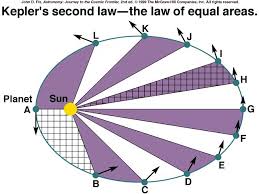
Where would the planet be moving fastest?

What is true about the area between points A-B and the Sun, and the area between points H-I and the Sun?


Which would have the greater linear velocity the outer horse on a carousel or the inner?
Outer
Inner
Both have the same velocity
Depends on the mass of the horse
Why do the inner horse and outer horse have different velocities?
The outer horse has to travel a greater distance in the same amount time as the inner
This is untrue the inner horse travels faster because it it does not have as far to go as the outer
This is not true. The horses travel at the same speed because they are connected on the carousel.
The outer horses are smaller so they can travel faster.

Which of the following planets has the greatest orbital period?
Mars
Earth
Venus
Mercury

A hamster runs on his wheel causing it spin around 10 times every 2.5 seconds. What is the frequency of the wheel?
0.25 Hz
4 Hz
25 Hz
Not enough information
The formula to determine circumference is:
2πr
πr2
2 1bh
34πr3

