
 Worksheets
Pre-Mock Exam Quiz #1
Total questions: 21
Worksheet time: 35mins
Name
Class
Date
1.

A mass is dropped from rest, and falls through a distance of 2.0 m in a vacuum. An observer records the time taken for the mass to fall through this distance using a manually operated stopwatch and repeats the measurements a further two times. The average result of these measured times, displayed in the table below, was used to determine a value for the acceleration of free fall. This was calculated to be 9.8 ms–2.
Which statement best relates to the experiment?
Which statement best relates to the experiment?
a)
The measurements are precise and accurate with no evidence of random errors.
b)
The measurements are not accurate and not always recorded to the degree of precision of the measuring device but the calculated experimental result is accurate.
c)
The measurements are not always recorded to the degree of precision of the measuring device but are accurate. Systematic errors may be present.
d)
The range of results shows that there were random errors made but the calculated value is correct so the experiment was successful.
2.

The masses and weights of different objects are independently measured. The graph is a plot of weight versus mass that includes error bars.
These experimental results suggest that
These experimental results suggest that
a)
the measurements show a significant systematic error but small random error.
b)
the measurements show a significant random error but small systematic error.
c)
the measurements are precise but not accurate.
d)
the weight of an object is proportional to its mass.
3.
The number of heartbeats of a person at rest in one hour, to the nearest order of magnitude is
a)
101
b)
102
c)
103
d)
105
4.
Which one of the following is a scalar quantity?
a)
Pressure
b)
Impulse
c)
Magnetic Field
d)
Weight
5.

At time t = 0, a body moves from rest with constant acceleration in a straight line. At time t, the body is distance s from its rest position.
A graph is drawn of s against t2, as shown.
Which statement describes the acceleration of the body?
A graph is drawn of s against t2, as shown.
Which statement describes the acceleration of the body?
a)
It is equal to half the value of the gradient of the graph.
b)
It is equal to the value of the gradient of the graph.
c)
It is equal to twice the value of the gradient of the graph.
d)
It is equal to the reciprocal of the gradient of the graph.
6.

A lift (elevator) consists of a passenger car supported by a cable which runs over a light, frictionless pulley to a balancing weight. The balancing weight falls as the passenger car rises.
What is the magnitude of the acceleration of the car when carrying just one passenger and when the pulley is free to rotate?
What is the magnitude of the acceleration of the car when carrying just one passenger and when the pulley is free to rotate?
a)
0.032 ms–2
b)
0.32 ms–2
c)
0.6 ms–2
d)
0.65 ms–2
7.

A wooden block rests on a rough board. The end of the board is then raised until the block slides down the plane of the board at constant velocity v.
Which row describes the forces acting on the block when sliding with constant velocity?
Which row describes the forces acting on the block when sliding with constant velocity?
a)
A
b)
B
c)
C
d)
D
8.
A spring of unextended length 40 mm is suspended from a fixed point. A load of 16 N is applied to the free end of the spring. This causes the spring to extend so that its final length is five times its original length. The spring obeys Hooke’s Law.
What is the energy stored in the spring due to this extension?
What is the energy stored in the spring due to this extension?
a)
1.3 J
b)
1.6 J
c)
2.6 J
d)
3.2 J
9.

Which one of the following is a true statement concerning the vertical component of the velocity and the acceleration of a projectile when it is at its maximum height?
a)
A
b)
B
c)
C
d)
D
10.
An electric train develops a power of 1.0 MW when travelling at a constant speed of 50ms−1. The net resistive force acting on the train is . . . .
a)
50 MN
b)
200 kN
c)
20 kN
d)
200 N
11.

An astronaut in outer space is holding a hammer and drifting at constant velocity. The astronaut throws the hammer in the opposite direction to that in which she is drifting. What change, if any, occurs in the total kinetic energy and the total momentum of the astronaut and hammer?
a)
A
b)
B
c)
C
d)
D
12.

An airtight container holds a fixed quantity of gas. Its pressure and volume are measured on four occasions when the temperature is 20 °C. The results are shown in the table. Which set of readings is incorrect?
a)
A
b)
B
c)
C
d)
D
13.
In a vacuum flask, which methods of heat transfer are prevented by the vacuum?
a)
conduction only
b)
convection only
c)
conduction and convection only
d)
conduction, convection, and radiation
14.

Ice is taken from a freezer and left in a room. The ice melts and eventually the water reaches room temperature.
Which energy transfers take place?
Which energy transfers take place?
a)
A
b)
B
c)
C
d)
D
15.
A fixed mass of gas at constant temperature is compressed to reduce its volume. How do the molecules of gas now strike the walls of the container?
a)
less often than before with a higher velocity
b)
less often than before with the same velocity
c)
more often than before with a higher velocity
d)
more often than before with the same velocity
16.
An ice-cube has a mass of 7.50 g. The ice-cube is at 0 °C. Heat from the surroundings reaches the ice-cube at an average rate of 1.25 J / s. How long does it take for all of the ice to melt? (specific latent heat of fusion of ice = 333 J / g)
a)
35.5s
b)
55.5s
c)
2000s
d)
3120s
17.
The acceleration of free fall of a small sphere of mass 5.0×10⁻³ kg when close to the surface of Jupiter is 25 ms−2 . The gravitational field strength at the surface of Jupiter is
a)
2.0×10⁻⁴ N kg−1
b)
1.3×10⁻¹ N kg−1
c)
25 N kg−1
d)
5.0×10³ N kg−1
18.
The centripetal force that causes a car to go round a bend in the road is provided by
a)
the force produced by the car engine acting on the wheels.
b)
the friction between the tyres and the road.
c)
the weight of the car.
d)
the force exerted by the driver on the steering wheel.
19.
If an object doubles its velocity, the required centripetal force is multiplied by …
a)
2
b)
4
c)
1/2
d)
1/4
20.

Which represents the acceleration of the ball?
a)
A
b)
B
c)
C
d)
D
21.
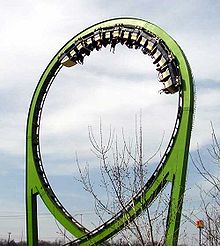
Where is the net force when the rollercoaster is at the top of the loop?
a)
Towards the sky
b)
Towards the Right
c)
Towards the left
d)
Towards the ground
100 %

