wayground logo

Free Printable Worksheets

Font size

S
M
L
XL
Worksheets

Fall Semester Review

Total questions: 91

Worksheet time: 1hrs 25mins

Name
Class
Date
1.
Which country is more developed?
a)
Country A
b)
Country B
c)
Country C
d)
Country D
2.
Which of the following is NOT an economic service provided by forests?
a)
provide habitat
b)
recreation
c)
lumber
d)
job opportunities 
3.
Neither mass or energy can be created or destroyed.
a)
First Law of Thermodynamics
b)
Second Law of Thermodynamics
c)
Murphy's Law
d)
DeWeese's Law
4.
When mass or energy changes form, it drops to a lower quality of mas or energy and heat is given off as a result.
a)
First Law of Thermodynamics
b)
Second Law of Thermodynamics
c)
Murphy's Law
d)
DeWeese's Law
5.
Which biome covers most of the land mass near the Earth's equator?
a)
tundra
b)
desert
c)
grassland
d)
tropical rainforest
6.
One characteristic feature of tundra is that only the surface thaws in the summer and refreezes in the winter, leaving a layer of permanently frozen subsoil.  This characteristic is known as
a)
glaciation
b)
permafrost
c)
crystallization
d)
soilfrost
7.
Which biome receives between 0 to 25 centimeters of rain per year, has a temperature range of 0 to 50 degrees Celsius, has poor soil, and is home to lizards, scorpions, and snakes?
a)
desert
b)
mountain
c)
taiga
d)
tundra
8.
Primary succession would occur on a 
a)
meadow destroyed by flood
b)
meadow destroyed by overgrazing 
c)
newly created volcanic island
d)
section of a forest destroyed by an avalanche 
9.
The use of Earth's renewable and nonrenewable natural resources in ways that do not constrain resource use in the future
a)
sustainability
b)
conservation
c)
preservation
d)
network
10.
All living organisms on Earth, including plants and animals, as well as microorganisms
a)
biosphere
b)
atmosphere
c)
lithosphere
d)
hydrosphere
11.
The thin layer of gases surrounding Earth
a)
atmosphere
b)
biosphere
c)
hydrosphere
d)
lithosphere
12.
The long-term average weather condition at a particular location
a)
climate
b)
weather
c)
region
d)
hearth
13.
All of the water on and near Earth's surface
a)
hydrosphere
b)
atmosphere
c)
biosphere
d)
lithosphere
14.
In a population of spiders there are three different sizes: small, medium, and large.
---The large spiders are easily seen by predators.
---Small spiders have a difficult time finding food.
What will most likely happen to this population of spiders after many generations?
a)
Small and large spiders will mutate
b)
Medium spiders will be the most plentiful
c)
Large spiders will learn to hide from predators
d)
Small and medium spiders will be the least plentiful
15.
The habitat of a moth species included trees with both light and dark colored bark.Therefore the moth species included both light and dark colored variants.Then the light-colored trees were wiped out by a disease, and within a few years nearly all the moths in this forest were dark colored. Which of the following choices BEST explains what happened?
a)
The light moths that survived all had dark offspring in order to adapt to the change.
b)
The dark moths were less visible to predators, so mostly light moths were eaten.
c)
The few light moths that survived did not mate, and therefore they had no offspring.
d)
The light moths changed their wing pigments to darker colors to avoid being eaten.
16.
How is secondary succession different from primary succession?
a)
Secondary succession occurs after a disturbance in an area that was previously uninhabited.
b)
Secondary succession occurs after a disturbance in an area in which the soil has remained intact.
17.
Globally, the leading cause of biodiversity loss is 
a)
invasive species
b)
poaching and overharvesting
c)
pollution
d)
habitat change and loss 
18.
 Characteristic or trait that helps an organism survive in its environment
a)
skills
b)
speciation
c)
natural instinct
d)
adaptation
19.
What is the main suspected environmental problem associated with the burning of fossil fuels?
a)
a. Depletion of fresh water
b)
b. Depletion of ozone
c)
c. Global cooling
d)
d. Global warming
20.
Which of the following is a term for a group of similar organisms that can reproduce fertile offspring?
a)
individual
b)
population
c)
species
d)
fossil
21.
What is THE most major cause of extinction today?
a)
habitat destruction by humans
b)
poaching
c)
disease
d)
hunting
22.
What is the role of the snake in this food web?
a)
Primary consumer
b)
Secondary consumer
c)
Tertiary consumer
d)
Producer
23.
What is Genetic Diversity ?
a)
The variety of genes or inhertable characteristics that are present in a population 
b)
Technique of adding essential materials to a degraded ecosystem 
c)
Found only in one specific geographic area
d)
Any materials or organism in the biosphere
24.
What is Species Diversity ?
a)
The Variety of ecosystems that are present in the biosphere 
b)
An event in which large percentage of all living species 
c)
One of the factors that is increasing the current rate of life extinction
d)
The number of different species and the relative abundance of each species 
25.
What type of growth model is this?
a)
exponential growth model
b)
logistic growth model
c)
Type I curve
d)
Type III curve
26.
symbiotic relationship in which both organisms benefit
a)
competition
b)
Mutualism
c)
nitrogen fixation
d)
energy pyramid
27.
Consumer that eats plants
a)
heterotroph
b)
herbivore
c)
producer
d)
community
28.
An environmental factor such as predation, disease, and competition that depends on the number of members in a population per unit
a)
dispersion
b)
density- independent factor
c)
density- dependent factor
d)
population growth rate
29.
Any factor that limits population growth
a)
Limiting Factor
b)
Immigration
c)
Succession
d)
Abiotic Factor
30.
When a population has reached carrying capacity
a)
Growth & Immigration are equal to Death & emigration
b)
Growth & Immigration are less than Death & emigration
c)
Growth & Immigration are greater than Death & emigration
d)
Growth is exponential
31.
Nitrogen gas accounts for what percentage of the atmosphere?
a)
55%
b)
5%
c)
Less than 1%
d)
78%
32.
Biogeochemical cycles: 
a)
only include processes conducted by or within living organisms.
b)
describe the movement of water and other materials throughout the abiotic and biotic environment.
c)
only pertain to exchanges and interactions that occur within the atmosphere.
d)
are used to describe the attempts of humans to recycle various pollutants.
33.
Birthrate remains high, death rate begins to fall, total population increasing
a)
Stage 1 Demographic Transition
b)
Stage 2 Demographic Transition
c)
Stage 3 Demographic Transition
d)
Stage 4 Demographic Transition
34.
All of the following are density independent factors EXCEPT
a)
Limited food
b)
Earthquakes
c)
Hurricanes
d)
Torandoes
35.
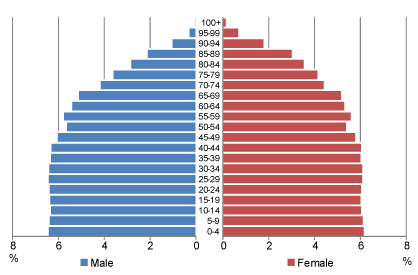
A pyramid shaped age structure diagram would represent what type of growth?
a)
Declining
b)
Stable
c)
Rapid
36.
The number of children an average woman would have during her reproductive years
a)
Birthrate
b)
IMR
c)
TFR
d)
Life expectancy
37.
All of the following are characteristics of R selected species except
a)
No prenatal care
b)
Short Lifespan
c)
Early reproductive age
d)
Few Offspring
38.
The number of individuals an environment can support is known as the
a)
Total Fertility Rate
b)
Exponential Growth
c)
Limiting Factor
d)
Carrying Capacity
39.
What kind of growth is this country experiencing?
a)
Exponential Growth
b)
Stable Growth
c)
Declining Growth
40.
Factors that affect the total fertility rate of the human population include which of the following?
I. Cultural traditions
II. Government policies and economic incentives
III. Education level and economic opportunities for females
a)
I only
b)
II only
c)
I and II only
d)
I, II, and III
41.
Which of the following is NOT a MAIN environmental problem?
a)
Resource Depletion
b)
Pollution
c)
Loss of Biodiversity
d)
Poverty
42.

How do you calculate doubling time?

a)

70 x growth rate

b)

growth rate / 70

c)

70 / growth rate

d)

70 + growth rate

43.

What is NOT an example of the tragedy of commons?

a)

Overfishing

b)

Cutting down trees on private land

c)

atmosphere

d)

Great Garbage Patch in the Pacific Ocean

44.

The layers of the atmosphere in order from the ground up are

a)

mesosphere, troposphere, stratosphere, thermosphere

b)

troposphere, stratosphere, mesosphere, thermosphere,

c)

thermosphere, mesosphere, stratosphere, troposphere

d)

troposphere, mesosphere, stratosphere, thermosphere

45.

Which species will reach sexually maturity quickly?

a)

r-selected

b)

K-selected

46.

Which species will have large populations?

a)

r-selected

b)

K-selected

47.

Which species will have parental care involved with their offspring?

a)

r-selected

b)

K-selected

48.

What does a carrying capacity do for a population?

a)

Determines the maximum amount the environment can hold

b)

Limits population size

c)

Can cause populations to decrease if they overshoot

d)

All of the above

49.

El Nino will warm the waters in the Pacific causing what to be suppressed?

a)

Upwelling

b)

Trade winds

c)

Thermohaline Belt

d)

Deep ocean currents

50.

What biome is commonly found at 30 degrees latitude?

a)

Rainforests

b)

Temperate Forests

c)

Tundra

d)

Deserts

51.

In a convection current

a)

Warm air sinks, and cool air rises

b)

warm air moves laterally, and cold air sinks

c)

warm air rises, and cool air sinks

d)

Warm air sinks, and cool air sinks

52.

Which layer of the atmosphere is extremely hot?

a)

Troposphere

b)

Stratosphere

c)

Mesosphere

d)

Thermosphere

53.

Which layer of the atmosphere has the ozone layer?

a)

Troposphere

b)

Stratosphere

c)

Mesosphere

d)

Exosphere

54.

The "Tragedy of The Commons" is...

a)

An economic issue where people do not have enough money to buy basic needs so they resort to stealing and breaking the law.

b)

A type of play where someone tragically dies or gets killed.

c)

Economic issue where individuals tend to take advantage of the natural resource and it becomes unavailable for everyone.

55.
Deep ocean technology has discovered organisms in hydrothermal vents that do not rely on sunlight to survive. What do these organisms use as their energy source?
a)
chemosynthesis
b)
electrical charge
c)
hydropower
d)
thermal heat
56.
Which is most likely to be the energy source for organisms living in hydrothermal vents?
a)
oxygen
b)
sunlight
c)
methane or sulfur
d)
carbon dioxide
57.
Where is the point on the Earth’s surface directly above the focus of an earthquake?
a)
Epicenter
b)
Fault
c)
Hypocenter
d)
Tremor
58.

What part of an earthquake occurs underground?

a)

Focus

b)

Epicenter

c)

P Waves

d)

S Waves

59.
This is the plastic layer of the mantle on which pieces of the lithosphere move.
a)
Lithosphere
b)
Asthenosphere
c)
Mesosphere
d)
Crust
60.
Where does the heat come from that drives this convection current in the mantle?
a)
The sun
b)
The crust
c)
the mantle
d)
the core
61.

Which crust is more dense?

a)

Oceanic

b)

Continental

c)

Convergent

d)

Divergent

62.

Two plates come together or collide at what boundary?

a)

Convergent

b)

Divergent

c)

Transform

63.

Two plates spread or move apart at what boundary?

a)

Convergent

b)

Divergent

c)

Transform

64.

Two plates slide past each other at what boundary?

a)

Covergent

b)

Divergent

c)

Transform

65.
When glucose levels in the blood rise, your brain sends a signal to your pancreas. The pancreas releases insulin, which opens channels in cell membranes to allow glucose to enter the cell, lowering blood sugar levels. 
a)
Positive Feedback Response
b)
Negative Feedback Loop 
66.
When you get cut, your skin cells release hormones that signal platelets to come and stop the bleeding. Platelets then release more hormones that signal even more platelets to help stop bleeding. The hormone signals continue until the cut is closed.
a)
Positive Feedback Response
b)
Negative Feedback Loop 
67.
As you get dehydrated, your blood becomes thicker and harder to pump. Your kidneys will respond by stopping urine production, sending the water from urine into your bloodstream to thin your blood back to normal level.
a)
Positive Feedback Response
b)
Negative Feedback Loop 
68.
Which is NOT a way that nitrogen compounds are added to the soil?
a)
Decay of dead organisms
b)
Denitrification
c)
Animal waste
d)
Nitrogen-fixation
69.
What happens during the process of nitrogen-fixation?
a)
Nitrogen compounds turn into free nitrogen
b)
Free nitrogen turns into nitrogen compounds
70.
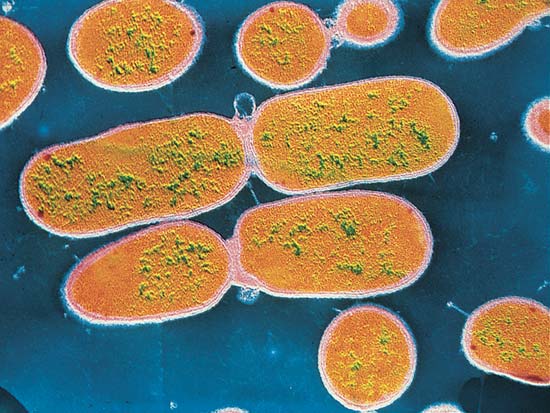
Which of the following describes the role of nitrogen-fixing bacteria in the nitrogen cycle? Nitrogen-fixing bacteria convert
a)
nitrates intro nitrogen gas
b)
ammonia into proteins
c)
nitrogen gas into ammonia
d)
proteins into nitrates
71.

The picture below is of a(n) ____ event.

a)

Non-El Nino (Normal)

b)

El Nino

c)

La Nina

72.

The image is of a(n):

a)

El Nino event

b)

La Nina event

c)

Non-El Nino (normal conditions)

73.
When Earth's rotation causes the wind to curve 
a)
cloudy 
b)
Coriolis effect
c)
high pressure
d)
low pressure 
74.
How to calculate Net Primary Production:
a)
(GPP)(respiration)=NPP
b)
GPP/respiration=NPP
c)
GPP+respiration=NPP
d)
GPP-respiration=NPP
75.
Disorder is a way of describing
a)
Entropy
b)
Energy
c)
Heat
d)
Ecology
76.
__________productivity = the organic materials that remain after photosynthetic organisms in the ecosystem have used some of these compounds for their cellular energy needs (cellular respiration).
a)
Gross
b)
Primary
c)
Net
d)
Secondary
77.

the average efficiency of energy transfer between trophic levels is approximately

a)

1 percent

b)

10 percent

c)

40 percent

d)

90 percent

78.
Based upon the conditions of the early Earth, which forms of live most likely appeared first?
a)
Prokaryotic and aerobic
b)
Prokaryotic and anaerobic 
c)
Eukaryotic and aerobic
d)
Eukaryotic and anaerobic
79.
The idea that Earth's early oceans had organic molecules that became the first life is called the...
a)
Primordial soup hypothesis
b)
Bubble hypothesis
c)
Miller-Urey Experiment
d)
Radioactive dating theory
80.
 A white cat had a litter of kittens that were orange, grey, and black and white spotted. Is this the result of sexual or asexual reproduction? And how would you characterize the offspring listed above?
a)
Sexual reproduction with uniform offspring
b)
Asexual reproduction with diverse offspring
c)
Sexual reproduction with diverse offspring
d)
Asexual reproduction with uniform offspring
81.
The offspring from asexually reproduced organisms are?
a)
Different than their parents
b)
Identical to parents
c)
Like a combination from both parents
d)
A different species
82.
The idea that no two species within an ecosystem can occupy the exact same niche
a)
niche overlap
b)
niche differentiation
c)
competitive exclusion
d)
niche decay
83.
A species whose presence indicates the health of an ecosystem
a)
keystone species
b)
Indicator species
c)
plants
d)
producers
84.
The ecological niches of three bird species are shown in the diagram. What is the advantage of each bird species having a different niche?
a)
As more birds feed higher in the tree, available energy increases.
b)
More abiotic resources are available for each bird.
c)
Predators are less likely to feed on birds in a variety of locations.
d)
There is less competition for food.
85.
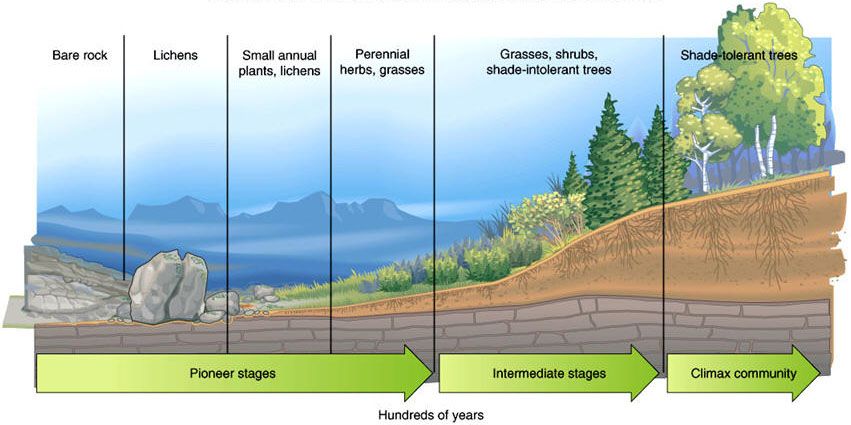
The picture shows what type of succession?
a)
primary
b)
secondary
c)
tertiary
d)
quadanary
86.
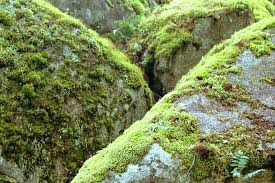
What are examples of pioneer species in a primary succession?
a)
Bushes and Shrubs
b)
Oak trees
c)
Mossess and Lichens 
d)
A rose Bush
87.
After a volcanic eruption, lava covers the land. What is the order that plants grow to repopulate the area?
a)
Lichens → Shrubs → Grasses → Trees
b)
Lichens → tree → shrubs→Grasses
c)
Grasses → Lichens → Shrubs → Trees
d)
Lichens → Grasses → Shrubs → Trees
88.
this type of succession occurs after a forest fire
a)
primary succession
b)
secondary succession
c)
both
89.
Type 1 curve
a)
high infant mortality, low adult mortality
b)
low infant mortality, high adult mortality
c)
equal adult and child mortality
90.
Type 3
a)
high infant morality, low adult mortality
b)
low infant mortality, high adult mortality
c)
equal infant and adult mortality
91.

Which of the following is an example of the bottleneck effect?

a)

Cheetah populations reach their lowest levels with reduced diversity and as they rebound are so genetically similar they appear to be inbred.

b)

Affected individuals with blue skin can trace their ancestry back to one of the first settlers in the region.

c)

The environment of a fox population changes and over time foxes who are white survive and pass on their genes to their offspring.

d)

Humans choose two dogs they like the characteristics of and breed them together.