Wayground logo

Free Printable Worksheets

Font size

S
M
L
XL
Worksheets

Physical Science Final Exam Review

Total questions: 40

Worksheet time: 41mins

Name
Class
Date
1.
Which of the following colors of visible light has the longest wavelength.
a)
red
b)
blue
c)
green
d)
orange
2.
How many electrons are in the outer most energy shell of a calcium atom?
a)
1
b)
2
c)
6
d)
8
3.
Which two elements have the same number of valence electrons?
a)
C and O
b)
Na and Mg
c)
Cl and F
d)
Ga and Ge
4.

How many valence electrons does Aluminum have?

a)

3

b)

4

c)

13

d)

18

5.

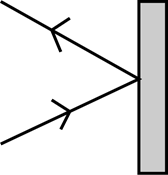
The picture shows which wave behavior?

a)

absorption

b)

diffraction

c)

reflection

d)

refraction

6.
The horizontal row on the periodic table is called a
a)
group
b)
family
c)
period
d)
atomic number
7.
The atomic number tells you what?
a)
number of electrons
b)
number of protons
c)
number of neutrons
d)
both electrons and protons in an atom.
8.

Volume is a measurable property of matter. Volume measures

a)

the amount of space an object takes up.

b)

the gravitational force exerted on the object.

c)

the distance around an object.

d)

the shape of the object.

9.

Ken needs to measure out 50 ML of water. Which of the following is the best tool for Ken to use?

a)

balance

b)

spring scale

c)

ruler

d)

graduated cylinder

10.

What is shown in the image?

a)

reflection

b)

diffraction

c)

refraction

d)

interference

11.
Why does the Earth have different seasons?
a)
because of the distance between Earth and the sun
b)
because of the speed of Earth as it rotates on its axis
c)
because the amount of light blocked by the moon on its axis
d)
because of the tilt of the Earth on its axis as it moves around the sun
12.

Why would a person be cooler on a hot sunny day wearing a light colored t-shirt and shorts than in a dark colored t-shirt and shorts made out of the same material?

a)

dark colors are hotter.

b)

dark colors absorb more radiation from the sun.

c)

dark colors reflect more radiation from the sun.

d)

solar radiation avoids light colored objects.

13.

The most important source of energy that heats the surface of Earth comes from:

a)

volcanic eruptions

b)

geysers

c)

the Sun

d)

the core

14.

Which letter corresponds to the crest of the wave?

a)

Z

b)

W

c)

X

d)

Y

15.

For sounds, the amplitude of a sound wave tells us the...

a)

Volume of the sound.

b)

Speed of the sound.

c)

Frequency of the sound.

d)

Resonant harmonics of a sound.

16.

The sky is blue because...

a)

the ocean absorbs blue.

b)

blue light is the shortest wavelength and passes with the least absorption in the sky.

c)

blue light is the longest wavelength and passes with the most absorption in the sky.

d)

the ocean reflects blue.

17.
Which is the wavelength?
a)
1
b)
2
c)
3
d)
4
18.
Why do we see lightning before we hear the thunder?
a)
Our eyes trick us
b)
Light travels faster than sound
c)
they're two separate things
19.
The illustration shows a light ray striking an object.
In the illustration, the light ray striking the object is-
a)
absorbed
b)
stopped
c)
reflected
d)
refracted
20.
Value representing the number of protons in an element
a)
Atomic Mass
b)
Mass Number
c)
Valence Electrons
d)
Atomic Number
21.

How many valence electrons does this picture show?

a)

2

b)

3

c)

4

d)

5

e)

6

22.

The number 16 for the atomic element sulfur is the

a)

ionic number

b)

isotope

c)

atomic mass

d)

atomic number

23.

What is this element?

a)

Helium

b)

Oxygen

c)

Sodium

d)

Phosphorous

24.

How many valence electrons does it have?

a)

1

b)

2

c)

8

d)

11

e)

12

25.

Is this the correct lewis dot for Chlorine?

a)

yes

b)

no

26.

Is this the correct lewis dot for Sodium?

a)

yes

b)

no

27.
What does the prefix milli- mean?
a)
1/100
b)
100
c)
1,000
d)
1/1,000
28.
The International System of Unites
a)
is a device used only to measure volume
b)
is used only for measuring length
c)
is based on units of 10
d)
is based on units of 12
29.
The base unit of metric length.
a)
Meter
b)
Liter 
c)
Kilogram
d)
milligram
30.
The basic unit of metric volume is called a_____.
a)
Kilogram
b)
milligram
c)
Liter
d)
milliliter
31.
The base for mass is the
a)
meter
b)
gram
c)
kilogram
d)
liter
32.
What is the length of the key?
a)
2 cm
b)
0 cm
c)
4 cm
d)
2 inches
33.
What is the length of the ribbon?
a)
9 cm
b)
2 cm
c)
7 cm
d)
11 cm 
34.
The abbreviation for gram is...
a)
G
b)
gg
c)
g
d)
gr
35.
What is the correct volume of the blue liquid?
a)
5 ml
b)
15 ml
c)
20 ml
d)
25 ml
36.
A graduated cylinder is used to measure the __________ of a liquid.
a)
temperature
b)
mass
c)
volume
d)
length
37.
Which is NOT a step for reading a graduated cylinder properly?
a)
Make sure the cylinder sits in the stand vertically.
b)
Be sure to hold it up to eye-level when reading.
c)
Read the water's volume by the bottom of the meniscus.
d)
Know the value of the scale for the sub-graduates.
38.
How many spaces are there between 20 and 25?
a)
3
b)
5
c)
7
d)
10
39.
What is the volume of the water in this graduated cylinder?
a)
18 mL
b)
20.3 mL
c)
10.7 mL
d)
17 mL
40.
What is the volume of the water in this graduated cylinder?
a)
11.5 mL
b)
13 mL
c)
10.3 mL
d)
11 mL