
 Worksheets
Term 2 Benchmark Review
Total questions: 50
Worksheet time: 2hrs 40mins

A researcher examines fossils found in some rock layers. The fossils shown were found in undisturbed layers of rock. Which fossil is the youngest?
Trilobites
Armored fish
Dinosaurs
Early horses

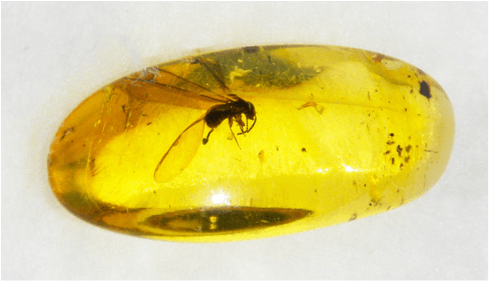
A baby woolly mammoth was discovered frozen for 40,000 years. What type of fossil would this be?
Mold
Trace
Preserved
Carbonized
What type of rock is formed from hardened and cooled magma?
Parent/Bed rock
Igneous rock
Metamorphic rock
Sedimentary rock
Much of the evidence that is used to support evolution of life on Earth is obtained by -------.
Studying fossils preserved in rock
Radioactive dating of rock
Relative dating of rock
Absolute dating of rock
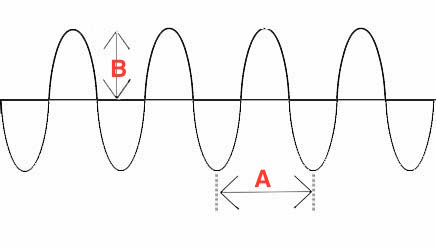
What property of this wave is represented by the letter "A"
amplitude
crest
trough
wavelength
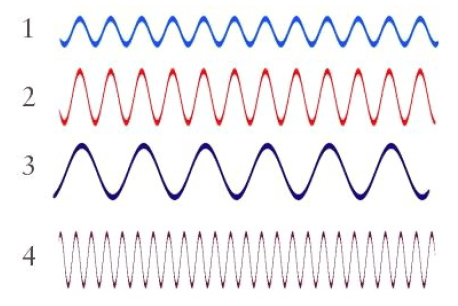

When a wave strikes and object and bounces off. An example echo.
medium
refraction
reflection
interference


Light waves bounce off of the surface of the medium
Reflection
Refraction
Diffraction

Separation of white light into their separate components.
Refraction
Reflection
Diffraction
Absorption

When the car travels towards the girl, there is a ------- and wavelengths are decreasing.
red shift
blue shift


Which makes a good index fossil?
a fossil not commonly found in rocks
a fossil that lived throughout geologic time
a fossil that lived during three geologic time periods
a fossil that lived during only one geologic time period and commonly found on many continents

The movement of the tectonic plates is caused by
the rotation of the Earth.
convection currents in the Asthenosphere
the gravity of the iron-nickel core.
the Moho discontinuity.
In some areas of the world, like California and Japan, earthquakes are a common occurrence. How can this best be explained?
The strong ocean currents are undermining both areas causing earthquakes.
Both areas are located near the edge of the Pacific Ocean, the unstable sand causes earthquakes.
Both areas are subjected to strong ocean wind and waves that causes earthquakes.
Both areas are on the boundary of active plates, the motion of the plates causes earthquakes.
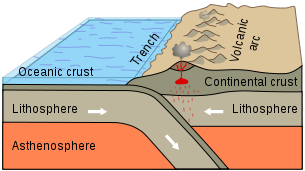
Subduction zones occur on Earth where dense oceanic crust dives under more buoyant continental crust. These boundaries are characterized by a deep ocean trench next to a high continental mountain range, large numbers of earthquakes and volcanoes. All of this is further evidence for the
big bang theory.
theory of plate tectonics.
origin of the species.
theory of natural selection.
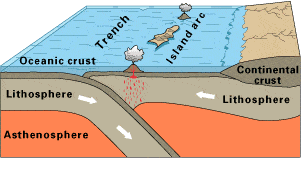
Observe this diagram of a plate boundary. One statement BEST describes what is happening. It is that
the oceanic crust is melting.
the denser ceanic crust is subducting under the less dense oceanic crust
volcanic islands are forming.
the tectonic plates are moving away from each other.
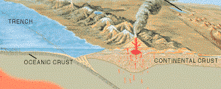
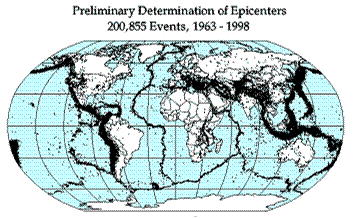
Earthquake epicenters (center of where the earthquakes started) were mapped for a 35 year period in the diagram above. The black dots indicate these epicenters. The black dots appear along what feature on Earth?
hot spots
plate boundaries
rift zones
sea floor spreading
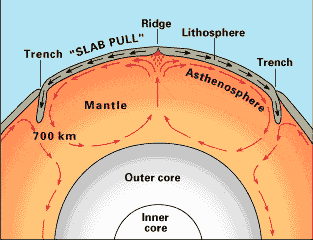
What is the source of energy that drives plate movement?
the subducton of the sea floor
the different densities of the oceanic and crustal plates
convection currents in the asthenosphere
the friction force between the plates that move past each other
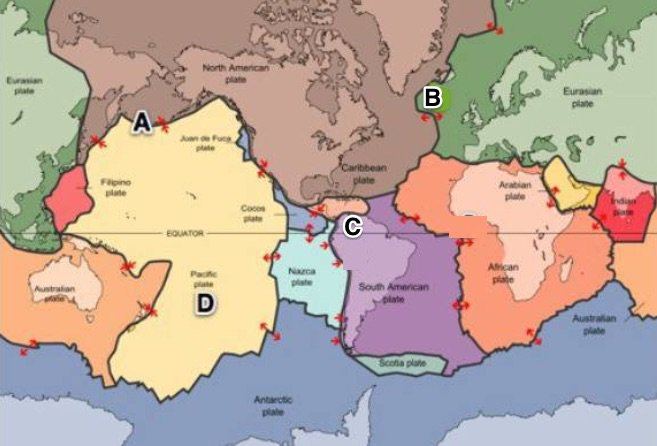
Where would sea floor spreading most likely occur?
At convergent boundaries (oceanic vs. oceanic)
At convergent boundaries (oceanic vs. continental)
At divergent plate boundaries (oceanic vs. oceanic)
At transform plate boundaries
This is the only part of the Earth's interior that is completely liquid/molten.
lithosphere
mantle
outer core
inner core
What causes the water table to rise?
Evaporation
Condensation
Precipitation
Runoff
What is the cause of the wearing down of mountain ranges?
continental drift
subduction
chemical and mechanical weathering
sea-floor spreading
What is the name that Alfred Wegener gave to the large supercontinent?
Pantene
Gondwanaland
Pangaea
Laurasia
What is formed when two oceanic plates converge?
a trench and volcanic islands
folded mountains
transform boundary
seafloor spreading
Most of the water on Earth is saline and non-potable. Where is most of the freshwater on Earth found?
estuaries
aquifers
glaciers and polar ice caps
rivers and lakes
Which layer of the Earth lies immediately below the lithosphere?
hydrosphere
inner core
outer core
asthenosphere
Plate tectonics theory and the law of superposition provides evidence to support
the big bang theory and the doppler effect
speciation and genetic drift
evolution of organisms and landforms
mass extinctions and weathering
Caves are typically formed by
mechanical weathering and runoff
mechanical weathering and groundwater flow
chemical weathering and groundwater flow
chemical weathering and runoff

What happens if a hurricane moves over land or cold ocean water?
it will strengthen
it will get weaken
it will upgrade its category
it will morph into a typhoon

What causes a thunderstorm cell?
Warm air rising quickly in unstable air.
Cool air rising quickly in unstable air.
Warm air falling quickly in unstable air.
Cold are falling quickly in unstable air.

The part of a hurricane where the most violent winds and heaviest rainfall are.
eye
eye wall
feeder bands
equator

