
 Worksheets
Imperialism
Total questions: 50
Worksheet time: 38mins
Define "colony."
a country which is controlled by a more powerful country.
the policy of extending the rule or authority of an empire or nation over foreign countries, or of acquiring and holding colonies.
An area of land under the jurisdiction (rule) of a ruler or state.
Having power and influence over others.
Which of these best describes the Scramble for Africa?
Imperialist powers sliced Africa amongst themselves by drawing borders on a map
Diplomats worked with tribal leaders to determine how to colonize countries in Africa
European countries worked to finance capital expansion in African nations through loans.
The United States used the Roosevelt Corollary to prevent nations from colonizing Africa.
Which of these was NOT a reason European powers colonized Africa and Asia?
They wanted to acquire power and prestige
They wanted to gain access to natural resources such as gold, rubber, timber, and metals
They had a mission to civilize "inferior races"
They wanted to protect weaker nations from other foreign influences
Why were European countries interested in colonizing Africa during the Age of Imperialism?
They wanted Africa's natural resources
They wanted land to develop new types of ships
They wanted to create a perfect society
They wanted to learn new languages
Which of the following is true about the Boxer Rebellion?
The rebellion took place in Japan.
The Boxers were trying to keep Christianity in China.
The Boxers were unhappy with foreign influence in China.
The Boxers were able to drive out the foreigners from China.
The Berlin Conference split up ________ among European nations.
Africa
Asia
Australia
South America
What does the phrase "the sun never sets over the British Empire" mean?
it's always sunny in Britain
it shows how large their empire was
it shows how dangerous they were
is a reference to the shiny money they had

Where did the Industrial Revolution begin?
Germany
France
Great Britain
United States
Who was excluded (left out) from the Berlin Conference?
representatives for the US
representatives of European countries
representatives of African countries
representatives of the 3rd Estate
Indian soldiers in the East India Company army
Raj
Sepoys
Opium
Colony
located in Egypt and provided shorter route to India and East Asia
Colony
Panama Canal
Imperialism
Suez Canal
Indian government controlled by the British
Sepoys
Raj
Protectorate
Sphere of Influence

Industrialization helped lead to the European colonization of Africa by---
developing tourist markets
increasing competition for overseas markets
causing governments to collapse
bringing major powers into armed conflict

Which country is forced to open up trade by the United States?
Japan
Korea
China
India

What movement tried to rid European influence from China?
Boxer Rebellion
Peoples Republic of China
Black Hand Society
Buddhists
The title given to the ruler of Japan during their period of isolationism
Shogun
Emperor
Czar
Samurai
After they lost the Opium War, foreign countries (especially England) had more control over this large nation
China
Japan
What product did England want?
opium
Silver
tea
silk
Japan’s increased foreign trade during the Meiji Restoration was closely related to its
need to maintain a traditional society
desire for a modern industrialized society
colonization by Western nations
encouragement of foreign investment
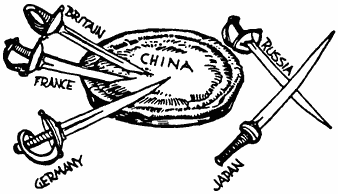

The Meiji Era in Japan wanted to eliminate the feudal system.

Where is Japan located?
17
26
28
25
What ruined the potato crop?
Animals
A disease
Weather
the potato crop wasn't ruined
The main cause of the mass starvation in Ireland during the 19th century was the
British blockade of Irish ports
failure of the potato crop
war between Protestants and Catholics in Northern Ireland
environmental damage caused by coal mining
Many critics believe that the policy of the British government during the Irish Famine
contributed to food shortages
ignored military concerns
discouraged emmigration
led directly to civil war
What was an immediate result of the mass starvation in Ireland in the late 1840s?
expansion of the Green Revolution to Ireland
acceptance of British rule by the Irish
migration of many Irish to other countries
creation of a mixed economy in Ireland
Adam Smith’s Wealth of Nations stressed the importance of
tradition
supply and demand
large corporations
government ownership
Laissez-faire capitalism as attributed to Adam Smith called for
heavy taxation of manufacturers
strict government control of the economy
minimal government involvement in the economy
government investments in major industries
In The Communist Manifesto, Karl Marx and Friedrich Engels expressed the idea that
religion should be the most important factor in society
power should be determined by a person’s wealth
profits from work should belong to the workers
supply and demand should control prices


