
 Worksheets
Biology - Neurons and Nerve Impulse transmission
Total questions: 20
Worksheet time: 10mins
Nerve impulse transmission refers to the ability of the neuron to...
reproduce
receive an chemical signal
produce sodium or potassium
send an electrochemical signal
A change in the external environment that initiates an impulse is known as a
synapse
response
stimulus
receptor
The voltage difference between the inside (-) and the outside (+) of the neuron in the resting state is called........
neutral state
active transport
action potential
resting membrane potential
Action potential refers to
a very positive charge inside and outside of the neuron
a very negative charge inside and outside of the neuron
a change of charge between the inside and outside of the neuron
action outside the membrane that cause the neuron's membrane to close all its pores
Which structures in a human transmit electrochemical messages?
veins
neurons
nephrons
lymph vessels
Which of the following gate opens during depolarization
Na+ gates
K+ gates
Na+/K+ pump
H+ pump
Which of the following gate opens during repolarization
Na+ gates and Na+/K+ pump
K+ gates and Na+/K+ pump
Na + and K+ gates
Na+ gates only
During depolarization outside of the cell is ......... charged and inside of the cell is............ charged
negatively / positively
positively / negatively
positively/ positively
negatively/ negatively
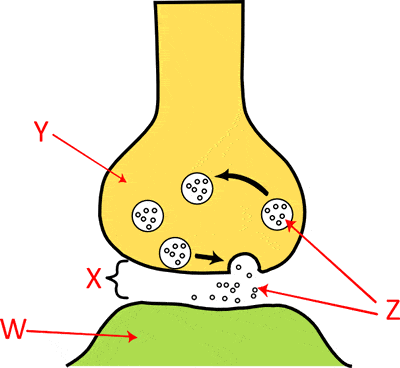
What is the most important factor required to maintain membrane potential
A reactive sodium pore
The sodium potassium pump
The release of neurotransmitters at the synaptic terminal
the the movement of water from high to low concentrations over the neuron's membrane
To aid in the transmission of an impulse, neurotransmitters are secreted
along an axon
by a dendrite
by a cyton
into a synapse
Repolarization is part of Action potential. Which of the following best describes repolarization.
Repolarization is the rebuilding of the sodium potassium pump.
Repolariztion is the change in membrane potential that returns it to a negative value (internally).
Repolariztion is the change in membrane potential that returns it to a positive value (internally) by opening Sodium pores.
Repolariztion is the flip-flop in membrane potential that changes charges between the nucleus and the cytoplasm of the neuron.
The sodium potassium pump...
is energy (ATP) free as sodium and potassium move in and out by diffusion as needed
moves 3 sodium ions into the neuron and 3 potassium out only if ATP is present
moves 3 sodium in to the neuron and 2 potassium without energy from ATP
moves 3 sodium out of the neuron and 2 potassium into the neuron only if there is energy from ATP
The depolarization of a spot on the neurons membrane begins with
the closing of sodium gates
the opening of sodium gates
the opening of potassium gates
the closing of the potassium gates
When the sodium gates (pores) open during depolarization sodium ions will ...
go in and out of the neuron freely
flood into the neuron approx. 5000 times faster
flood out of the neuron approx. 5000 times faster
goes out 3/2 times faster as potassium comes in
Before an action potential moves to the next neuron it must release
sodium into the synapse
positive protons into the synapse
neurotransmitters into the synapse
negative electrons in to the synapse
Once action potential occurs at one spot on the neuron's membrane it...
causes the immediate release of neurotransmitters
stops action potential at the adjacent spots
causes depolarization in adjacent membrane
causes repolarization in the adjacent membrane
nerve impulses work by...
moving electricity from the axon to the dendrites
quickly pumping sodium form the dendrites to the axon
moving neurotransmitters from the cell body to the axon terminal
spreading of a changing membrane potential over the membrane of the neuron
The axon hillock is the are of the cell body that
Allows massive amounts of sodium to flood out of the cell body.
Speeds up all electrochemical impulses (action potential) that are moving down the axon
Controls the initiation chemical impulse down the axon after processing the strength of incoming signals.
Moves chemical impulse down the dendrites after processing the strength of incoming signals form other neurons

