
 Worksheets
Round 3 - Separating Mixtures
Total questions: 15
Worksheet time: 10mins
Name
Class
Date
1.
Name the separation method that causes wet clothes on a clothes line to dry
a)
Chromatography
b)
Filtration
c)
Distillation
d)
Evaporation
2.
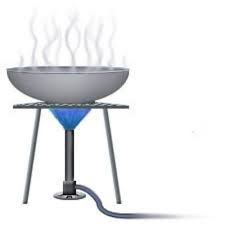
Name the separation technique shown in the diagram.
a)
evaporation
b)
distillation
c)
filtration
3.
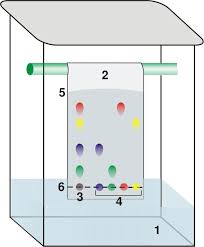
Dyes in water soluble markers may be separated by means of..
a)
crystallization
b)
sublimation
c)
chromatography
d)
sedimentation
4.
Which one of the following would you use to separate sand from iron filings?
a)
a bar magnet
b)
filter paper
c)
chromatography paper
d)
alum
5.
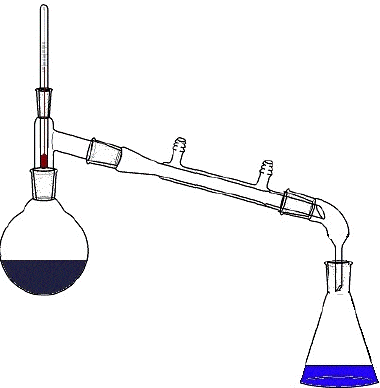
Water and alcohol are easily separated by distillation because of their
a)
different melting points
b)
different colours
c)
different densities
d)
different boiling points
6.

The diagram shows the apparatus for separating soil and water. What are the labelled parts?
a)
A = residue, B = distillate
b)
A = residue, B = filtrate
c)
A = filtrate, B = residue
d)
A = distillate, B = filtrate
7.

In a coffee machine, the ground coffee is separated from the coffee solution by using..
a)
sand paper
b)
filter paper
c)
toilet paper
d)
tissue paper
8.

Liquids that do not mix may be separated by using..
a)
an evaporating dish
b)
a separating funnel
c)
a loading
d)
a sedimentation
9.
Sand and gravel may be separated from each other through using..
a)
a filter funnel
b)
a sieve
c)
an evaporating basin
d)
a distillation
10.
Making a mixture results in ___________________ only.
a)
chemical reactions
b)
separate parts
c)
physical changes
d)
two subtances
11.
Which one of the following is NOT a mixture?
a)
Sugar
b)
Paint
c)
Crude oil
d)
Air
12.

This method is utilized in industries like junkyards to remove metal scraps from other materials.
a)
chromatography
b)
physical manipulation
c)
use of magnet
d)
distillation
13.
Two or more substances mingled together, but not chemically combined are known as a
a)
residue
b)
solution
c)
distillate
d)
mixture
14.
Boiling point is a point at which liquid turns in to..
a)
solid
b)
liquid
c)
molten
d)
gas
15.
How do you separate tea leaves and water?
a)
DECANTATION
b)
EVAPORATION
c)
SIEVING
d)
FILTRATION
100 %

