wayground logo

Free Printable Worksheets

Font size

S
M
L
XL
Worksheets

Drawing 1 EOC Review

Total questions: 100

Worksheet time: 55mins

Name
Class
Date
1.
An element of art that refers to the lightness and darkness of a color.
a)
hue
b)
value
c)
movement
d)
contrast
2.
A mark with length and direction, created by a point that moves across a surface.
a)
line
b)
value
c)
contrast
d)
form
3.
The empty or open area between, around, above below and within objects.
a)
form
b)
balance
c)
color
d)
space
4.
The empty or open area between, around, above below and within objects.
a)
form
b)
balance
c)
color
d)
space
5.
Any three dimensional object that can be measured by height, width and depth.
a)
emphasis
b)
space
c)
form
d)
shape
6.
The element of art that refers to the surface quality of an object or the way something feels such as rough-smooth
a)
shape
b)
texture
c)
color
d)
line
7.
A flat figure created when actual or implied lines surround a space-can be geometric or organic
a)
line
b)
form
c)
shape
d)
space
8.
Element of art produced when a wavelength of light strikes an object and reflects back to the eyes.
a)
primary
b)
secondary
c)
teriary
d)
color
9.
Another name for related colors-have one color in common. Colors that appear next to each other on the color wheel.
a)
analogous colors
b)
shape
c)
texture
d)
color
10.
Colors that are directly opposite on the color wheel.  When mixed together, they makes neutral gray or brown.
a)
complementary
b)
texture
c)
analogous
d)
color
11.
Area in a work of art that catches and holds the viewers attention.
a)
space
b)
unity
c)
emphasis
d)
balance
12.
The relation of one object to another in size,amount, number.
a)
variety
b)
monochromatic
c)
proportion
d)
triad
13.
The use of different lines shapes, textures,colors and other elements of design to create interest in a work of art.
a)
variety
b)
emphasis
c)
rhythm
d)
value
14.

The Elements of Art are:

a)

The rules of art

b)

The building blocks of art

c)

The materials used to make art

d)

The place you go to look at art

15.

Line is

a)

the lightness or darkness of a color or shade

b)

something that goes straight in either direction forever

c)

a moving point

d)

a Principle of Design

16.

Which is NOT an Element of Art?

a)

Line

b)

Balance

c)

Shape

d)

Value

17.

The Principles of Design are:

a)

The building blocks of Art

b)

The rules of art

c)

The materials used to make art

d)

The place you go to look at art

18.

Shape is:

a)

the lightness or darkness of a color or shade

b)

a moving point

c)

an area enclosed by a line

d)

the area between objects in an artwork

19.

One way to show space in an artwork is:

a)

add complementary colors

b)

add light and dark values

c)

add patterns to shapes

d)

add foreground, middleground, background

20.

You can create textures by making _________ with other elements

a)

tints and shades

b)

actual and implied

c)

foreground, middleground, background

d)

patterns

21.

Complementary colors are:

a)

colors that look good together

b)

opposites on the color wheel

c)

side by side on the color wheel

d)

one color plus black and white

22.

Analogous colors are

a)

colors that look good together

b)

colors that are side by side on the color wheel

c)

colors that are opposites on the color wheel

d)

one color plus black and white

23.

Brown, black, grey, and white are______________ colors

a)

primary

b)

secondary

c)

tertiary

d)

neutral

24.

Primary colors are

a)

blue, black, red

b)

blue, black, purple

c)

blue, green, purple

d)

blue, red, yellow

25.

How do you make primary colors

a)

you can't make them, but they make all other colors

b)

you mix two secondary colors together in equal amounts

c)

you mix a secondary and a tertiary color together in equal amounts

d)

you mix one color plus black or white

26.

Secondary colors are:

a)

red, blue, black

b)

blue, green, purple

c)

purple, orange, green

d)

purple, blue, red

27.

How do you make a secondary color?

a)

mix two tertiary colors together in equal amounts

b)

mix two primary colors together in equal amounts

c)

mix a primary and a tertiary color together in equal amounts

d)

mix one color with black or white

28.

Tertiary colors are:

a)

red-orange, yellow-orange, yellow-green, blue-green, blue-violet, and red-violet

b)

red, red-orange, orange, yellow-orange, yellow, yellow-green, green, and blue-green

c)

red, orange, yellow, green, blue, indigo, violet

d)

black, dark red, red, light red, white

29.

You make a tertiary color by

a)

mixing two primary colors

b)

mixing one primary color and one tertiary color

c)

mixing one primary color with one secondary color

d)

mixing one primary color with black and white

30.

What is an example of a monochromatic color scheme?

a)

red, yellow, blue

b)

red, red-orange, orange, yellow-orange, yellow

c)

red, orange, yellow, blue, indigo, violet

d)

black, dark red, red, light red, white

31.

How do you create value in an artwork?

a)

by adding complementary colors

b)

by adding dark and light

c)

by adding patterns

d)

by adding shapes

32.

Texture can be ______________ if you can feel it, or _______________ if it's 2-D

a)

factual, imagined

b)

real, pretend

c)

positive, negative

d)

actual, implied

33.

Shapes can be either _______ or _________

a)

geometric, abstract

b)

geometric, neutral

c)

geometric, radial

d)

geometric, organic

34.
A three dimensional object, such as a cube or ball or the representation of a 3-D object. 3-D objects have height, length, and width.
a)
form
b)
shape
c)
space
35.
a)
shape
b)
form
36.
Texture you can actually feel.
a)
tactile
b)
visual
37.
The darkness or lightness of a color. Shades are dark, tints are light.
a)
value
b)
color
c)
shade
38.
a)
geometric forms
b)
geometric shapes
c)
organic forms
39.
a)
diagonal
b)
vertical
c)
horizontal
40.
Which of these is NOT an element of art?
a)
color
b)
line
c)
space
d)
hue
41.
The way something feels to the touch (actual/tactile) or how it may look (visual).
a)
texture
b)
color
c)
line
42.
A two dimensional area created by connecting lines.
a)
shape
b)
form
c)
space
43.
The visual quality of objects caused by the amount of light reflected by them.
a)
color
b)
value
c)
color wheel
44.
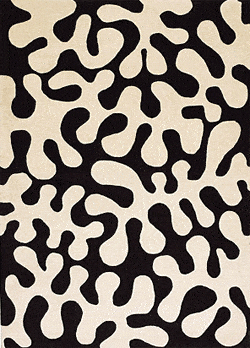
What phrase best describes this image?
a)
geometric forms
b)
geometric shapes
c)
organic shapes
d)
organic forms
45.
Positive is what is there, negative is where there isn't anything.
a)
Space
b)
Shape
c)
Line
d)
Form
46.
What type of Balance is this image an example of ?
a)
Symmetrical
b)
Asymmetrical
c)
Formal
d)
Symmetrical & Formal
47.

What principle does this image demonstrate?

a)

Pop Art

b)

Variety in shape and color

c)

Flowers make good subjects in art

48.
Emphasis refers to the part of art which is what?
a)
The most colorful
b)
In the center
c)
The most dominant
49.
This painting shows which principle?
a)
Emphasis
b)
Symmetry
c)
Movement/Rhythm
50.
This painting by Vincent Van Gogh demonstrates which principle?
a)
Movement/Rhythm
b)
Symmetry
51.
Can a black and white painting such as this painting by Franz Kline show emphasis?
a)
Yes
b)
No
52.
This painting demonstrates which principle?
a)
Contrast of color
b)
Contrast of shape
c)
Contrast of color & shape
d)
Sunset
53.
What is the emphasis of this photograph?
a)
The green apples around the pepper
b)
The red pepper in the center
c)
The little man peeking through the apples
54.
Did this architect use pattern for this design?
a)
yes
b)
no
55.
Is this portrait by Chuck Close symmetrical or asymmetrical?
a)
Asymmetrical
b)
Symmetrical
56.
How does this painting show unity?
a)
Use of Color and Shape
b)
Use of Emphasis
c)
Use of Details
57.
Analogous color like these are the most what?
a)
Contrasting
b)
Beautiful
c)
Harmonious
58.
Which principles did Andy Warhol use in his screen print of Marilyn Monroe?
a)
Emphasis
b)
 Color
c)
Variety & Repetition
59.
Which principles does this photograph by Will Stewartd demonstrate?
a)
Variety & Movement
b)
Emphasis & Repetition
60.
__________ is the element that is emphasized.
a)
Contrast
b)
Balance
c)
Focal Point
d)
Aspect Ratio
61.
The concept where you break a design into thirds/critical area is in the intersections a third
a)
Balance
b)
Repetition
c)
White Space
d)
Rule of Thirds
62.

What composition rule is BEST being shown in this photograph?

a)

High Angle Perspective

b)

Rule of Thirds

c)

Symmetrical Balance

63.

What composition rule is BEST being shown in this photograph?

a)

High Angle Perspective

b)

Rule of Thirds

c)

Symmetrical Balance

64.
The area of a landscape that is closest to you
a)
Foreground
b)
Middle ground
c)
Background
d)
Horizon Line
65.
The area of a landscape that is furthest away from you
a)
Foreground
b)
Middle ground
c)
Background
d)
Horizon Line
66.
The area of a landscape that is NOT furthest away or closest to you, but somewhere in between
a)
Foreground
b)
Middle ground
c)
Background
d)
Horizon Line
67.
The area of a landscape where the sky meets the ground
a)
Foreground
b)
Middle ground 
c)
Background
d)
Horizon Line
68.
The area of a landscape that is at the bottom of the picture plane
a)
Foreground
b)
Middle ground
c)
Background
d)
Horizon Line
69.
The area of a landscape that is at the top of the picture plane
a)
Foreground
b)
Middle ground
c)
Background
d)
Horizon Line
70.
As objects move further away from you in space, they get ________.
a)
smaller
b)
larger
c)
they do not change
d)
squishier
71.
As objects move further away from you in space, they become ________.
a)
less detailed
b)
more detailed
c)
they do not change
d)
more pink
72.
__________ is when an artist creates the illusion of space 
a)
atmospheric perspective
b)
space
c)
one point perspective
73.
Why aren't all the boats the same size?
a)
they get smaller as they get further away
b)
 the boats are all the same size
c)
the boat in the water is a smaller boat
74.
The runner is in the ____________
a)
Foreground
b)
Middle ground
c)
Background
75.
The cactus extends past the picture plane because 
a)
it is in the foreground, closest to you
b)
it's a big cactus
76.

What is the act of organizing the elements of artwork into a harmoniously unified whole?

a)

Value

b)

Color

c)

Composition

d)

Tonal Shading

77.

Shading is the process of darkening an object to create a variation of light and dark.

a)

True

b)

False

78.

Value is the lightness and darkness of a color.

a)

True

b)

False

79.

Value is the ___________ or ___________ of a color or shade.

a)

sharpness, dullness

b)

grays, tints

c)

texture, feeling

d)

darkness, lightness

80.

What is the tool we use to find our values. This shows the full tonal range of a color or shade.

a)

Tonal Window

b)

Value Scale

c)

Value Step

d)

Contrast Scale

81.

The ___________is the lightest part of a round surface.

a)

Core of the Shadow

b)

Cast Shadow

c)

Transitional Light

d)

Highlight

82.

The ________ ___________ is the shadow an object projects onto a surface.

a)

Projected Darkness

b)

Cast Shadow

c)

Core of the Shadow

d)

Reflective Shadow

83.

This is a style of drawing to make objects appear three-dimensional on a two-dimensional surface.

a)

Merging

b)

Blending

c)

Shaping

d)

Shading

84.

Would you consider this to be a simple or complex form?

a)

Simple

b)

Complex

85.

Would you consider this to be a simple or complex form?

a)

Simple

b)

Complex

86.
What line technique is primarily being used in this drawing?
a)
scumbling
b)
hatching
c)
cross hatching
d)
stippling
87.
Which line technique is shown?
a)
blending
b)
stippling
c)
hatching
d)
cross hatching
88.
Which line technique is shown?
a)
blending
b)
stippling
c)
hatching
d)
cross hatching
89.
Which line technique is shown?
a)
blending
b)
stippling
c)
hatching
d)
cross hatching
90.
What is the green arrow pointing to? 
a)
Shadow
b)
Highlight
c)
Reflected Light
d)
Cast Shadow
91.
Which Color Pencil Technique is shown?
a)
Hatching
b)
Smooth Transition
Blending
c)
Cross Hatching
d)
Stippling
92.
Which Color Pencil Technique is shown?
a)
Hatching
b)
Stippling
c)
Cross Hatching
d)
Grisaille
93.
Which Color Pencil Technique is shown?
a)
Burnishing
b)
Hatching
c)
Cross Hatching
d)
Stippling
94.
What type of shading technique does this artist use?
a)
Hatching 
b)
Shading 
c)
Crosshatching 
d)
Blended 
95.

This is an example of:

a)

Cross Hatching

b)

Blended Shading

c)

Stippling

d)

Hatching

96.

This is an example of:

a)

Hatching

b)

Cross Hatching

c)

Blended Shading

d)

Stippling

97.

The two main elements of art used with drawing and shading techniques are:

a)

Line and Value

b)

Shape and Space

c)

Form and Color

d)

Color and Line

98.

This type of line is:

a)

contour

b)

cross contour

c)

gesture

d)

blind contour

99.

This type of line is:

a)

gesture

b)

contour

c)

continuous

d)

blind contour

100.
Pressing harder or using a bigger nib or marker can give a darker appearance with line techniques.
a)
true
b)
false