
Font size
 Worksheets
IB ESS Topic 6.2 Stratospheric ozone
Total questions: 20
Worksheet time: 46mins

Layer of reactive gas at 20-30km above the Earth (15-20km at the poles) absorbing UV radiation
Greenhouse Gases
Troposphere
Stratosphere
Ozone Layer
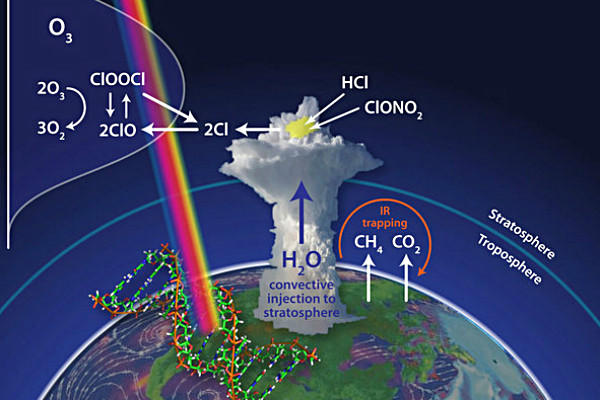
The breakdown of stratospheric ozone;
I. Can originate from the emission of chlorofluorocarbons (CFCs).
II. Is catalyzed through a free chlorine (Cl) atom.
III. Prevents all UV rays from reaching the earth’s surface.
I only
III only
I,&II
I,II,& III

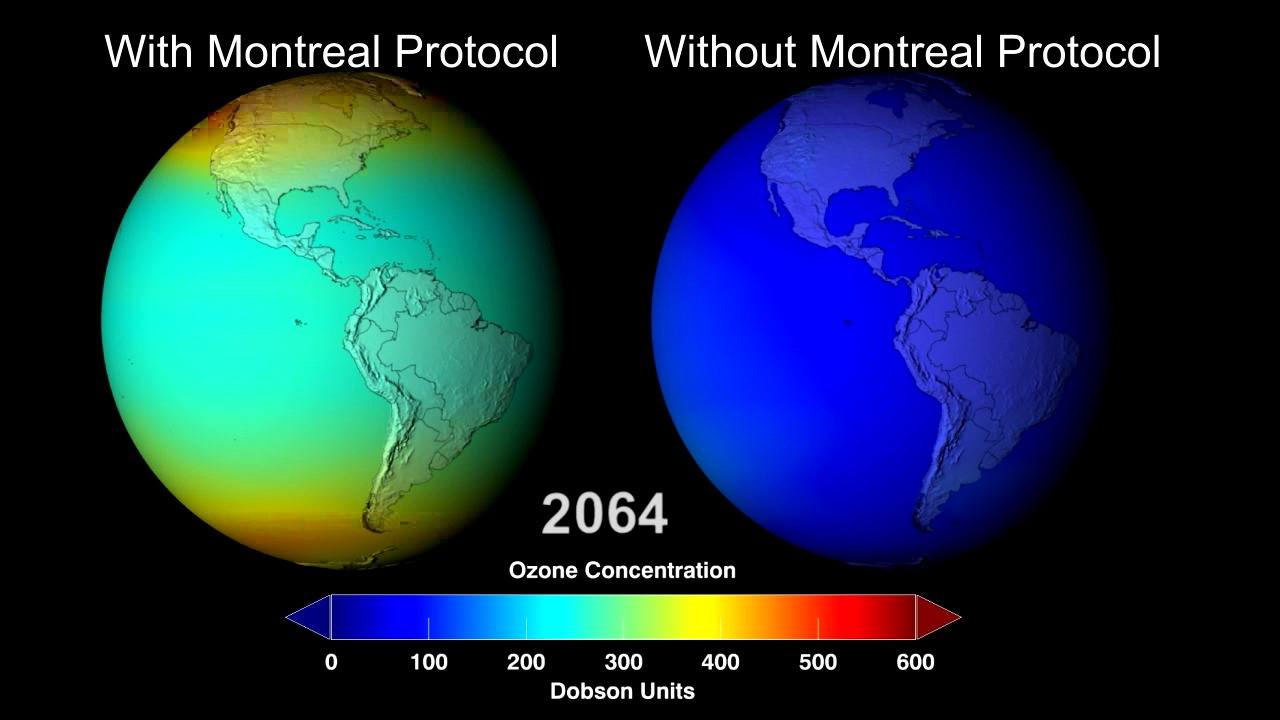
Which agreement allowed for a reduction, and eventual elimination, of CFC production and use?
Montreal Protoccol
Kyoto Protoccol
Paris Agreement
Minamata convention

How do CFCs affect ozone production?
UV radiation frees a chlorine atom, which breaks down ozone.
Infrared radiation frees a chlorine atom, which breaks down ozone.
UV radiation frees a fluorine atom, which breaks down ozone.
Infrared radiation frees a chlorine atom, which breaks down ozone.

Though CFC production has been curtailed, the threat to upper atmosphericozone continues because CFCs
become harmless quickly.
destroy ozone for only a short time.
persist but stop destroying ozone.
persist and continue to destroy ozone for decades.
Which is NOT a result of the reduction in stratospheric ozone?
reduced photosynthetic activity
increased skin cancer
increased likelihood of cataracts
increased birth defects
Which is not an example of an ecological consequence of reduced stratospheric ozone?
loss of biodiversity from reduced photosynthesis in plants
collapse of marine food webs
increased crop yield
reduced terrestrial biome productivity
UV rays can cause obvious short term damage, such as sunburn, as well as long term damage that accumulates with each exposure to the sun.
True
False
Which statement regarding the decreased level of stratospheric ozone is correct?
Increased photosynthetic activity has been measured in the phytoplankton around Antarctica
The largest decrease in the level of stratospheric ozone over the Arctic region occurs between January and April
Although the Montreal Protocol led to a reduction in the use of CFCs, it will have little effect on stratospheric ozone levels in the long term
There is no correlation between the incidence of cataracts and skin cancers and the lower level so stratospheric ozone
The global crop yields of wheat, rice, and corn have increased since the reduction in CFC use
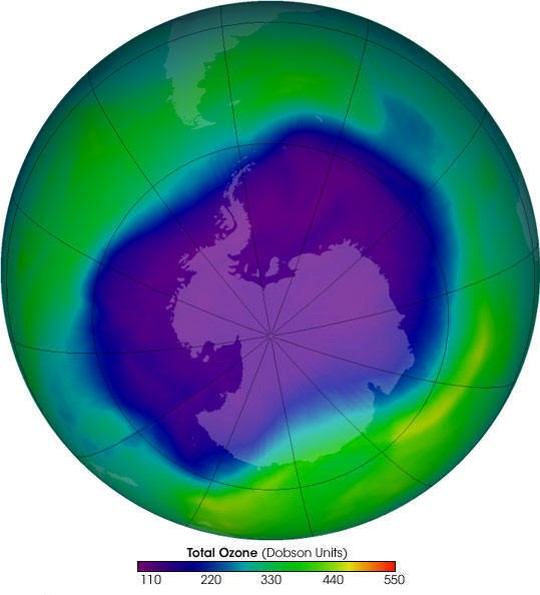
Location of the large whole in the ozone.
Antarctica
Artic
Iceland
Africa
Why are the ozone holes (arctic and antarctic) over the poles? ...chose the ONE best answer...
stratospheric ice clouds
global winds
global distillation effect
ODS use is greatest at the poles
Antarctica has more pronounced ozone destruction because... (choose all that apply)
the global distillation effect moves CFCs there more than the Arctic.
the stratospheric ice clouds are more pronounced there
the stratospheric ice clouds are less pronounced there
the circumpolar vortex is more pronounced there
Antarctic _____ has the ______ free CFC levels and ______ ozone levels.
Antarctic WINTER has the LOWEST free CFC levels and HIGHEST ozone levels.
Antarctic WINTER has the HIGHEST free CFC levels and LOWEST ozone levels.
Antarctic SUMMER has the LOWEST free CFC levels and HIGHEST ozone levels.
Antarctic SUMMER has the HIGHEST free CFC levels and HIGHEST ozone levels.
Which is true about ozone formation and destruction? select all that apply
Its formation and destruction is an example of a dynamic process in nature.
It forms when a free oxygen atom reacts with a molecule of oxygen.
UV radiation breaks up ozone by splitting off an oxygen atom.
Ozone cannot reform once it absorbs UV radiation.
Which options are true for Stratospheric ozone? (select all that apply)
CFCs are stable in the troposphere
CFCs are unstable in the stratosphere
Tropospheric O3 is a pollutant and Stratospheric O3 is a protectant
O3 naturally absorbs UV and breaks apart
Which are consequences of stratospheric ozone depletion? (select all that apply)
cataracts
skin cancer
phytoplankton population increase
decreased crop yield
wrinkling/aging/burning of skin
Which is NOT a result of the reduction in stratospheric ozone?
reduced photosynthetic activity
increased skin cancer
increased likelihood of cataracts
increased birth defects
Which chemical that replaced CFCs in refrigerants is now a concern as a major greenhouse gas?
CFCs
HFCs
DDT
CFCl2
Which is not an example of an ecological consequence of reduced stratospheric ozone?
loss of biodiversity from reduced photosynthesis in plants
collapse of marine food webs
reduced crop yield
reduced terrestrial biome productivity
Which is most strongly absorbed by ozone in the statosphere?
UV-A
UV-B
UV-C
UV-B and UV-C
UV-A and UV-B

