wayground logo

Free Printable Worksheets

Font size

S
M
L
XL
Worksheets

Semester 1 Final Review 2019

Total questions: 166

Worksheet time: 2hrs 5mins

Name
Class
Date
1.
Most of Earth's fresh water is 
a)
locked up in glacial ice 
b)
groundwater
c)
in lakes and rivers 
d)
water vapor 
2.
The major source of Earth's energy is 
a)
geothermal energy
b)
tidal energy
c)
wind energy
d)
solar energy
3.
Phytoplankton play an important role in the carbon cycle because
a)
photosynthesis by phytoplankton removes carbon from the atmosphere
b)
they convert carbon dioxide to methane 
c)
they breathe out carbon dioxide into the air 
d)
they eat animals that have stored carbon
4.
Most of Earth's liquid form of water is
a)
in clouds
b)
the the ground
c)
in lakes and rivers
d)
in oceans
5.
Most of Earth's fresh water is 
a)
locked up in glacial ice 
b)
groundwater
c)
in lakes and rivers 
d)
water vapor 
6.
The rift valley along a mid-ocean ridge marks
a)
a boundary between two plates 
b)
a region where subduction is occuring
c)
a region where a deep- sea trench is forming   
d)
a boundary between oceanic and continental crust
7.
Compared to the average elevation of the continents, the average depth of the ocean is about 
a)
one half as great
b)
one quarter as great
c)
two times as great 
d)
four times as great
8.
The average mass of dissolved salts in 1000 grams of seawater is
a)
1 gram
b)
35 grams 
c)
70 grams
d)
100 grams
9.
Which pair of factors would both cause salinity to increase?
a)
evaporation and freezing of sea water
b)
freezing of sea water and precipitation
c)
precipitation and melting of sea ice
d)
melting of sea ice and evaporation
10.
Two factors used to identify a water mass are 
a)
salinity and type of phytoplankton typesof phytoplankton 
b)
oxygen concentration and water temperature 
c)
types of phytoplankton and oxygen concentration
d)
water temperature and salinity
11.
Th most abundant ion in seawater
a)
calcium 
b)
chloride
c)
sodium 
d)
sulfate
12.
Sample P is 100 grams of water from the ocean surface in the North Atlantic. Sample Q is 350 grams of water from the ocean surface in the South Pacific. Which statement is not true?
a)
Both samples contain abou thte smae percentage of chloride ions
b)
Both smaples contain abou tthe smae mass of dissolved ions
c)
both samples contain the same type of ions
d)
both samples contain magnesium ions
13.
What percent of the ocean's volume is made up by the mixed layer?
a)
about 2%
b)
about 5%
c)
about 30%
d)
none of the above
14.
Which of the following is one factor that causes heat to be mixed evenly in the mixed layer?
a)
swimming plankton
b)
temperature differences
c)
strong winds
d)
density differences 
15.
The zone in which seawater temperatures change rapidly is called the 
a)
seasonal layer
b)
mixed layer
c)
thermocline
d)
none of the above
16.
Salinity tends to be above average 
a)
in area of high precipitation 
b)
where large rivers enter the ocean 
c)
where icebergs are melting
d)
in hot areas 
17.
Th deep rich waters of the ocean are 
a)
rich in both oxygen and carbon dioxide 
b)
poor in both oxygen and carbon dioxide
c)
rich in oxygen but poor in carbon dioxide
d)
poor in oxygen and rich in carbon dioxide
18.
Smokers are vents on the sea floor that emit smoke that is black due to fine particles of
a)
iron sulfide
b)
bacteria
c)
basaltic magma 
d)
soot
19.
Smokers are vents on the sea floor that emit smoke that is black due to fine particles of
a)
iron sulfide
b)
bacteria
c)
basaltic magma 
d)
soot
20.
Surface currents in the ocean are primarily driven by
a)
winds
b)
waves
c)
temperature differences
d)
density differences
21.
Surface currents flowing away from the equator carrry 
a)
cool water
b)
upwelling water 
c)
warm water
d)
downwelling water
22.
Surface currents flowing away from the equator carrry 
a)
cool water
b)
upwelling water 
c)
warm water
d)
downwelling water
23.
Two examples of warm ocean currents are the 
a)
Gulf stream and the Kuroshio Current
b)
Kurshio Current and the Canary Current
c)
Canary Current ad the California Current
d)
California Current and the Gulf stream
24.
Deep ocean currents are driven by 
a)
tidal forces 
b)
differences in density 
c)
differences in oxygen content
d)
changes in conveyor belt cirulation
25.
Turbidity current densit results from water mixing with 
a)
higher salinity water
b)
colder water 
c)
cold-core water rings 
d)
sediment particles
26.
When seawater freezes, most of the salt
a)
is included in the ice, increasing its density
b)
is left behind, increasing the density of the remaining seawater
c)
is included in the ice, decreasing its density 
d)
is left behind, decreasing the density of the remaining seawater
27.
Upwelling is important to sea life because it 
a)
cools the surface water 
b)
brings nutrients to the surface water
c)
keeps ocean temperature uniform 
d)
brings carbon dioxide to the surface
28.
Major commercial fishing areas are usually located in areas 
a)
where density current form
b)
where seawater oxygen levels are high
c)
of persistent upwelling
d)
that experience frequent turbidity currents
29.

What theory states that at one time, the entire universe was confined to a dense, hot, super mass ball?

a)

Nebular Theory

b)

Identity Status Theory

c)

Theory of Relativity

d)

Big Bang Theory

30.

Galaxies are __________ from where the Big Bang occurred.

a)

Expanding

b)

Shrinking

c)

Not Moving

31.

What is the center of the universe in the Geocentric model?

a)

Mars

b)

Neptune

c)

The Sun

d)

The Earth

32.

What is the center of the universe in the heliocentric theory?

a)

Neptune

b)

Mars

c)

The Sun

d)

The Earth

33.

What Galaxy does Earth reside in?

a)

Andromeda Galaxy

b)

Elliptical Galaxy

c)

Milky Way Galaxy

d)

Spiral Galaxy

34.

The______________ theory describes how bodies of our solar system evolved from an enormous dust cloud called the solar nebula?

a)

Big Bang Theory

b)

Nebular Theory

c)

Theory of Light

d)

Theory of Dark

35.
What part of the moon do we see from Earth?
a)
all of it
b)
the same side
c)
none of it
d)
only one quarter
36.
As the moon's shape appears to get smaller, we say that the moon is _.
a)
swelling
b)
waxing
c)
waning
d)
disappearing
37.
Which moon phase is when you can't see the moon at all?
a)
Waning crescent
b)
Full moon
c)
Waxing gibbous
d)
New moon
38.
The cycle of the moon lasts about a _.
a)
day
b)
year
c)
week
d)
month
39.
There are ______ phases of the moon.
a)
12
b)
10
c)
8
d)
5
40.
Name the phase of the moon for letter f
a)
Waning Gibbous
b)
Waxing Gibbous
c)
Waning Crescent
d)
Waxing Crescent
41.
Name the phase of the moon for letter a
a)
First Quarter
b)
Last Quarter
c)
Waxing Gibbous
d)
Waning Gibbous
42.
Name the phase of the moon for letter c
a)
New Moon
b)
Full Moon
c)
Waxing Crescent
d)
Waning Crescent
43.

Occurs when Earth is positioned between the moon and the sun and when Earth's shadow crosses the lighted half of the moon.

a)

Solar Eclipse

b)

Eclipse

c)

Lunar Eclipse

d)

Perigee

44.
The __________ has planets, moons, comets, and asteroids.
a)
solar system
b)
earth
c)
rotation
d)
United States
45.
Which outer planets have rings?
a)
Just Saturn
b)
Saturn and Jupiter
c)
Jupiter, Neptune, and Saturn
d)
all 4 of them
46.
The GAS GIANTS or Outer planets are:
a)
Mercury, Earth, Jupiter, Saturn
b)
Saturn, Neptune, Pluto, Mars
c)
Saturn, Jupiter, Uranus, Neptune
d)
Earth, Mars, Saturn, Neptune
47.
Which planet is closest to the sun?
a)
Uranus
b)
Mercury
c)
Neptune
d)
Earth
48.
Besides Pluto, which planet is the furthest planet from the sun?
a)
Mercury
b)
Earth
c)
Neptune
d)
Uranus
49.
What is similar about all of the inner planets?
a)
rocky
b)
gasses
c)
many moons
d)
takes a long time to revolve around the sun
50.
What is similar about all of the Outer Planets?
a)
small
b)
large
c)
few moons
d)
takes a short amount of time to go around the sun
51.
Between which two planets is the asteroid belt located?
a)
Mercury & Venus
b)
Mars & Jupiter
c)
Uranus & Neptune
d)
Neptune & Pluto
52.
Which planet takes the least time to go around the sun?
a)
Mercury
b)
Earth
c)
Mars
d)
Jupiter
53.
Which planet is red because of iron oxide or rust?
a)
Venus
b)
Mars
c)
Jupiter
d)
Saturn
54.

Which planet's average temperature make it the hottest planet in the solar system?

a)

Mercury

b)

Venus

c)

Earth

d)

Mars

55.

The "Great Red Spot" is a storm on which planet?

a)

Earth

b)

Mars

c)

Jupiter

d)

Saturn

56.

Which planet rotates on its side?

a)

Venus

b)

Earth

c)

Saturn

d)

Uranus

57.
There is one star in our solar system.
a)
True
b)
False
58.
What type of graph is this?
a)
Bar Graph
b)
Line Plot
c)
Pictograph
d)
Tally Chart
59.
On what day of the week did the most shooting stars occur?
a)
Monday
b)
Wednesday
c)
Thursday
d)
Friday
60.
What pattern is evident on this line graph?
a)
Ability to do situps had no change as the days continued
b)
Ability to do situps decreased as the days continued
c)
Ability to do situps increased as the days continued
d)
Ability to do situps does not pertain to the graph
61.
At 60 seconds, how far had this object traveled? 
a)
0 m
b)
10 m
c)
20 m
d)
40 m
62.
What is the control for the experiment? 
a)
the thing being tested
b)
the normal situation
c)
what we measure in the end
d)
what we change 
63.
The Independent/Manipulated Variable goes on the ___ axis
a)
x
b)
y
64.
The Dependent/Responding Variable goes on the ___ axis
a)
x
b)
y
65.
Why is this graph misleading?
a)
it only lists 5 players
b)
It goes in intervals of 50
c)
The axis doesn't start at zero and makes it look like a big difference in wins.
d)
Not misleading
66.

Stars are formed from big clouds of gas and dust is known as:

a)

dust cloud

b)

space fog

c)

neutron clouds

d)

nebulae

67.

The only force acting on the nebulae is:

a)

thermal expansion

b)

singularities

c)

gravity

d)

microscopic adhesion

68.

A star is born when:

a)

nuclear fusion starts

b)

a nebula becomes a protostar

c)

gases in a nebula condense

d)

hydrogen is used up in fusion processes

69.

Once star has ignited and has used up all of the hydrogen are called:

a)

Neutron Star

b)

White Dwarfs

c)

Red Giants

d)

Black Holes

70.

When the core of a Red Giant collapses it becomes a:

a)

White Dwarf

b)

Supernova

c)

Red Supergiant

d)

Black Hole

71.

When a massive star begins to cool and expand it is known as a:

a)

Black Dwarf

b)

Red Giant

c)

Red Supergiant

d)

White Dwarf

72.

When the core of a Red Supergiant collapses, a bright event occurs, known as:

a)

white dwarf

b)

supernova

c)

big bang

d)

black hole

73.

After a supernova, the core can collapse into a neutron star, or if massive enough it can become a:

a)

Black Hole

b)

White Dwarf

c)

Red Supergiant

d)

Black Dwarf

74.

One possible outcome that is left after a supernova is a super dense core called a:

a)

Neutron Star

b)

White Dwarf

c)

Red Giant

d)

Black Dwarf

75.

A black hole is black because:

a)

there is nothing in it

b)

it is too small to see

c)

it is inherently evil

d)

even light cannot escape its gravity

76.

Our sun is currently in what star stage?

a)

Protostar

b)

Nebula

c)

Main Sequence

d)

Red Giant

77.

Main sequence stars are made primarily of which elements?

a)

Hydrogen only

b)

Helium and Carbon

c)

Carbon and Iron

d)

Hydrogen and Helium

78.

A star that has begun nuclear fusion will last for:

a)

millions of years

b)

a few thousand years

c)

as long as the universe survives

d)

forever

79.
What fuel do stars use? 
a)
Oxygen
b)
Hydrogen
c)
Carbon
d)
Iron
80.
Which star has the lowest temperature?
a)
A
b)
B
c)
C
d)
D
81.
Which star is considered a Main Sequence Star?
a)
A
b)
B
c)
C
d)
D
82.
What type of galaxy is this?
a)
Spiral
b)
Elliptical
c)
Irregular
d)
Irrational
83.
What type of galaxy is this?
a)
Spiral
b)
Elliptical
c)
Irregular 
d)
Irrational
84.
Our Galaxy is called the
a)
Mily Galaxy
b)
Milky Way Galaxy
c)
Andromeda Galaxy
d)
Pinwheel Galaxy
85.
Which of these puts the main parts of an average star's life cycle in the correct order?
a)
protostar>
main sequence>
red giant >
white dwarf
b)
protostar> 
main sequence> 
white dwarf> 
red giant
c)
main sequence> 
protostar> 
white dwarf> 
red giant
d)
protostar> 
red giant >
main sequence> 
white dwarf
86.
What is an inference? 
a)
Just a guess.
b)
A statement based off of your observations. 
c)
The same as an observation. 
d)
Examples of something. 
87.
Which statement is an inference about this picture?
a)
The van is tan.
b)
The  van ran into KFC. 
c)
The driver was hungry. 
d)
An ambulance may be on the way. 
88.
When scientists collect data that is measurable with numbers, we call it...
a)
qualitative
b)
quantitative
c)
hypothetical
d)
graphable
89.
Measuring the number of times a person breathes after exercise involves ____ data. 
a)
quantitative
b)
qualitative
90.
What are comets made of?
a)
Metals like iron and nickel
b)
Gas
c)
Hydrogen Gas
d)
Ice and rock
91.
The orbit of comets is which shape?
a)
Circular
b)
Elliptical/Oval
c)
Comets do not orbit the Sun
92.
Where do most comets come from?
a)
In the Oort Cloud beyond Neptune
b)
In the Asteroid Belt between Mars and Jupiter
c)
Near the Sun
d)
Earth's atmosphere
93.
In the diagram, A and C refer to which part of a comet?
a)
Nucleus
b)
Tail
c)
Coma
94.
In the diagram, which part of the comet is B pointing to?
a)
Coma
b)
Nucleus
c)
Tail
95.
D is pointing to which part of a comet?
a)
Coma
b)
Tail
c)
Nucleus
96.
A light streaking across the night sky is classified as a/an....
a)
Meteorite
b)
Asteroid
c)
Comet
d)
Meteor
97.
In the diagram, a comet's tail always points where?
a)
Towards the Sun
b)
Away from the Sun
c)
Towards Earth
d)
Away from Earth
98.
The cloud of gas and dust around the solid icy ball of a comet is the...
a)
Nucleus
b)
Coma
c)
Tail
99.
Meteoroids are...
a)
debris from asteroids/comets floating around in space
b)
burn up completely in the atmosphere
c)
hit the ground
100.
Where is ocean water the densest.
a)
The surface
b)
The middle
c)
The bottom
d)
Lake Michigan
101.
Two types of ocean currents are
a)
local and global
b)
sea and land
c)
surface and deep
d)
warm and cold
102.
Warm ocean currents generally come from
a)
The North Pole
b)
The South Pole
c)
The Equator
d)
Both A and B
103.
A horizontal movement of ocean water that is caused by wind and that occurs at or near the ocean's surface.
a)
Gulf Stream
b)
Global Conveyor Belt
c)
Surface Current
d)
Gyre
104.
Why are surface currents at the surface of the ocean?
a)
colder temperature
b)
colder temperature & more salinty
c)
warmer temperature & less salinty
d)
less salinty
105.
Ocean water is more dense than fresh water at the same temperature due to differences in:  
a)
Wind patterns
b)
 Lifeforms
c)
Currents
d)
Salinity
106.

There are _____ oceans in the world

a)

4

b)

6

c)

5

d)

9

107.

Oceans cover about ______ of the surface of the earth.

a)

60%

b)

70%

c)

80%

d)

90%

108.

The _________ is located in the North Pole.

a)

Antarctic Ocean

b)

Southern Ocean

c)

Arctic Ocean

d)

Indian Ocean

109.

Underwater volcanoes with flat tops are known as

a)

shelf

b)

abyss

c)

guyots

d)

slope

110.

The deepest parts of the ocean are called

a)

trenches

b)

abyss

c)

deep sea plain

d)

guyot

111.

Whales, eels, dolphin and squid are examples of

a)

benthos

b)

nekton

c)

zooplankton

112.

Lobsters, starfish, warms and snails are examples of

a)

zooplankton

b)

benthos

c)

nekton

113.

Pythoplankton inhabit

a)

the bottom of the ocean

b)

the middle of the ocean

c)

the surface of the ocean

d)

the beginning of the ocean

114.
What two elements make up water?
a)
Helium and oxygen
b)
Hydrogen and oxygen
c)
helium and carbon
d)
oxygen and carbon
115.
What word describes when water is attracted to other substances?
a)
cohesion
b)
adhesion
c)
capillary action
d)
surface tension
116.
Why does ice float?
a)
As water freezes, it expands and its density decreases.
b)
As water freezes, it takes up more hydrogen from the atmosphere, causing it to have a greater buoyancy.
c)
As water freezes, air becomes trapped between the hydrogen bonds of water molecules.
d)
As water freezes, it takes up more oxygen from the atmosphere, causing it to have a greater buoyancy.
117.
Attractions between the negative Oxygen atom of one water molecule and the positive Hydrogen atom of another water molecule are called
a)
Covalent bonds
b)
Ionic bonds
c)
Polar bonds
d)
Hydrogen bonds
118.
Large bodies of water, such as lakes and oceans, do not quickly fluctuate in temperature. What is the reason for this phenomenon?
a)
Water is an acid.
b)
Water is a versatile solvent.
c)
Water has a high heat capacity.
d)
 Water acts as a buffer.
119.
Why does water move from the roots to the leaves of plants?
a)
Water is pushed by solutes
b)
Capillary action pulls the water molecules like a chain
c)
Water is pulled by gravity
d)
Water’s cohesion causes it to “pull” towards the leaves
120.
What is water?
a)
An atom
b)
A molecule composed of 2 parts Oxygen and one part Hydrogen
c)
A molecular compound composed of 2 parts Hydrogen and one part Oxygen
d)
A pure substance composed of 2 parts Hydrogen and one part Oxygen
121.
What is the chemical formula for water?
a)
H20
b)
h2o
c)
H2O2
d)
H2O
122.
What is adhesion?
a)
Water's ability to stick to itself
b)
Water's ability to stick to other substances
c)
The strength of the cohesion of all the water molecules combined
d)
Tape, glue and other adhesives
123.
What is cohesion?
a)
Water's ability to stick to itself
b)
Water's ability to stick to other substances
c)
The strength of the cohesion of all the water molecules combined
d)
Tape, glue and other adhesives
124.

Which ocean floor feature is labeled "F"?

a)

Continental Shelf

b)

Abyssal Plain

c)

Ocean Trench

d)

Continental Slope

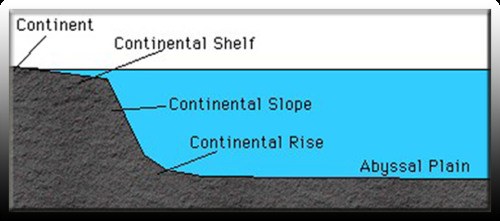
125.

"A" on the diagram labels the...

a)

Continental Shelf

b)

Abyssal Plain

c)

Continental Slope

d)

Ocean Trench

126.

Which ocean floor feature is the steep cliff-like drop beyond the continental shelf?

a)

Continental Shelf

b)

Continental Slope

c)

Abyssal Plain

d)

Ocean Trench

127.

Which part of the ocean floor is labeled "D"?

a)

Mid-Ocean Ridge

b)

Continental Slope

c)

Blue-Ridge Mountains

d)

Abyssal Plain

128.

A gently sloping area that connects the steep walls of the continental slope to the bottom of the ocean floor is called the... (sediments/deposition)

a)

Abyssal Plain

b)

Ocean Trench

c)

Continental Rise

d)

Mid-Ocean Ridges

129.
In what zone does approximately 90% of all ocean life live?
a)
sunlight
b)
twilight
c)
midnight
130.
Which layer of the ocean starts at 600 feet and extends to 3000 feet?
a)
sunlight
b)
twilight
c)
midnight
131.
Which zone has the warmest water temperature?
a)
sunlight
b)
twilight
c)
midnight
132.

Which Zone is from 0-200 meter below sea level?

a)

Twilight Zone

b)

Sunlight Zone

c)

Midnight Zone

133.

What are the zones of the Ocean in order?

a)

Sunlight, Twlight, Midnight, Abyssal (Trenches)

b)

Trench, Seamount, Sunlight

c)

Sunlight Midnight Twilight Abyssal

d)

Abyssal Sunlight Twilight Midnight

134.

Which geologic feature is the deepest found in the ocean to date?

a)

The Sandwich Trench

b)

The Marianna Trench

c)

The Ring of Fire

d)

The Mid-Atlantic Ridge

135.

Based on your knowledge of density, what temperature do you think it is in the Abyssal zone on the ocean floor?

a)

0 degrees C

b)

32 degrees F

c)

-10 degrees F

d)

4 degrees C

136.
the area between the high tide and the low tide mark
a)
benthic zone
b)
intertidal zone
c)
pelagic zone
d)
abyssal zone
137.
organisms that live on or in the bottom
a)
benthos
b)
neuston
c)
littoral
d)
heterotrophs
138.
organisms that swim against the ocean’s currents
a)
 neuston
b)
plankton
c)
nekton
d)
naphron
139.
organisms that drift in the ocean unable to swim against the currents
a)
benthos
b)
plankton
c)
nekton
d)
epifauna
140.
As oceans become deeper, the water pressure ___________________.
a)
increases
b)
decreases
c)
stays the same
141.
A prediction or guess based on observations.
a)
data
b)
scientific process
c)
hypothesis
d)
question
142.
A test used to discover something unknown.
a)
data
b)
variable
c)
conclusion
d)
experiment
143.
All factors that can change in an experiment.
a)
variable
b)
data
c)
conclusion
d)
result
144.
An explanation to a problem, which can be tested scientifically through an investigation is known as what?
a)
variable
b)
hypothesis
c)
experiment
d)
control
145.
What is the last step of scientific method?
a)
hypothesis
b)
observe
c)
present results
d)
question
146.
What is one of the first steps when investigating a scientific question?
a)
variable
b)
research
c)
conclude
d)
observe
147.

What is the contour interval of this map?

a)

10m

b)

50m

c)

100m

d)

150m

148.

Toward which direction does Moody Creek flow?

a)

southwest

b)

northwest

c)

northeast

d)

southeast

149.

Which two points have the same elevation?

a)

G and F

b)

B and D

c)

C and D

d)

G and C

150.
What is the approximate location of letter B?
a)
80oN, 0o
b)
0o, 80oW
c)
80oS, 0o
d)
0o, 80oE
151.
Latitude lines run
a)
East to West
b)
North to South
152.
Which letter would you find at 15oS, 60oW?
a)
A
b)
C
c)
L
d)
H
153.
The 0 degree line of longitude that divides the Eastern and Western Hemispheres.
a)
Prime Meridian
b)
meridian
c)
equator
d)
parallel
154.
Contour lines that are very close together indicate the land is _______________
a)
gentle/gradual
b)
a forest
c)
steep
d)
a swamp
155.
What could be the lowest elevation in the depression?
a)
50 feet
b)
41 feet
c)
60 feet
d)
51 feet
156.
What is the map symbol (darker lines)?
a)
roads
b)
index contour
c)
contour interval
d)
waves
157.
What could be the elevation of the mountain top?
a)
860 km
b)
840 km
c)
841 - 859 km
d)
861 - 869 km
158.
0 degrees latitude; an imaginary line that runs around the middle of Earth, like a belt
a)
Tropic of Cancer
b)
Equator
c)
Prime Meridian
d)
Tropic of Capricorn
159.
180 degrees longitude; an imaginary line that runs up and down through the Pacific Ocean
a)
International Date Line
b)
Equator
c)
Time Zone Line
d)
Prime Meridian
160.
As you travel from west to east, does it get later or earlier?
a)
Earlier
b)
Later
161.
How many time zones are there in the world?
a)
24
b)
12
c)
6
d)
48
162.

How many degrees of Longitude is each time zone?

a)

5

b)

60

c)

30

d)

15

163.

When you are traveling East, do you add or subtract one hour for each time zone through which you travel?

a)

Add

b)

Subtract

164.

Large Landmasses are called _______

a)

mountains

b)

continents

165.

A piece of land totally surrounded by water.

a)

Island

b)

Peninsula

c)

Plain

d)

Cape

166.

Used as the starting point to measure degrees of north and south latitude.

a)

Prime Meridian

b)

Equator