
Font size
 Worksheets
2nd nine week review
Total questions: 53
Worksheet time: 3hrs 39mins
What's that humming sound? Could it be hummingbird, the only bird capable of backward flight? Hummingbirds have many unique flight habits that distinguish them from other birds. Most birds flap their wings up and down to fly, but the hummingbird moves its wings forward and backward very rapidly in a figure eight pattern. This allows the hummingbird to hover in position, fly upside down, and move about very rapidly. And while other birds have to push off with their feet to begin flying, and work their ways up to their top speeds, the hummingbird can both start flying at maximum speed and stop flying instantaneously. After you've seen a hummingbird in flight, it's unlikely that you'll mistake them for another bird.
What is the central idea?
Birds and hummingbirds are very different.
Hummingbirds make a humming sound.
The hummingbird fly in a totally unique and unusual way.
Hummingbird wings fly in figure eight patterns.
What is the central idea of the passage?
Millions of acres of tropical rainforest have been destroyed. Many animals and people lose their homes when the rain forest is cut down. Today, people are destroying the forests so quickly that the animals are unable to adapt. Many of these animals, such as the leopard, need miles and miles of untouched rain forest in order to live. Furthermore, as more of the rainforest is destroyed, the risk of air pollution and loss of oxygen increases.
Leopards are losing their homes.
The destruction of the rain forest is harming humans and animals.
Forest provide oxygen for humans and animals.
The destruction of the rain forest is an interesting subject.
Authors present information to readers using a specific feature called ___ ____.
text summaries
text evidence
text structure
text dependent
This type of text structure uses signal words such as problem, issue, idea, causes, and leads to.
problem and solution
chronological order
cause and effect
description
This type of text structure represents the characteristics of a person, place, thing, or idea giving the reader a image in his or her mind.
description
problem and solution
compare and contrast
chronological order
This type of text structure is the source of an issue that leads to the outcome.
Sequencing
description
cause and effect
compare and contrast
To identify this type of text structure, ask yourself: is the events taking place in a certain order?
description
sequencing
cause and effect
compare and contrast
This type of text structure is used to note the similarities and the differences in items.
description
sequencing
cause and effect
compare and contrast
Wild chimpanzees are rapidly disappearing in the rain forests. Some people are trying to solve this issue. Otherwise, chimpanzees may one day exist only in zoos. Groups are protesting the removal of trees from the rain forests where the chimpanzees live. People will need to work together to save the chimpanzees. Which choice correctly identifies the text structure?
description
problem and solution
compare and contrast
chronological order
Making a peanut butter and jelly sandwich is both easy and delicious. First, get out your materials (peanut butter, jelly, bread, and a knife). Second, spread peanut butter on one piece of bread and jelly on another. Third, combine the two halves so that the peanut butter and jelly mix. Then, enjoy you sandwich. Finally, clean up your mess.
description
sequencing
cause and effect
compare and contrast
The life story of a famous baseball player written by a sports writer.
poetry
biography
mythology
autobiography
realistic fiction
Two girls start a club at school for children who like horses.
poetry
biography
mythology
autobiography
realistic fiction
A made-up story that explains the existence of a natural phenomenon such as gods or goddesses.
poetry
biography
mythology
autobiography
realistic fiction
Genres are broken into two main categories. Stories that come from the author's imagination fall into which category?
fiction
nonfiction
autobiography
realistic fiction
Genres are broken into two main categories. Stories that contain facts about real people, events, and places fall into which category?
fiction
nonfiction
historical fiction
realistic fiction
What are the reasons an author writes material?
persuade
inform
educate
entertain
infer
When a writer persuades his/her reader, he or sh tries to convince, influence, and sway the reader to believe his/her opinion.
true
false
Inform means the author gives information to the reader.
true
false
To entertain means people enjoy something.
true
false
What is the author's purpose? A recipe to make an award-winning spicy chicken salad.
inform
educate
entertain
persuade
What is the author's purpose? A note from your friend asking you to be his science partner.
inform
educate
entertain
persuade
What is the author's purpose? Joe had been fishing for over two hours without a single bite. Suddenly there was a nibble at the end of his fishing line. He stood up on the boat and leaned out too far. Just then there was a sharp yank on the line. Joe fell overboard and landed head first into the water. Joe and his friends laughed and laughed.
inform
educate
entertain
persuade
refers to the main idea, moral, or lesson of the story.
tone
mood
theme
central idea
Which of the following is an example of theme?
Happiness
Jack risked his life to save Jane.
Cinderella was thoughtful and kind.
Don't Judge people by outward appearances.
The main theme in a text might be difficult to figure out because:
it is rarely stated explicitly
only complicated adult stories have themes.
authors rarely want readers to figure it out.
it has little to do with plot, characters, and other story elements.
If you put theme into a formula, it would look like which of the following examples?
topic = theme
topic + author's purpose = theme
inference + prior knowledge = theme
topic and/or subject + the message or lesson = theme
Which apply to theme
inferred
can be found in the title
teaches a lesson
usually found in fiction
found in the illustrations
In a spell of dry weather, when the Birds could find very little to drink, a thirsty Crow found a pitcher with a little water in it. But the pitcher was high and had a narrow neck, and no matter how he tried, the Crow could not reach the water. The poor thing felt as if he would die of thirst. Then an idea came to him. Picking up some small pebbles, he dropped them into the pitcher one by one. With each pebble the water rose a little higher until at last it was near enough so he could drink.
What is the theme?
Persistence pays off in the end.
Quitters end up winning in the end.
Respect nature and she will provide for you.
know your limitations so your not disappointed.
The difference between the theme of the story and the topic of the story is theme is the lesson and the topic is what the story is about.
true
false
What helps you find the theme in a story?
understanding the setting of the story.
understanding the conflict in the story.
understanding the resolution of the story.
understanding the static character's actions.
A theme can be supported by
your own words
evidence from the text
rational and reasons
All the above
Which word correctly matches the following definition: details that explain the central idea
topic sentence
topic statement
thesis statement
supporting details
The central idea is supported by.....
Folktales and fables
research and stories
thesis statements and opinions
main ideas and supporting details.
"Are you already done?" his father asked. "It seems like you just got in the water." Jacob was finished with his shower in two minutes. He got his body and hair wet, rubbed shampoo on his hair, washed his body with soap, and rinsed off. He liked fast showers. Fast showers allowed Jacob to save water, save energy, and have more time to play. In fact, Jacob never took a bath because he said it waste water. To him, the faster the bath, the better.
What is the central idea of the passage?
Jacob is very clean
Jacob never took showers
Jacob likes to take fast baths
Jacob prefers baths over showers.
If you are feeling sad, you can make yourself feel better by doing a few simple things. You can take a walk (or get another form of exercise), you can talk to a friend, or you can write down your feelings. Writing down the good things in your life will help too. Doing something good for someone else will also help you feel better. If you still feel a little sad, act happy. It works like magic to make you feel better!
What is the central idea?
we're not always happy.
sometimes people feel sad
sometimes people feel silly and unpredictable.
there are many ways to make yourself feel better.


This feature explains what the illustration/photograph is. It tells you what you see in the picture.
Glossary
Index
Table of contents
Caption


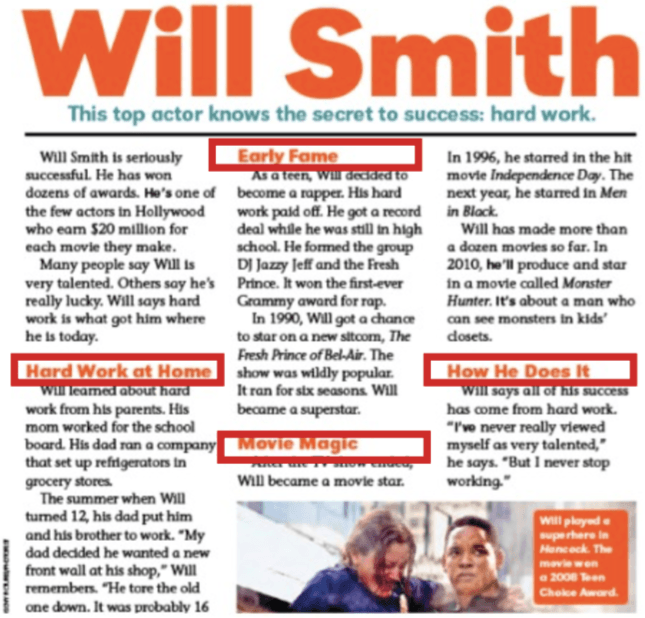

Often found at the end of the text as a summary of the person's life events- helps the reader see dates and events.
Labels
Illustrations
Timeline
Captions
Often found at the end of the text as a summary of the person's life events- helps the reader see dates and events. These events are known as a timeline. It is a form of the text structure called ....
sequencing
description
chronological order
problem and solution

