Wayground logo

Free Printable Worksheets

Font size

S
M
L
XL
Worksheets

2.8 Cellular Respiration & 2.9 Photosynthesis

Total questions: 30

Worksheet time: 26mins

Name
Class
Date
1.

Select the two REACTANTS of photosynthesis.

a)

oxygen

b)

carbon dioxide

c)

glucose

d)

water

2.

Select the two REACTANTS of cellular respiration.

a)

oxygen

b)

carbon dioxide

c)

glucose

d)

water

3.

Select the two PRODUCTS of cellular respiration.

a)

oxygen

b)

carbon dioxide

c)

glucose

d)

water

4.

Select the two PRODUCTS of photosynthesis.

a)

oxygen

b)

carbon dioxide

c)

glucose

d)

water

5.

What is the purpose of cellular respiration?

a)

to make oxygen

b)

to make carbon dioxide

c)

to make sugar

d)

to make ATP energy

6.

Select the step(s) of cellular respiration that require no oxygen.

a)

glycolysis

b)

Krebs cycle

c)

electron transport chain

d)

carbonation

7.

Select the step(s) of cellular respiration that require oxygen.

a)

glycolysis

b)

Krebs cycle

c)

electron transport chain

d)

carbonation

8.

What is the energy source for photosynthesis?

a)

ATP energy

b)

sunlight

c)

electricity

d)

ADP energy

9.
Which organelle performs PHOTOSYNTHESIS?
a)
Chloroplast
b)
Mitochondria
10.
Chloroplasts are...
a)
Structures of animal cells to produce ATP
b)
Organelles where lipids are elaborated
c)
Specialized structures of plants where food is made
d)
Waste organelle of plants
11.

What are the names of the two reactions that occur during photosynthesis?

a)

Light independent reaction

b)

Krebs Cylce

c)

Light deferment reaction

d)

Light dependent reaction

12.
Use the diagram to answer the question. Which chemical is an electron carrier molecule?
a)
H2O
b)
carbon dioxide
c)
NADP+
d)
oxygen
13.

Both plants and animals use photosynthesis.

a)

True

b)

False

14.

If a plant is facing away from the sun, it will move to face the sun.

a)

True

b)

False

15.
Which type of respiration occurs without the presence of oxygen?
a)
Aerobic 
b)
Anaerobic 
16.
What is the net gain of ATP during glycolysis?
a)
1
b)
2
c)
4
d)
34
17.

Select all the organisms that use cellular respiration.

a)

Bears

b)

Beets

c)

Bacteria

d)

Blue whales

18.
___ produces the most ATP.
a)
Aerobic respiration
b)
Anaerobic respriation
c)
Glycolysis
d)
Photosynthesis
19.

What is the total net gain of ATP at the end of aerobic respiration?

a)

2-4 ATP

b)

32-34 ATP

c)

36-38 ATP

d)

40-42 ATP

20.
How does the amount of energy resulting from fermentation compare with that of aerobic respiration? 
a)
Aerobic respiration results in less energy.
b)
Each process results in equal amounts of energy.
c)
Aerobic respiration results in more energy.
d)
Each process results in variable amounts of energy. 
21.
Which type of fermentation occurs in muscles?
a)
Alcoholic 
b)
Lactic acid
22.
What are tiny organelles that convert glucose into ATP?
a)
Ribosomes
b)
Vesicles
c)
Cytoskeleton
d)
Mitochondria
23.
A weightlifter is using heavy weights in short bursts for a competition. Because his muscle cells are not able to take in enough oxygen to make very much ATP the weightlifter begins to get fatigue in his muscles. Which of the following processes is most likely going on in the muscles of the weightlifter as he competes in his event? 
a)
 As the cells run out of oxygen they switch to anaerobic respiration, which allows the cell to make small amounts of ATP in the absence of oxygen. 
b)
As the cells run out of oxygen, they die off gradually and the weightlifter's muscles have fewer contracting muscle cells.
c)
The cells will never run out of oxygen if the weightlifter is breathing.
d)
As the cells run out of oxygen, they will continue to make the same amount of ATP, since oxygen is not required to make ATP. 
24.
A weightlifter is using heavy weights in short bursts for a competition. Because his muscle cells are not able to take in enough oxygen to make very much ATP the weightlifter begins to get fatigue in his muscles. Which of the following processes is most likely going on in the muscles of the weightlifter as he competes in his event? 
a)
 As the cells run out of oxygen they switch to anaerobic respiration, which allows the cell to make small amounts of ATP in the absence of oxygen. 
b)
As the cells run out of oxygen, they die off gradually and the weightlifter's muscles have fewer contracting muscle cells.
c)
The cells will never run out of oxygen if the weightlifter is breathing.
d)
As the cells run out of oxygen, they will continue to make the same amount of ATP, since oxygen is not required to make ATP. 
25.
Two different species of bacteria are examined. Scientists find that species X always produces CO2 and H2O during cellular respiration. Species Y always produces ethyl alcohol and CO2. Which conclusion can be made from these observations? 
a)
 Only species Y is aerobic.
b)
Only species Y is anaerobic.
c)
Both species X and Y are aerobic.
d)
 Both species X and Y are anaerobic. 
26.

After the bond depicted in the photo is broken, what will be the correct name of the molecule?

a)

ATP

b)

Glucose

c)

ADP

d)

NADPH

27.

Light absorbing molecules that gather the sun's energy are called:

a)

pigments

b)

glucose

c)

thylakoids

d)

chloroplasts

28.

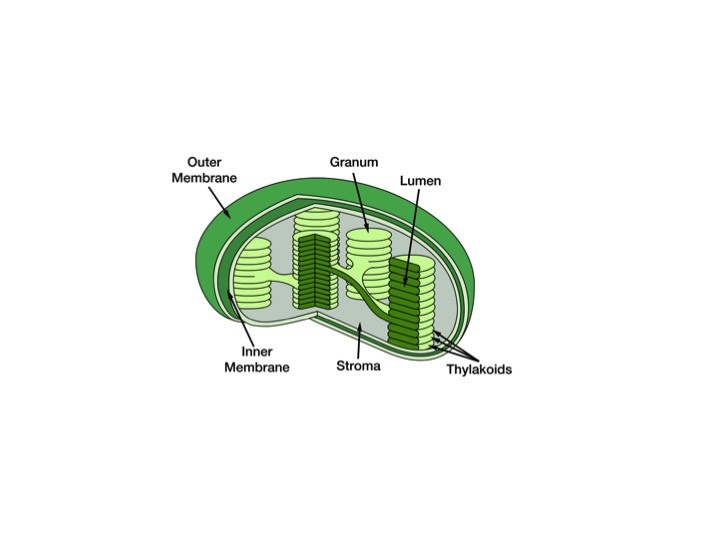
The light dependent portion of photosynthesis takes place in what part of the chloroplast?

a)

mitochondria

b)

cytoplasm

c)

thylakoids

d)

stroma

29.

What are the correct steps, in order, of cellular respiration?

a)

Light Dependent Reaction, Calvin Cycle, Dark Reaction

b)

Glycolysis, Krebs Cycle, Electron Transport Chain

c)

Photosynthesis, Glucose, Respiration

d)

Krebs Cycle, Glycolysis, Electron Transport Chain

30.

What molecule(s) is/are used to transfer electrons?

a)

ADP/ATP

b)

NADH/NAD+

c)

FADH/FAD+

d)

Pyruvate

e)

CoA