Wayground logo

Free Printable Worksheets

Font size

S
M
L
XL
Worksheets

Term 2 Week 8 Energetics Exam Review

Total questions: 30

Worksheet time: 13mins

Name
Class
Date
1.
What type of macromolecule are enzymes?
a)
Protein
b)
Carbohydrate
c)
Lipid
d)
Nucleic Acid
2.
Which of the following correctly describes how enzymes work?  
a)
they lower the energy of the reactants to increase the rxn rate
b)
they supply energy to the reaction to increase the rxn rate
c)
they lower the energy of the products to increase the rxn rate
d)
they lower the activation energy of the reaction to increase the rxn rate
3.
Enzymes are made up of these repeating monomers.
a)
monosaccharides
b)
amino acids
c)
nucleotides
d)
phospholipids
4.
The part of the enzyme that the substrate bonds to is called the _____.
a)
active site
b)
activation energy
c)
bond site
d)
peptide bond
5.
The energy needed to start a reaction
a)
activation energy
b)
adhesion energy
c)
chemical energy
d)
cohesion energy
6.
Blocking Active site of an enzyme
a)
competitive inhibition
b)
allosteric inhibition
7.
Which of these is most likely an enzyme?  
a)
Sucrose
b)
Galactose
c)
Fructose
d)
Amylase
8.

If a mutation occurs in a DNA sequence that codes for an enzyme, what is the most likely result?

a)

There will likely be no change in the shape and function of the enzyme.

b)

The enzyme will most likely fold in a way that makes its shape incompatible with the substrate and the enzyme will not function correctly.

c)

The enzyme will not be produced at all.

d)

The enzyme will have an enhanced ability to bind with the substrate.
9.
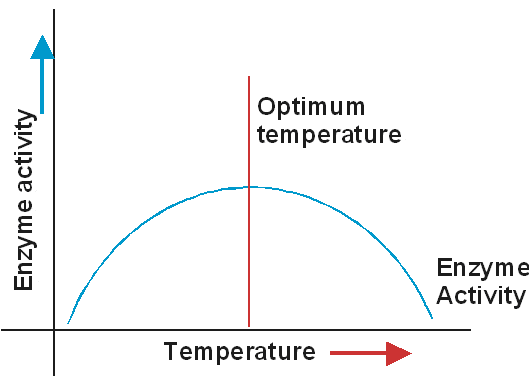
At high temperatures enzyme activity declines because of:
a)
Denaturation
b)
Decreased Kinetic Motion
c)
Increased H-Bonding
d)
Dissociation of Ionic Compounds
10.

The part of the enzyme that the non-competitive inhibitor binds to.

a)

Active site

b)

Allosteric site

c)

Construction site

d)

Binding site

11.
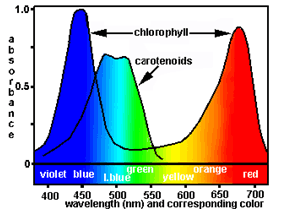
What is one function of the other pigments  besides chlorophyll, in the chloroplast?
a)
to block damaging wavelengths of light
b)
to absorb different wavelengths than the chloroplasts
c)
to provide different colors to the leaves
d)
to transfer energy to a separate photosystem beside the one using chlorophyll a and b.
12.
What is the primary function of the light reactions of photosynthesis?
a)
To produce glucose
b)
To produce NADPH and ATP
c)
To use ATP
d)
To produce RuBP
13.
Where is glucose synthesized
a)
Photosystem II
b)
Photosystem I
c)
Calvin Cycle
d)
Glycolysis
14.
Where does the carbon come from that is used to form glucose?
a)
The soil
b)
CO2 in the air
c)
From other carbohydrates
d)
Calvin Cycle
15.
Which of the following is the correct equation for PHOTOSYNTHESIS?
a)
CO2 + light + H2O --> O2 + glucose
b)
CO2 + glucose + H2O --> O2 + light
c)
O2 + light + H2O --> CO2 + glucose
d)
CO2 + O2 + H2O --> Light+ glucose
16.

The NADP+ is

a)

oxidized during the light reaction

b)

reduced during the light reaction

c)

oxidized during the Calvin cycle

d)

reduced during the Calvin cycle

17.

During noncyclic photophosphorylation all of the following occur EXCEPT

a)

ATP is made using electron energy that will leave on NADPH

b)

results in oxygen gas being produced

c)

water is split (photolysis)

d)

electrons from photosystem 1 return back to photosystem 2

18.

Photosynthesis goal is to

a)

convert light energy into glucose energy

b)

use light energy to make oxygen gas

c)

convert sugar energy into ATP

d)

convert sugar energy into oxygen gas

19.

Rubisco is important in which step of photosynthesis

a)

energizing the electrons in chlorophyll

b)

carbon fixation when CO2 is connected to RUBP during calvin cycle

c)

regeneration phase as RUBP is made during calvin cycle

d)

reduction of the carbon chain during the calvin cycle

20.

If the proton (H+) pump in the thylakoid was not working which molecule could not be made during the light reaction?

a)

NADPH

b)

ATP

c)

Water

d)

Oxygen gas

21.
Which process is the largest contributor to the release of CO2 
a)
Citric Acid Cycle or Krebs Cycle
b)
Pyruvate Oxidation
c)
Glycolysis
d)
Oxidative Phosphorylation 
22.
If ADP is phosphorylated then what is this indicating in the reaction? 
a)
ADP is forming into ATP
b)
ADP is becoming AMP
c)
ADP is being used to power other reactions
d)
ADP is being created by the reaction
23.
Which molecule is not an important molecule regarding Cellular Respiration? 
a)
H2O
b)
NADH
c)
O2
d)
CO2
24.
Which process does not occur in aerobic conditions? 
a)
Fermentation
b)
Pyruvate Oxidation
c)
Citric Acid Cycle or Krebs cycle 
d)
Oxidative Phosphorylation 
25.
What is the main job of the electron carriers in cellular respiration? 
a)
Transport electrons and hydrogen atoms to the electron transport chain 
b)
Capture energy throughout the process of cellular respiration
c)
Provide the reactants for the process of cellular respiration
d)
Pump positive hydrogen ions and shuttle electrons across the electron transport chain and contribute to chemiosmosis
26.

Glycolysis occurs in the _____.

a)

mitochondrial matrix

b)

inner membrane

c)

cytoplasm

d)

cell membrane

27.

Glycolysis splits glucose into 2 molecules of

a)

Acetyl CoA

b)

pyruvate

c)

citric acid

d)

fructokinase

28.

Chemiosmosis occurs as H+ ions move through ____ in the cristae, making ATP.

a)

foldings

b)

ATP synthase

c)

protein channels

29.

The ETC provides the energy needed to make the majority of the cell's ATP in a process known as:

a)

chemiosmosis

b)

substrate level phosphorylation

c)

oxidative phosphorylation

30.

How many ATP molecules are produced when FADH2 delivers electrons to the electron transport system?

a)

1

b)

2

c)

4

d)

36