

Wayground logo

Free Printable Worksheets

Font size

S
M
L
XL
Worksheets

The Great Depression and World War II

Total questions: 40

Worksheet time: 22mins
Name
Class
Date
1.
Which of the following was a major cause of the Great Depression?
a)
overproduction and underconsumption
b)
a decrease in the supply of consumer goods
c)
an increase in demand for imported products
d)
an increase in the price of wheat on the world market
2.
Who was the President of the United States when the Stock Market crashed?
a)
Franklin D. Roosevelt
b)
Herbert Hoover
c)
Woodrow Wilson
d)
Theodore Roosevelt
3.
How did "bank runs" impact the American people during the Great Depression?
a)
Banks eventually ran out of money to loan, and people's life savings were gone.
b)
Banks made loans throughout the Great Depression, helping people pays bills until they could find work.
c)
Banks were able to people's deposits safe, but they could not loan out any more money.
d)
Banks were not at all involved in the Great Depression because people did not use them.
4.
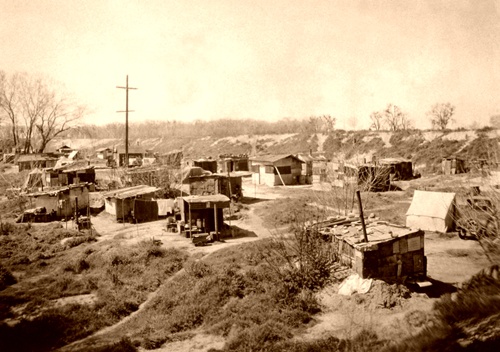
What was the main reason for the emergence of “Hoovervilles” like the one shown in the photograph?
a)
Many Americans had lost jobs during the Great Depression.
b)
Thousands of homes had been destroyed by the effects of the Dust Bowl.
c)
Housing projects could not keep up with the demand for homes needed by the poor.
d)
Preparations for World War I had created a shortage of building materials.
5.
During the 1930s, poor land management and severe drought conditions across parts of the Midwest resulted in the
a)
formation of the United States Department of Agriculture
b)
creation of wheat surpluses
c)
growth of the Populist movement
d)
development of Dust Bowl conditions on the Great Plains
6.
Which of these statements is true of the 1932 presidential election?
a)
Franklin Roosevelt won in a landslide.
b)
Hoover lost by a narrow margin.
c)
Huey Long ran a strong third-party campaign.
d)
Roosevelt won a third term.
7.
FDR addressed the American public in weekly broadcasts known as:
a)
FDR Hour
b)
Hangin' With Franklin
c)
Fireside Chats
d)
Around the Fire
8.
What was a guiding principle of the New Deal economic policies?
a)
Pro-business tax breaks would solve the problems associated with urban poverty.
b)
Antitrust legislation would destroy the free market economy of the United States.
c)
Rugged individualism must be allowed to solve social inequality.
d)
Government must assume more responsibility for helping the poor.
9.
A major result of the New Deal was that it
a)
eliminated poverty in the US
b)
extended the merit system in the civil service
c)
destroyed the private enterprise system
d)
greatly increased the size and power of the Federal Government
10.
What was a economic impact of the Great Depression?
a)
Stock market crashed and millions of Americans lost their jobs
b)
Many Americans moved to California in search for Gold
c)
Many Americans began to become wealthy due to Oil being found in Texas
11.
How is the Dust Bowl and the Great Depression related?
a)
Both events caused Americans to struggle financially
b)
Both events caused riots throughout the nation
c)
Both events led to World War II beginning 
12.
What was created to end the Great Depression?
a)
The New Deal
b)
American Purchase
c)
Stock Market
d)
Economic control
13.
What was the effect of the Dust Bowl?
a)
New farming techniques were used to prevent erosion
b)
Many Americans moved to east Texas for proper soil
c)
The New Deal restricted farmers from buying future stocks
14.
The falling of the _________ was the main reason why the Great Depression began
a)
stock market
b)
soldiers
c)
deported goods
15.
In the early part of the war, the US
a)
supported Germany
b)
remained an ally of Italy
c)
supported England and France
d)
remained neutral
16.
The second atomic bomb used in war was dropped on
a)
HIroshima
b)
Nagasaki
c)
Pearl Harbor
d)
Okinawa
17.
The last of the Axis powers to surrender was
a)
Italy
b)
Germany
c)
Japan
d)
Austria
18.
World War 2 began with Germany's invasion of
a)
Czechosolvakia
b)
Austria
c)
Poland
d)
France
19.
The US entrance to the was was prompted by
a)
a Japanese attack on the US
b)
a German attack on the US
c)
an Austrian attack on the US
d)
an Italian attack on the British
20.
D-Day refers to the day on which
a)
the US dropped an atomic bomb on Hiroshima
b)
the US entered the war
c)
the Allies stage a massive invasion of France
d)
the Germans surrendere
21.
How did WW2 end?
a)
both sides agreed to peacefully resolve their differences
b)
the US dropped two atomic bombs on Japan
c)
the Germans forced the Soviets to surrender
d)
the League of Nations declared the war illegal
22.
In response to the Axis aggression in the 1930s, western democracies followed a policy of
a)
containment
b)
appeasement
c)
aggression
d)
genocide
23.
An example of genocide during WW2 was
a)
the US and forced internment of Japanese-Americans
b)
Russia and the great purges of military leaders
c)
Germany's attempted destruction of everyone of Jewis heritage
d)
Japan's terrible treatment of Allied soldiers and POWs
24.
The Manhattan Project was
a)
the secret plan to build an atomic weapon
b)
the secret German plan to bomb New York
c)
the Japanese plan to bomb New York
d)
the American plan to build a wall around New York
25.
The military strategy practice by Americans against the Japanese was called
a)
puddle-jumping
b)
island-hoppine
c)
Operation strikeback
d)
Island campaign
26.
A new type of warfare consisting of planes, cannons, and tanks all use quickly at the same time was called
a)
Speed assult
b)
Blitzkrieg
c)
Operation Lightening
d)
Operation Quicksilver
27.

Who ruled as a dictator and leader of the Nazi party and wanted to build a powerful military and make his country a strong nation?

a)

Hitler

b)

Mussolini

c)

Stalin

28.
Which 3 countries made up the Axis Powers?
a)
American, England, and Russia
b)
Sweden, Germany, and Denmark
c)
Italy, Russia, and Austria
d)
Italy, Germany, and Japan
29.

The Allies consisted of......

a)

Japan, Germany, and America

b)

America, France, and Australia

c)

America, U.S.S.R, and Britain

d)

Germany, China, Japan, and Hawaii

30.
When was Pearl Harbor attacked?
a)
December 7, 1941
b)
September 1, 1939
c)
October 31, 1941
d)
December 25, 1941
31.
Which country used kamikaze attacks during WWII?
a)
Germany
b)
United States
c)
Japan
d)
Soviet Union
32.
Why did Adolf Hitler want Germany to invade other counties?
a)
To expand Germany's land and power
b)
To gain more people for his Nazi army.
c)
To give money and resources to Africa
d)
To help surrounding counties get out of the depression.
33.
How did WWII help the US get out of the Great Depression?
a)
This led to the US sending money to the Allies.
b)
The war led to more jobs, new technology and the creation of atomic energy.
c)
People spent more money to buy as much as possible.
34.
How did women's involvement in the workforce during World War 2 affect them after the war was over?
a)
Women gave up their rights
b)
Women started fighting for equal rights and more power
c)
Women stayed at home and kept quiet
d)
Women fought for the right to vote
35.
Why were Japanese Americans sent to internment camps?
a)
They threatened United States citizens
b)
They started fighting after the bombing of Pearl Harbor
c)
The government believed Japanese Americans were a threat
d)
The government wanted to kill all Japanese
36.
Who was the leader of Great Britain during WW2?
a)
Winston Churchill
b)
Adolf Hitler
37.

Approximately when did World War 2 begin and end?

a)

1929-1945

b)

1939-1945

c)

1939-1954

d)

1929-1954

38.

To confine someone as a prisoner, especially for military or political purposes, is called what?

a)

Determent

b)

Intermittent

c)

Internment

d)

Intermental

39.

According to Order 9066, which people on the west coast were to be relocated?

a)

People of Japanese ancestry

b)

People of Hawaiian ancestry

c)

People of Native American ancestry

d)

People of French ancestry

40.

TRUE or FALSE: Japanese internment had no psychological effect on the Americans interned nor did it have any psychological effect on American society.

a)

TRUE

b)

FALSE
