wayground logo

Free Printable Worksheets

NEW

Font size

S
M
L
XL
Worksheets

Honors Chemistry - Fall Semester Review

Total questions: 63

Worksheet time: 11mins
Name
Class
Date
1.
A helium nucleus with two protons and two neutrons is called a(n) ____.  
a)
alpha particle
b)
electroscope
c)
beta particle
d)
gamma ray
2.
Which type of nuclear radiation is being emitted here?
a)
Alpha
b)
beta
c)
gamma 
d)
none
3.
Solve this equation for alpha decay.
85209At = ___ + 24He
a)
83205Bi
b)
86209Rn
c)
81207Tl
d)
85208At
4.
Solve this equation for beta decay.
614C = ___ + -10e
a)
410Be
b)
714N
c)
210He
d)
613C
5.
Has the highest penetrating power.  Can penetrate our body.  Even several cm thick of lead or several meters thick of concrete cannot stop all of it.
a)
Alpha
b)
Beta
c)
Gamma
6.
Uranium-238  decays into  Thorium-234  by emitting .........
a)
an alpha particle
b)
a beta particle
c)
gamma rays
d)
visible light
7.
The process of nuclear change in an atom of radioactive material is called... 
a)
nuclear decay
b)
nuclear mass
c)
isotopes
d)
radon
8.
Radioactive materials have unstable...
a)
electrons
b)
protons
c)
nuclei
d)
neutrons
9.
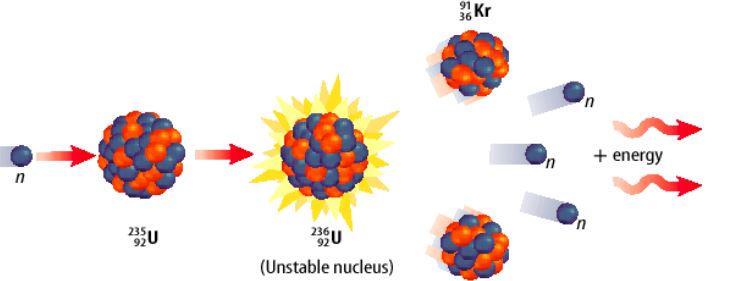
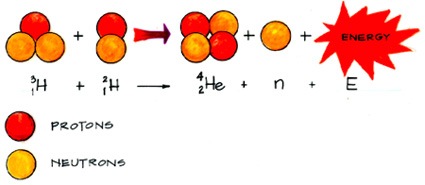
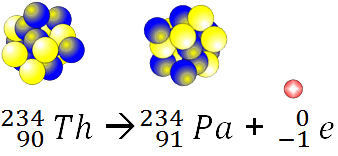
This is an example of...
a)
Fission  reaction
b)
Fusion reaction
c)
Decomposition reaction
d)
Decay
10.
Which process involves the joining of small nuclei?
a)
Beta decay
b)
Alpha decay
c)
Nuclear fission
d)
Nuclear fusion
11.

Subatomic particles with a negative charge

a)

Electrons

b)

Neutrons

c)

Protons

d)

Quarks

12.
subatomic particles found on the outermost shell & responsible for the atom's reactivity
a)
neutrons
b)
valence electrons
c)
isotopes
d)
ions
13.
Subatomic particles with a positive charge
a)
neutrons
b)
atomic mass
c)
protons
d)
isotopes
14.
Measure mainly of the nuclear particles: protons + neutrons
a)
Subatomic Particles
b)
Atomic Number
c)
Atomic Mass
d)
Gluons
15.
Value representing the number of protons in an element
a)
Atomic Mass
b)
Mass Number
c)
Valence Electrons
d)
Atomic Number
16.
Subatomic particles that are neutral in charge
a)
Neutrons
b)
Protons
c)
Nucleus 
d)
Electrons
17.
Atoms of the same element with a different number of neutrons
a)
Ion
b)
Gluons
c)
Isotope
d)
Quarks
18.
A charged atom
a)
Ion
b)
Isotope
c)
Electron Cloud
d)
Quark
19.
Discovered the nucleus of the atom through the Gold Foil Experiment
a)
Rutherford
b)
Chadwick
c)
Thomson
d)
Dalton
20.

Proposed the Modern Electron Cloud Model of the atom

a)

Schrodinger

b)

Dalton

c)

Chadwick

d)

Rutherford

21.
Discovered the electron within the atom
a)
Thomson
b)
Chadwick 
c)
Schrodinger & Heisenberg
d)
Dalton
22.

Created the model of the atom similar to the orbits of planets

a)

Bohr

b)

Dalton

c)

Rutherford

d)

Chadwick

23.
Believed that atoms of the same element are identical to each other
a)
Bohr
b)
Rutherford
c)
Dalton
d)
Thomson
24.
What atom matches this electron configuration?
1s22s22p63s23p64s23d10
a)
Zinc
b)
Copper
c)
Nickel
d)
Germanium
25.
What atom matches this electron configuration?
1s22s22p63s2
a)
Neon
b)
Magnesium
c)
Aluminum
d)
Potassium
26.
How many electrons does Si contain? (click to see image)
a)
14
b)
28
c)
2
d)
4
27.
How many electrons can the first energy level hold?
a)
1
b)
2
c)
8
d)
0
28.
Which electron configuration belongs to Chlorine (Cl)?
a)
1s2s2p3s3p5
b)
1s2s2p3s3p6
c)
1s2s2p3s3p7
29.
There are 4 different types of subshells s,p,d,f
a)
true
b)
false
30.
Electrons occupy orbitals of lowest energy first is part of what electron configuration rule?
a)
Hund’s Rule
b)
Aufbau Principle
c)
Pauli Exclusion Principle
31.
Electron arrangement that uses arrows
a)
Electron configuration
b)
Shorthand configuration
c)
Lewis dot structure
d)
Orbital diagram
32.
What is the shorthand electron configuration for Sulfur atom?
a)
[Ar] 3p4
b)
[He] 3s23p4
c)
[Ne] 3s23p4
d)
[Na] 3s23p3
33.
Which of the following is a p block element?
a)
Ca
b)
Ar
c)
Re
d)
Au
34.
What electron configuration matches an oxygen atom?
a)
1s22s22p63s2, 3p64s23d104p5
b)
1s22s22p4
c)
1s22s22p6
d)
1s22s22p63s23p64s23d1
35.
What is the electron configuration of Ag?
a)
1s2 2s2 2p6 3s2 3p6 4s2 3d10 4p6 5s1 4d10
b)
[Kr] 5s2 4d9
c)
1s2 2s2 2p6 3s2 3p6 4s2 4p6 5s2 4d9
d)
1s2 2s2 2p6 3s2 3p6 3d10 4s2 4d10 4p6 5d10 5s2 4d9
36.
Identify the Electron Configuration for Aluminum (Al)
a)
1s2s2p3s3p1
b)
1s2s2p3s3p3
c)
1s2s2p3s4p1
37.
An orbital can at most hold how many electrons?
a)
1 electron
b)
2 electrons
c)
3 electrons
d)
4 electrons
38.
Ionic bonds are between...
a)
nonmetals and nonmetals
b)
carbon and oxygen
c)
metals and nonmentals
d)
hydrogen and chlorine
39.
Covalent bonds are between...
a)
two or more nonmetals
b)
sodium and chlorine
c)
metals and metals
d)
metals and nonmetals
40.
What is the name for an ion with a positive charge?
a)
cation
b)
anion
c)
onion
d)
union
41.
What is the name for an ion with a negative charge?
a)
cation
b)
anion
c)
onion
d)
union
42.
What kind of bond forms when atoms share electrons?
a)
ionic
b)
covalent
c)
artificial
d)
univalent
43.
What kind of bond forms when atoms exchange electrons?
a)
ionic
b)
covalent
c)
artificial
d)
univalent
44.
What are valence electrons?
a)
sum of the protons and neutrons
b)
protons minus electrons
c)
electrons in the inner shells
d)
electrons in the outer shell
45.
If an atom loses two electrons what charge will it have?
a)
-2
b)
-1
c)
+1
d)
+2
46.

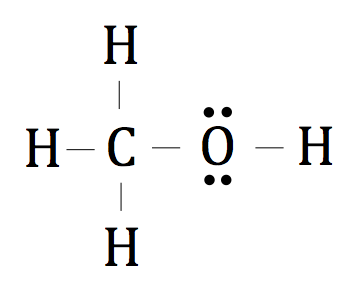
Classify the following molecule.

a)

polar

b)

nonpolar

47.

Classify the following molecule.

a)

polar

b)

nonpolar

48.

Classify the following molecule.

a)

polar

b)

nonpolar

49.

Is the following molecule polar or nonpolar?

a)

polar

b)

nonpolar

50.
F2
a)
Polar 
b)
Nonpolar 
51.
H2O
a)
Polar 
b)
Nonpolar 
52.
According to VSEPR, molecules adjust their shapes to keep which of the following as far away as possible?
a)
Pairs of valence electrons
b)
Inner shell electrons
c)
Mobile Electrons
d)
Electrons closest to the nucleus
53.
What shape is this?
a)
tetrahedral
b)
trigonal pyramid
c)
trigonal planar
d)
bent or angular
54.
What is the VSEPR theory used to predict?
a)
Bond Strength
b)
Polarity
c)
Molecular Shape
d)
Electronegativity
55.
Which of these has a double bond?
a)
Cl2
b)
H2
c)
N2
d)
O2
56.
Which of the following describes water?
a)
Linear structure, nonpolar
b)
Linear structure, polar
c)
Bent structure, nonpolar
d)
Bent structure, polar
57.
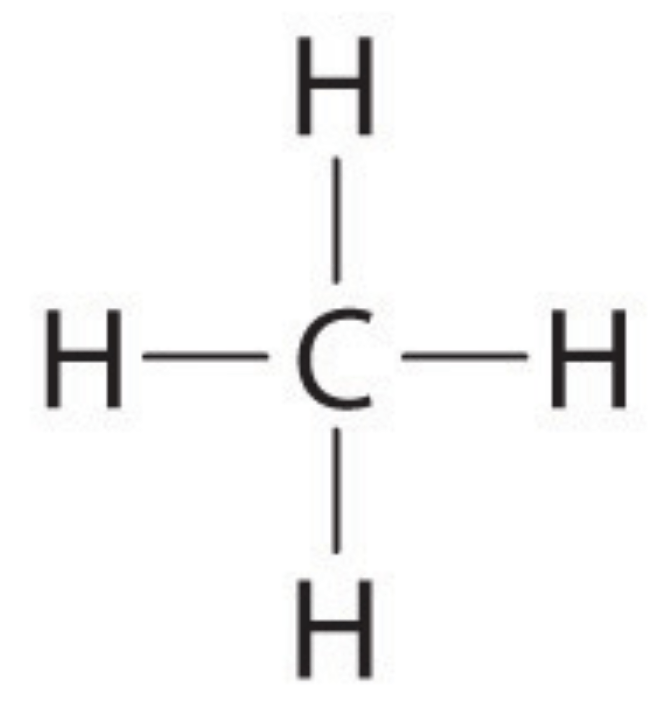
Which molecule could this be?
a)
H2O
b)
CO2
c)
NH3
d)
CH4
58.

Which sample has hydrogen bonding?

a)

H2S

b)

CH4

c)

NH3

d)

HI

59.

Which substance has the weakest intermolecular forces?

a)

Substance A, boiling point of 75 °C

b)

Substance B, boiling point of 105 °C

c)

Substance C, boiling point of 25 °C

d)

Substance d, boiling point of 45 °C

60.

Which substance would have the weakest intermolecular forces of attraction?

a)

CH4

b)

NaCl

c)

H2O

d)

MgF2

61.

The weaker the intermolecular forces of a substance the _____________ the boiling point

a)

higher

b)

lower

62.

________________________ have the strongest intermolecular forces of attraction.

a)

Dipole- Dipole

b)

Dispersion

c)

Hydrogen Bonds

63.

Intermolecular forces for: CO2

a)

Dispersion Force

b)

Dipole dipole

c)

Hydrogen bonding