
 Worksheets
Africa Storyline part 3
Total questions: 42
Worksheet time: 40mins

Which organelle is responsible making food (Glucose) using sunlight?
Cell Membrane
Nucleus
Chloroplast
Mitochondria
Exit: Carbon dioxide
Exit: Glucose
Exit: Oxygen
Exit: Water vapor
Apple tree
Which of the following organelles is responsible for cellular respiration?
Mitochondria
Nucleus
Endoplasmic Reticulum
Ribosome
Where do animals get the glucose they need for cellular respiration?
Plants
Mitochondria
Sun
other animals

What process puts nutrients like nitrogen back into atmosphere and soil once animals and plants die?
15 out of 25 kids chose to go swimming at camp. What percent is that?
15%
20%
45%
60%
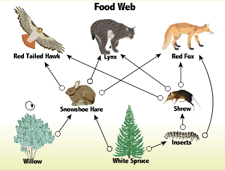


This may cause a population to increase
increase of food supply
removal of predators
removal of disease
all of these
Elephant populations that experience poaching have many more tuskless elephants compared to populations that are protected. Why?
Tusk-less elephants were more likely to survive the poachers
Individuals lost their tusks because they needed to avoid the poachers.
Why are some elephants tuskless?
because having tusks makes them a target for poachers.
because they inherited a mutation that makes them tuskless

Look at the genotype data: Why does each lion have two alleles for each gene?
organisms inherit (receive) one allele from mom and one allele from dad
organisms have two dominant alleles for every gene
organisms have two alleles in case one is not inherited correctly
organisms inherit both alleles from their mother
What is net energy?
Total number of energy available from prey
Total energy cost of prey
Total energy available from prey MINUS total energy cost of prey
The sum of all possible prey's available energy
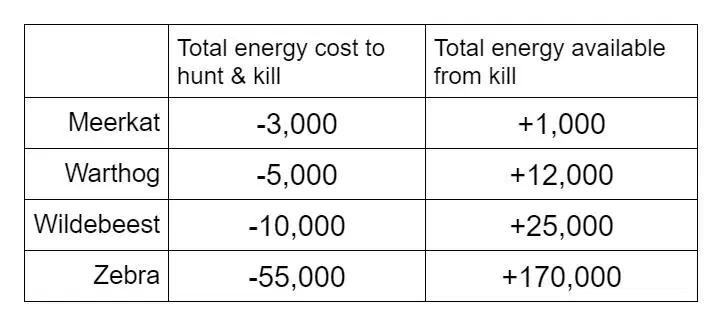
If a hyena consumes 1 warthog, what is its net energy?
-2,000 kcal
+7,000 kcal
-7,000 kcal
+12,000
Grab a calculator:
fish = 400 kcal
jellyfish = 100 kcal
squid = 350 kcal
If a sea turtle eats 2 fish, 1 jellyfish, and 3 squid, how many calories did it consume?
850 kcal
1600 kcal
1200 kcal
1,950 kcal
Baby genotype: C/D
Mother genotype: A/C
Father genotype: C/D
Which allele did the FATHER give to the baby?
A
B
C
D
Which of the following elements are found in carbohydrates? Select all that are present.
Carbon
Hydrogen
Oxygen
Nitrogen

Looking at the image of the skull and digestive system, would you say this animal was an omnivore, carnivore or herbivore.
Omnivore
Herbivore
Carnivore
Match the following macromolecule to its components and function
C, H, O
Long term energy storage and cell membranes
Lipids
C, H, O, N, S
Multiple functions - growth, repair, immunity, etc.
Proteins
C,H,O
main source of energy/quick energy
Carbohydrates
C, H, O, N, P
Genetic material, code for traits
Nucleic Acids
A zoologist tested a sample of food to see what animal she'd feed it to. It tested positive for lipids and proteins and tested negative for carbohydrates. The zoologist should feed it to the
Giraffe
Zebra
Leopard
Gazelle

Looking at the nutrition labels, Snack A would be most beneficial for
Dylan who is getting ready to race in a track meet and needs a source of quick energy.
Savannah is getting ready to go on a long hike and needs to store energy.
Joe just finished weightlifting and needs something to help repair the tissues and build muscle.
Looking at the nutrition labels, Snack B would be most beneficial for
Dylan who is getting ready to race in a track meet and needs a source of quick energy.
Savannah is getting ready to go on a long hike and needs to store energy.
Joe just finished weightlifting and needs something to help repair the tissues and build muscle.
Looking at the nutrition labels, Snack C would be most beneficial for
Dylan who is getting ready to race in a track meet and needs a source of quick energy.
Savannah is getting ready to go on a long hike and needs to store energy.
Joe just finished weightlifting and needs something to help repair the tissues and build muscle.
Match the Macromolecule to its monomer
Carbohydrates
Monosaccharide
Lipids/Fats
Fatty acid/glycerol
Proteins
Amino Acids
Nucleic Acid
Nucleotides
How might a lack of sunlight disrupt the food web?
It would cause consumers to consume less.
It would prevent decomposers from decomposing matter
It would prevent producers from producing nutrients.
It would not disrupt the food web at all.
They always point to the smallest animals.
They point to the animal that tastes the best.
They always point to the producers.
They point in the direction that energy is flowing.

Owl
Grasshopper
Lilypad
Mouse

Energy is released from ATP when
the last phosphate bond breaks
the bond between adenine and sugar breaks
the bonds in the sugar molecule break
In photosynthesis, _______ energy from the sun gets converted to _________ energy stored in glucose.
chemical, chemical
light, chemical
kinetic, potential
Fermentation is an ___________ process because it __________
aerobic; uses oxygen
anaerobic; does not use oxygen
automatic; makes a ton of ATP for the cell

